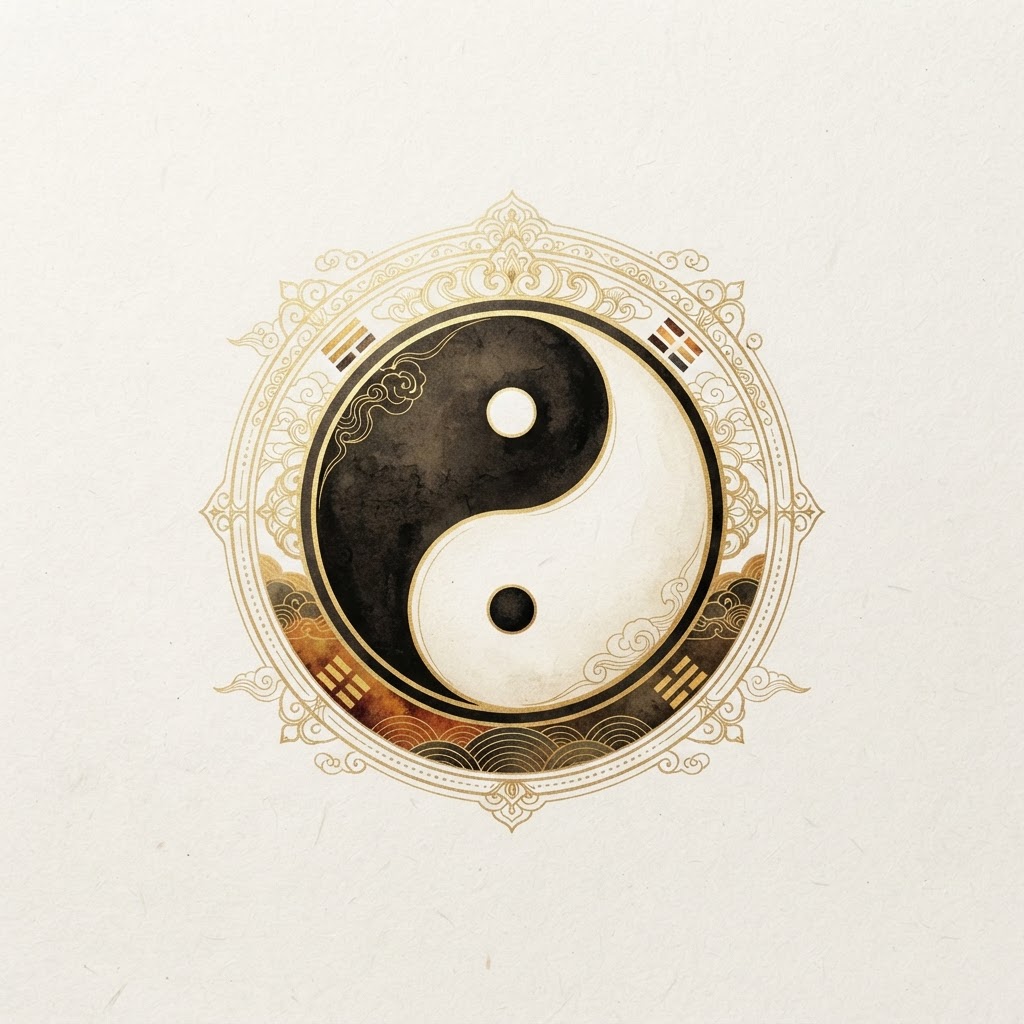
Yin Yang: Meaning, Origin & Symbolism
Also known as: Taijitu, Dual Pole, Yin-Yang Diagram
Universal Spiritual Symbols
Ancient Chinese / Taoist
Heart Chakra
Third Eye Chakra
Water
Balance
Harmony
Wisdom
Transformation
The ancient Chinese emblem of dynamic balance, complementary opposites, and continuous cosmic transformation.
Quick Facts
- Category
- Universal Spiritual Symbols
- Culture / Origin
- Ancient Chinese / Taoist
- Geographic Origin
- China
- Historical Period
- Zhou Dynasty
- Estimated Age
- circa 1000 BCE
- Element
- Water
- Planet
- Moon
- Chakra
- Heart, Third Eye
- Zodiac
- Pisces, Libra
- Deities
- Fuxi, Nüwa
- Verification
- unverified
What is Yin Yang?
The Yin Yang, traditionally known as the Taijitu, represents the fundamental duality of the universe according to classical Chinese philosophy and Taoism. Rather than conflicting adversaries, Yin and Yang are complementary forces that interact to form a dynamic, self-sustaining system.
The iconic swirling circle features a dark portion (Yin) and a light portion (Yang), each containing a small seed of its opposite. This design illustrates that nothing is completely absolute: within dark resides light, within activity rests stillness, and every phenomenon will eventually transform into its polar counterpart.
Meaning of Yin Yang
Dynamic balance and interdependence of complementary cosmic opposites.
Origin & History
The conceptual framework of Yin and Yang emerged early in Chinese history, referenced extensively in the I Ching (Book of Changes) during the Western Zhou dynasty. The terms originally referred to the shady and sunny sides of a hill or river.
The specific visual diagram known as the Taijitu was later formalized by Song Dynasty Neo-Confucian philosopher Zhou Dunyi in his treatise Taijitu Shuo, synthesizing ancient Taoist cosmological principles with metaphysical balance.
Spiritual Meaning
Spiritually, Yin Yang teaches acceptance of life's natural rhythms and flow, embodied by the concept of Wu Wei (effortless action). It reminds seekers that spiritual wholeness requires integrating both shadow and light, stillness and action, receptive wisdom and assertive creation.
It rejects rigid dogma in favor of organic adaptation, suggesting that true spiritual mastery lies in remaining balanced amid constant change.
Symbolism
Yin (black) represents darkness, receptivity, the feminine, water, and stillness. Yang (white) represents light, activity, the masculine, fire, and assertion. The curved dividing line conveys fluid motion and transformation, while the opposing central dots demonstrate that each force contains the nucleus of the other.
Traditional Uses
A cosmological schematic reflecting the birth of the manifold world from the undifferentiated void (Wuji) into ordered manifestation.
Modern Spiritual Uses
A universal icon for emotional equilibrium, mindfulness, holistic lifestyle balance, and psychological integration of contradictory impulses.
Healing Associations
Forms the bedrock of Traditional Chinese Medicine (TCM), diagnosing and restoring health by balancing deficient or excessive bodily energies.
Protection Associations
Employed in traditional Feng Shui to harmonize discordant Qi and neutralize malevolent or chaotic environmental energies.
How the Symbol Is Used
- •Tai Chi
- •Qigong
- •Traditional Chinese Medicine
- •Feng Shui
Cultural Context
Ancient Chinese / Taoist — China (Zhou Dynasty)
Sources & References
- 1.I Ching: The Book of Changes
- 2.Tao Te Ching by Laozi
- 3.Taijitu Shuo by Zhou Dunyi
This content is for educational and informational purposes only. Where modern spiritual interpretations are described, they are not presented as ancient historical facts. It is not a substitute for professional medical or spiritual advice.