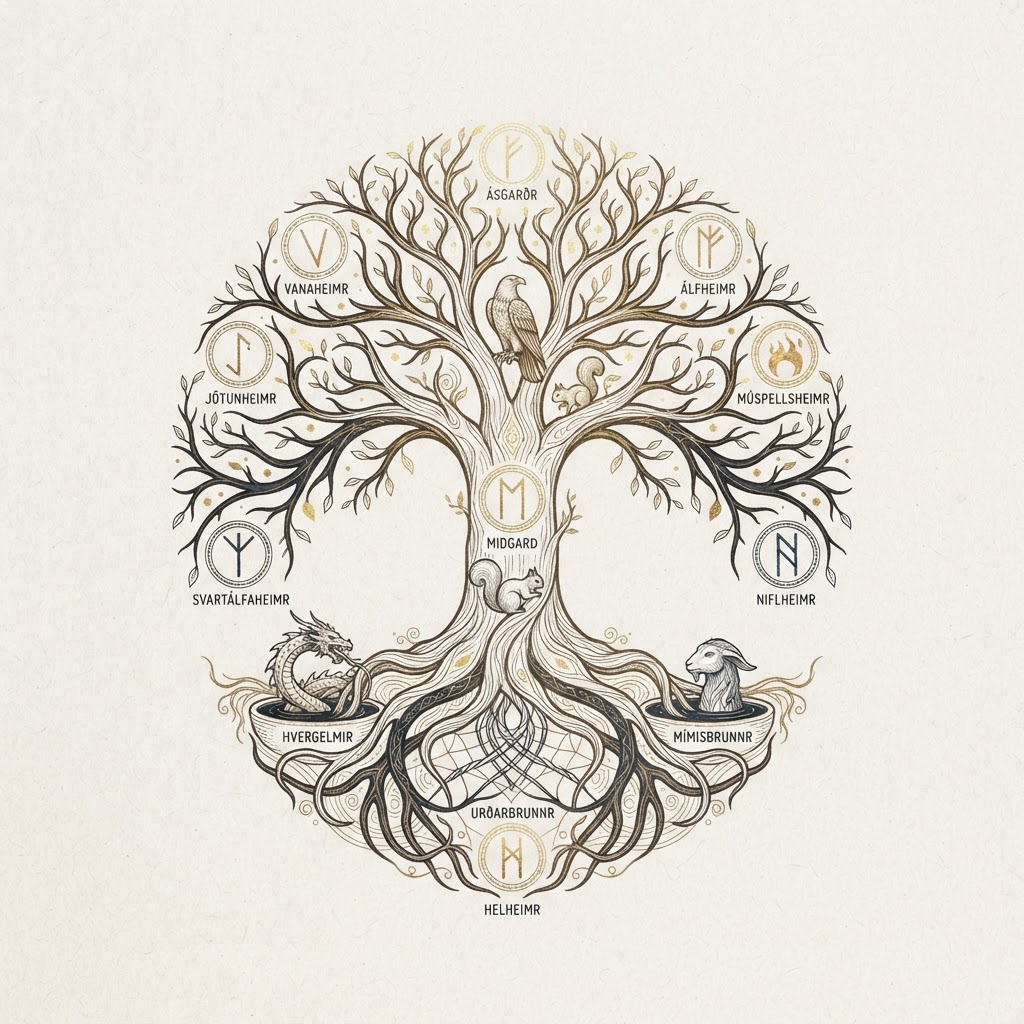
Yggdrasil: Meaning, Origin & Symbolism
Also known as: The World Tree, Mímameiðr, Læraðr
Norse/Germanic
Norse/Germanic
Root Chakra
Heart Chakra
Crown Chakra
Earth
Grounding
Wisdom
Harmony
Longevity
The immense, sacred ash tree that connects and supports the nine realms of the Norse cosmos.
Quick Facts
- Category
- Norse/Germanic
- Culture / Origin
- Norse/Germanic
- Geographic Origin
- Northern Europe
- Historical Period
- Migration Period to Medieval Period
- Estimated Age
- Pre-Viking Era (circa 1st millennium CE or older)
- Element
- Earth
- Planet
- Earth
- Chakra
- Root, Heart, Crown
- Zodiac
- Capricorn, Virgo, Taurus
- Deities
- Odin, The Norns, Mimir
- Verification
- unverified
What is Yggdrasil?
Yggdrasil is the great cosmic axis mundi of Norse cosmology, an evergreen ash tree that unites the heavens, the terrestrial world, and the subterranean underworlds. Its roots tap into primordial wells—Urðarbrunnr (Well of Fate), Hvergelmir (Roaring Kettle), and Mímisbrunnr (Mímir's Well of Wisdom). Upon its branches and trunk reside mythical creatures: the eagle perched at its crown, the hawk Veðrfölnir, the dragon Níðhöggr gnawing at its roots, four stags browsing its leaves, and the squirrel Ratatoskr scurrying between them carrying messages of discord. The tree represents the living, breathing universe, constantly suffering decay yet continuously renewed by the holy water sprinkled upon it by the Norns. Odin famously hung himself from Yggdrasil for nine nights as a voluntary sacrifice to obtain the knowledge of the runes.
Meaning of Yggdrasil
The central cosmological tree uniting the Nine Worlds, embodying life, fate, and cosmic order.
Origin & History
Central to ancient Germanic cosmology, sacred groves and cosmic pillars (such as the Irminsul destroyed by Charlemagne) were earthly manifestations of the World Tree archetype. Both the Elder and Younger Eddas detail its geography and maintenance by the three Norns.
Spiritual Meaning
Yggdrasil symbolizes universal interconnectedness, showing that the physical, psychic, and divine realms are organic branches of a single living entity. It teaches that wisdom requires grounding into dark ancestral depths while striving upward toward illuminated heights. The tree reminds the seeker that endurance through suffering is a path to enlightenment, exemplified by Odin's self-sacrifice upon its branches.
Symbolism
The roots signify ancestral memory and destiny; the trunk represents stability and conscious life; the crown represents transcendent states of awareness and divine communion.
Traditional Uses
Understood as the literal and metaphorical pillar maintaining the structure of the cosmos until its shaking during the cataclysm of Ragnarök.
Modern Spiritual Uses
Regarded as a profound ecological and spiritual metaphor for holistic living, inner psychological balance, and global interconnectedness.
Healing Associations
Restores holistic vitality, aligns bodily energy centers, and supports deep somatic grounding.
Protection Associations
Offers spiritual stability, rooting the practitioner firmly in their body and environment during crisis.
How the Symbol Is Used
- •Shamanic journeying
- •Tree meditation
- •Holistic healing rituals
- •Cosmological contemplation
Cultural Context
Norse/Germanic — Northern Europe (Migration Period to Medieval Period)
Sources & References
- 1.Poetic Edda (Völuspá and Grímnismál)
- 2.Mircea Eliade, Shamanism: Archaic Techniques of Ecstasy
- 3.Paul B. Du Chaillu, The Viking Age
This content is for educational and informational purposes only. Where modern spiritual interpretations are described, they are not presented as ancient historical facts. It is not a substitute for professional medical or spiritual advice.