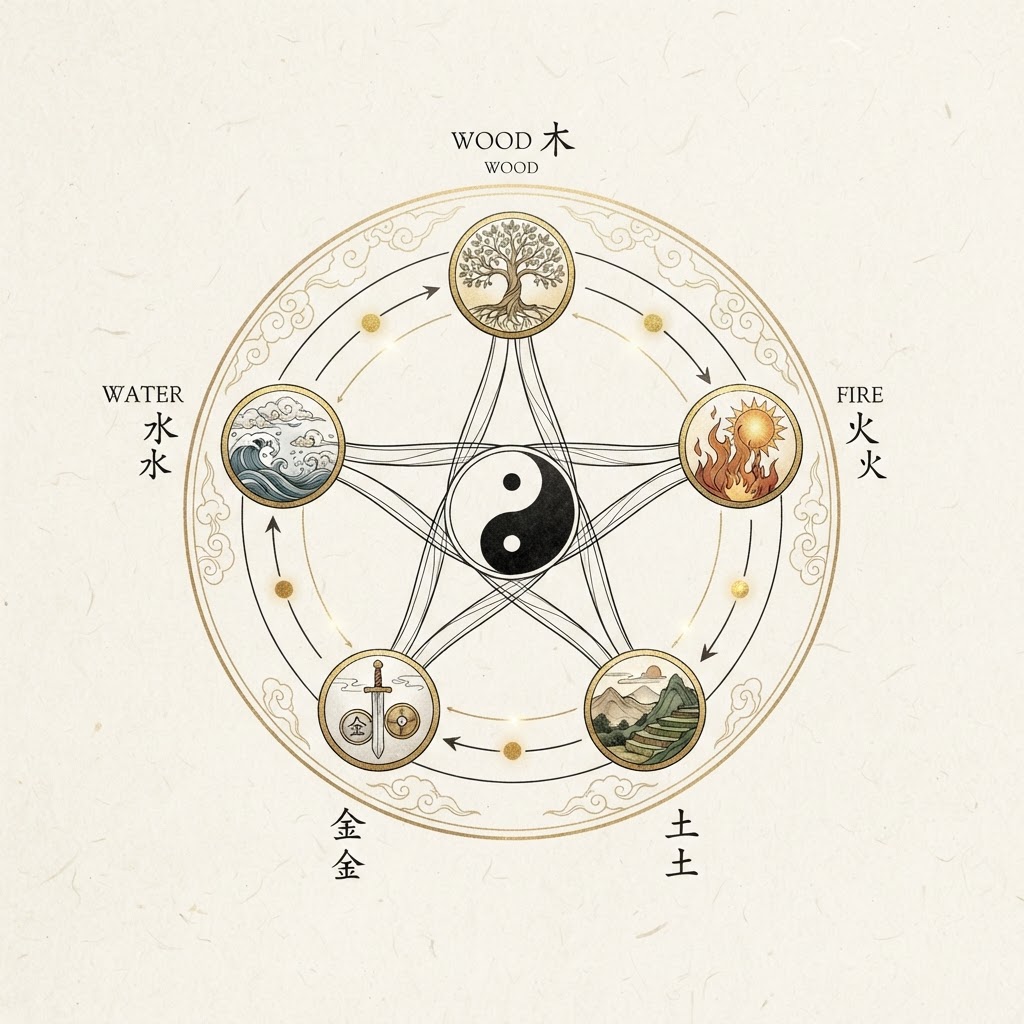
Wuxing: Meaning, Origin & Symbolism
Also known as: Five Elements, Five Phases, Five Movements
Taoist/Chinese
Taoist/Chinese
Solar Plexus Chakra
Sacral Chakra
Heart Chakra
Earth
Healing
Balance
Transformation
Harmony
The dynamic fivefold cyclical matrix—Wood, Fire, Earth, Metal, and Water—governing natural processes and physical balance.
Quick Facts
- Category
- Taoist/Chinese
- Culture / Origin
- Taoist/Chinese
- Geographic Origin
- China
- Historical Period
- Warring States period to Han Dynasty
- Estimated Age
- circa 4th Century BCE
- Element
- Earth
- Chakra
- Solar Plexus, Sacral, Heart
- Deities
- Five Directional Emperors (Wudi)
- Verification
- unverified
What is Wuxing?
Wuxing, often translated as the Five Elements or more accurately as the Five Phases, is a structural framework of Chinese natural philosophy and Taoism. Rather than describing static material substances, Wuxing defines five interconnected qualities of energy and patterns of motion: Wood (growth, expansion), Fire (heat, upward movement), Earth (stability, centering), Metal (condensation, inward gathering), and Water (fluidity, descent, rest).
The interaction between these five phases operates primarily through two dynamic cycles: the Sheng (Generative or Nourishing) cycle, where each phase gives birth to the next, and the Ke (Overcoming or Controlling) cycle, which maintains balance by preventing any single phase from becoming overwhelmingly dominant. Together, these cycles form a self-regulating, perpetual system.
Wuxing is deeply woven into Chinese civilization, forming the analytical bedrock of Traditional Chinese Medicine, astrology (Four Pillars of Destiny), culinary arts, governance, music, and the internal martial arts.
Meaning of Wuxing
Wuxing represents the five cyclical phases of transformation through which all physical phenomena and energetic expressions manifest and regulate themselves.
Origin & History
The conceptual development of Wuxing is historically credited to Zou Yan and the School of Naturalists (Yinyang Jia) during the Warring States period (c. 475–221 BCE). It was later synthesized with Yin-Yang theory and Confucian-Taoist statecraft during the Han Dynasty, notably codified in texts such as the 'Hanshu' and the 'Huangdi Neijing' (The Yellow Emperor's Classic of Medicine).
Dynasties utilized the Wuxing cycle to interpret historical transitions, aligning imperial banners, official robes, and rituals with the ruling element. Concurrently, Taoist adepts adapted it as a foundational schematic for bodily cultivation and alchemical transmutation.
Spiritual Meaning
Spiritually, Wuxing serves as a reminder that existence is a continuous process of becoming and releasing. Spiritual stagnation occurs when a person clings to a particular state of mind or emotional phase. Understanding Wuxing encourages aligning one's life with cosmic rhythms—knowing when to initiate growth (Wood), blossom (Fire), ground oneself (Earth), discern and refine (Metal), and rest in stillness (Water).
In internal alchemy, the five elements are correlated with the Five Shen (spiritual aspects of consciousness: Hun, Shen, Yi, Po, and Zhi). Transforming negative emotions into their corresponding virtues allows the practitioner to unite the five energies in the lower Dantian, establishing foundational spiritual enlightenment.
Symbolism
Typically depicted as a pentagon of circles connected by an outer generative circle and an inner five-pointed star of control. Wood represents spring and green; Fire represents summer and red; Earth represents seasonal transitions and yellow; Metal represents autumn and white; Water represents winter and black/deep blue.
Traditional Uses
In traditional philosophy and medicine, Wuxing provides an empirical system of correspondences linking celestial events, geography, seasons, internal organs, tastes, emotions, and moral virtues into an organic whole.
Modern Spiritual Uses
Modern holistic health and integrative therapies utilize the Five Elements model to understand psychosomatic connections, constitutional body types, seasonal eating habits, and emotional self-regulation.
Healing Associations
Central to acupuncture and herbalism, where balancing the five organ systems (Zang-Fu) restores vitality and cures disease.
Protection Associations
Utilized in spatial Feng Shui to neutralize energetic clashes by introducing balancing elements to disperse destructive patterns.
How the Symbol Is Used
- •Traditional Chinese Medicine
- •Acupuncture
- •Qigong
- •Feng Shui
- •BaZi Astrology
Cultural Context
Taoist/Chinese — China (Warring States period to Han Dynasty)
Sources & References
- 1.Unschuld, Paul U. 'Medicine in China: A History of Ideas' (1985)
- 2.Porkert, Manfred. 'The Theoretical Foundations of Chinese Medicine' (1974)
- 3.Needham, Joseph. 'Science and Civilisation in China, Vol. 2' (1956)
This content is for educational and informational purposes only. Where modern spiritual interpretations are described, they are not presented as ancient historical facts. It is not a substitute for professional medical or spiritual advice.