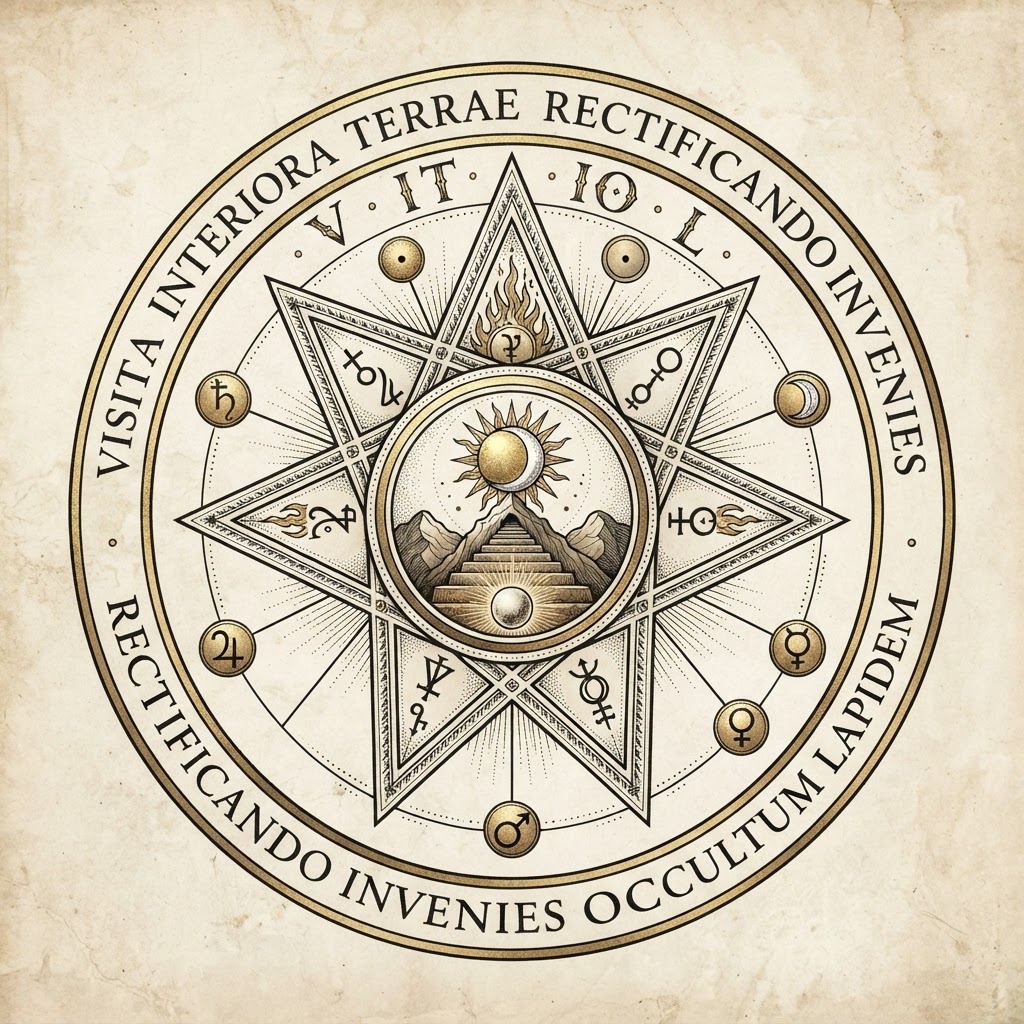
VITRIOL Emblem: Meaning, Origin & Symbolism
Also known as: Alchemical Mandala of Basil Valentine, Azoth Mandala, Vitriol Acronym
Hermetic
European Renaissance Alchemy
Root Chakra
Third Eye Chakra
Earth
Transformation
Wisdom
Clarity
A seven-pointed star enclosed by an acronym, urging the seeker to descend into the interior of the earth to find the hidden stone.
Quick Facts
- Category
- Hermetic
- Culture / Origin
- European Renaissance Alchemy
- Geographic Origin
- Germany / Western Europe
- Historical Period
- Late Medieval to Early Modern
- Estimated Age
- circa 1600 CE
- Element
- Earth
- Planet
- Saturn
- Chakra
- Root, Third Eye
- Zodiac
- Scorpio, Capricorn
- Deities
- Pluto, Hades, Hermes Psychopompos
- Verification
- unverified
What is VITRIOL Emblem?
The V.I.T.R.I.O.L. emblem is one of the most celebrated and psychologically evocative mandalas in Hermetic alchemy. Originating in the works attributed to the 15th-century alchemist Basil Valentine, the visual glyph features a central human face enveloped by a seven-pointed star (heptagram). Each point of the star corresponds to one of the seven classical planets, the seven traditional metals, and the distinct phases of the alchemical Great Work.
The emblem is circumscribed by the Latin motto forming the acronym V.I.T.R.I.O.L.: 'Visita Interiora Terrae Rectificando Invenies Occultum Lapidem' ('Visit the interior of the earth; by rectification, you will find the hidden stone'). In both literal and spiritual alchemy, this emblem serves as an unambiguous directive: true transmutative gold is not discovered on the comfortable surface of life, but by descending courageously into the dark, raw depths of one's own unconscious nature.
Meaning of VITRIOL Emblem
The emblem is an alchemical command to introspect deeply into the shadow of the self to discover the incorruptible divine soul.
Origin & History
Although attributed to the legendary 15th-century Benedictine monk Basilius Valentinus (Basil Valentine), the emblem first gained widespread distribution in 1599 in the publication of 'The Twelve Keys' and later in Johann Daniel Mylius's 'Philosophia Reformata' (1622).
The term 'vitriol' chemically denoted copper or iron sulfate—a highly corrosive green or blue compound crucial to laboratory alchemical distillations. However, esoteric philosophers recognized the word as a deliberate cryptographic acrostic. The emblem became a central teaching device among Rosicrucian circles and later Scottish Rite Freemasonry, where it represents the necessary psychic underworld journey prior to spiritual illumination.
Spiritual Meaning
In spiritual psychology, the V.I.T.R.I.O.L. mandala is the ultimate map for shadow work and radical self-honesty. The 'interior of the earth' refers directly to the deepest recesses of the human psyche—the buried traumas, neglected potentials, and shadow traits that the ego systematically avoids. The symbol teaches that illumination is impossible without this perilous interior descent.
'Rectification' refers to the rigorous purification, balancing, and alignment of what is found in those depths. By bringing conscious light to the suppressed underworld of the mind, the practitioner unearths the 'Hidden Stone'—the authentic divine self. The emblem asserts that the very substance considered worthless or terrifying by the mundane world is the indispensable raw material for spiritual perfection.
Symbolism
The seven points of the star represent the seven classical planets and alchemical operations; the central human face represents the adept's self-reflection; the surrounding circular Latin motto forms the boundary of initiation and inner exploration.
Traditional Uses
Classically interpreted as an instruction for laboratory calcination and distillation, while spiritually serving as the map of the soul's necessary descent into the dark underworld before resurrection.
Modern Spiritual Uses
Regarded in modern depth psychology and holistic therapy as the quintessential symbol for Carl Jung's process of shadow integration and radical inward transformation.
Healing Associations
Employed to encourage psychological resilience during profound emotional crises, inner transformation, and existential processing.
How the Symbol Is Used
- •Spiritual Alchemy
- •Shadow Work
- •Jungian Active Imagination
- •Masonic Chamber of Reflection
Cultural Context
European Renaissance Alchemy — Germany / Western Europe (Late Medieval to Early Modern)
Sources & References
- 1.The Twelve Keys of Basil Valentine (1599)
- 2.Azoth, or the Star of the Duodenum by Basilius Valentinus
- 3.Psychology and Alchemy by C.G. Jung
This content is for educational and informational purposes only. Where modern spiritual interpretations are described, they are not presented as ancient historical facts. It is not a substitute for professional medical or spiritual advice.