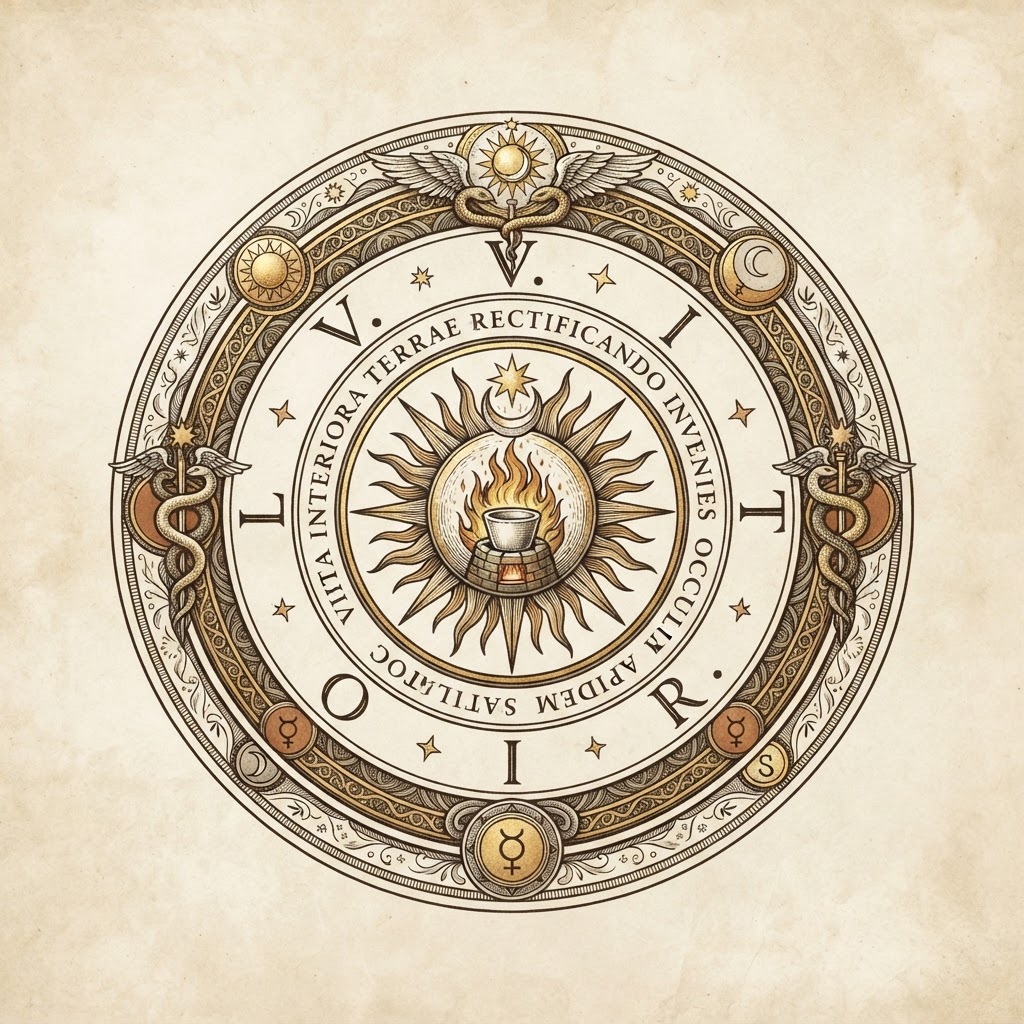
V.I.T.R.I.O.L.: Meaning, Origin & Symbolism
Also known as: Vitriolum, Azoth Acronym, Visita Interiora Terrae
Alchemical
European Renaissance
Root Chakra
Third Eye Chakra
Earth
Transformation
Wisdom
A famous Latin alchemical acronym and sigil instructing seekers to explore the depths of their soul to discover hidden truth.
Quick Facts
- Category
- Alchemical
- Culture / Origin
- European Renaissance
- Geographic Origin
- Central Europe
- Historical Period
- Late Renaissance
- Estimated Age
- circa 1599 CE
- Element
- Earth
- Planet
- Saturn
- Chakra
- Root, Third Eye
- Zodiac
- Scorpio, Capricorn
- Deities
- Pluto, Hades, Osiris
- Verification
- unverified
What is V.I.T.R.I.O.L.?
V.I.T.R.I.O.L. is both a chemical substance (iron or copper sulfate) and one of the most celebrated hermetic acrostics in Western alchemy. It represents the Latin maxim: 'Visita Interiora Terrae Rectificando Invenies Occultum Lapidem', which translates to: 'Visit the interior of the earth; through rectification, you will find the hidden stone.'
Frequently depicted within a seven-pointed star surrounded by planetary emblems and alchemical scenes, V.I.T.R.I.O.L. acts as a concise roadmap for the entire Great Work. It urges the practitioner to courageously descend into their inner darkness, cleanse what is corrupted, and uncover the divine seed of spiritual immortality.
Meaning of V.I.T.R.I.O.L.
The directive to seek enlightenment by descending into and purifying the inner depths of the self.
Origin & History
The acronym first appeared prominently in the 1599 text 'Aureum Vellus' (Golden Fleece) attributed to Basil Valentine, a pseudonymous German Benedictine alchemist. It was further detailed in 'The Twelve Keys of Basil Valentine' and Johann Daniel Mylius's 'Opus Medico-Chymicum'.
While operating as a cipher for sulfuric acid (oil of vitriol)—a key solvent in physical alchemy—it simultaneously codified the psychological necessity of introspection and shadow work.
Spiritual Meaning
Spiritually, V.I.T.R.I.O.L. is the classic motif of the underworld journey (katabasis). It asserts that genuine spiritual awakening cannot be found through intellectual escapism, but requires descending into one's repressed emotions, shadow traits, and unconscious complexes.
By bravely confronting and 'rectifying' these hidden wounds, the seeker extracts the invaluable wisdom that forms the true foundation of inner illumination.
Symbolism
The seven letters correspond to the seven classical planets, the seven chakras, and the seven phases of alchemical transmutation, while the earth symbolizes the dense physical and unconscious self.
Traditional Uses
Historically understood as both a laboratory recipe for potent acid and an esoteric directive for inner moral and spiritual purification.
Modern Spiritual Uses
Heavily utilized in modern shadow work, archetypal depth psychology, and introspective meditation as a reminder that healing begins by facing repressed pain.
Healing Associations
Associated with uncovering the root causes of chronic psychosomatic distress and transmuting emotional trauma.
Protection Associations
Used to shield the practitioner during deep introspective journeys and psycho-spiritual underworld passages.
How the Symbol Is Used
- •Shadow work
- •Active imagination
- •Introspective journaling
Cultural Context
European Renaissance — Central Europe (Late Renaissance)
Sources & References
- 1.Valentine, Basil, The Twelve Keys
- 2.Mylius, Johann Daniel, Opus Medico-Chymicum
- 3.Hillman, James, The Thought of the Heart and the Soul of the World
This content is for educational and informational purposes only. Where modern spiritual interpretations are described, they are not presented as ancient historical facts. It is not a substitute for professional medical or spiritual advice.