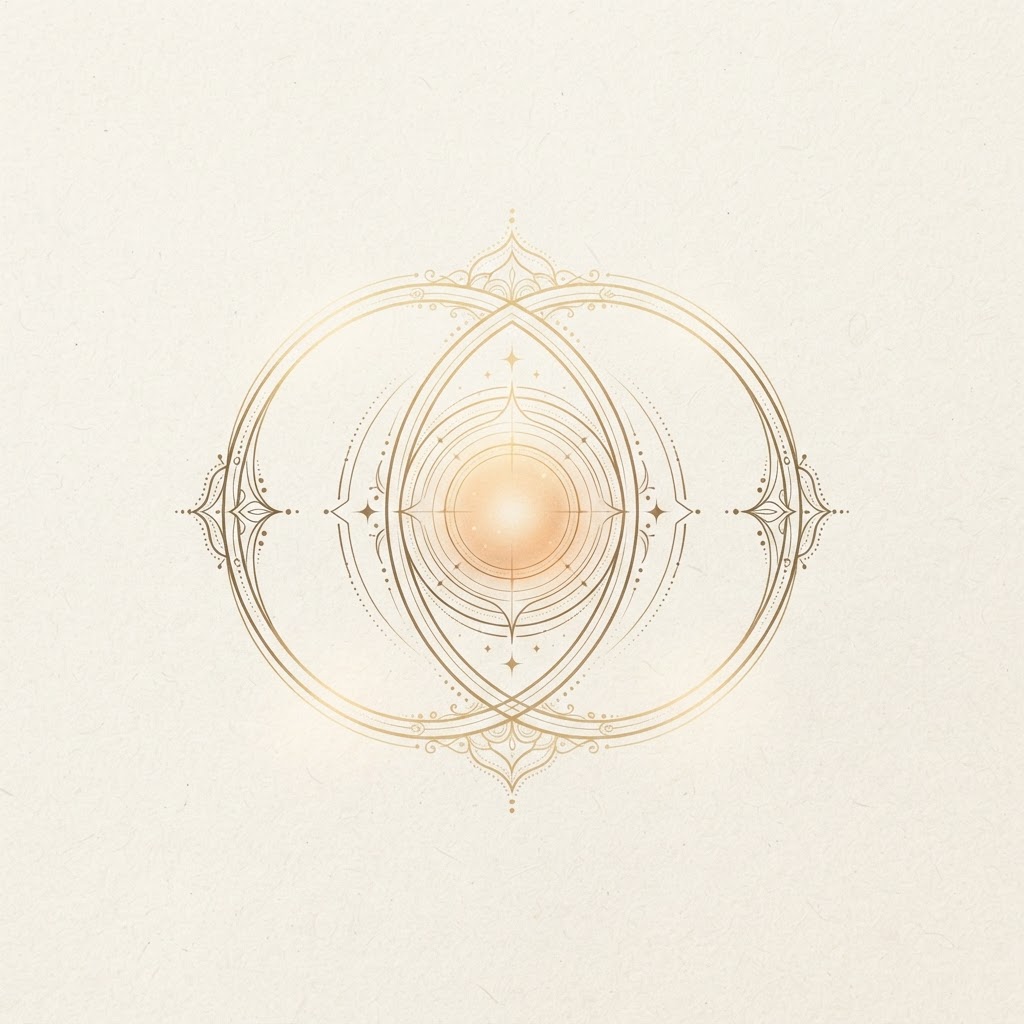
Vesica Piscis: Meaning, Origin & Symbolism
Also known as: Mandorla, Ichthys Portal, Vessel of the Fish
Sacred Geometry
Greco-Roman and Christian Esotericism
Sacral Chakra
Heart Chakra
Water
Unity
Balance
Creativity
Transformation
An almond-shaped geometric figure formed by the intersection of two identical discs whose centers touch each other's perimeters.
Quick Facts
- Category
- Sacred Geometry
- Culture / Origin
- Greco-Roman and Christian Esotericism
- Geographic Origin
- Eastern Mediterranean and Western Europe
- Historical Period
- Classical Antiquity to Medieval
- Estimated Age
- circa 300 BCE
- Element
- Water
- Planet
- Moon
- Chakra
- Sacral, Heart
- Zodiac
- Pisces
- Deities
- Christ, Isis, Virgin Mary
- Verification
- unverified
What is Vesica Piscis?
The Vesica Piscis (Latin for 'bladder of a fish') is formed when two circles of equal radius intersect in such a manner that each circle passes through the exact center of the other. The resulting central almond shape yields a length-to-width ratio of the square root of three (approximately 1.73205), an irrational number foundational to the geometry of the equilateral triangle and the golden ratio. It is universally revered as the primary womb of geometry from which geometric figures such as the equilateral triangle, the regular hexagon, and the double square naturally unfold. Across artistic and architectural history, particularly in Gothic cathedral architecture, this geometric portal has framed depictions of transcendent deities, saints, and cosmic transitions.
Meaning of Vesica Piscis
The bridge between spirit and matter, representing creation emerging from the union of complementary opposites.
Origin & History
The mathematical foundation of the Vesica Piscis was formally codified in the opening proposition of Euclid's Elements (Book I, Proposition 1) to construct an equilateral triangle using compass and straightedge. In early Christianity, the symbol merged with the Ichthys and emerged prominently in sacred art as the mandorla—an almond-shaped halo encasing Christ during the Transfiguration, Ascension, or Judgment. Medieval Master Masons extensively utilized the geometric properties of the Vesica Piscis to determine the proportions of Gothic cathedrals, sacred vaults, and vaulted arches, embodying divine measure within stone.
Spiritual Meaning
The Vesica Piscis represents the cosmic intersection where the eternal, non-physical realm of Spirit intersects with the physical, temporal world of Form. It symbolizes the sacred portal of birth, emergence, and divine communion, depicting how the interaction of duality gives birth to a transcendent third state of consciousness. In spiritual practice, it serves as an emblem of mediation, mutual understanding, and divine reconciliation between Heaven and Earth.
Symbolism
The two individual circles represent unmanifest consciousness and manifest polarity, light and shadow, or feminine and masculine dynamics. The central almond-shaped intersection represents the cosmic womb, divine light, and the doorway through which spiritual energy enters tangible reality.
Traditional Uses
Interpreted in Christian iconography as the Mandorla expressing the dual human and divine natures of Christ, and in Pythagorean geometry as the origin of numerical and geometrical expansion.
Modern Spiritual Uses
Viewed in contemporary spiritual traditions as a portal of heart-centered creation, sacred feminine embodiment, and non-dual integration.
Healing Associations
Applied in meditative visual focus to reconcile internal emotional contradictions and heal polarized thinking.
Protection Associations
Employed traditionally in ecclesiastical entryways and tympanums as a guardian portal preserving sacred sanctuary space.
How the Symbol Is Used
- •Contemplative prayer
- •Gothic architectural design
- •Sacred geometry drafting
- •Meditation
Cultural Context
Greco-Roman and Christian Esotericism — Eastern Mediterranean and Western Europe (Classical Antiquity to Medieval)
Sources & References
- 1.Euclid. Elements. Book I, Proposition 1, circa 300 BCE.
- 2.Pennick, Nigel. Sacred Geometry: Symbolism and Purpose in Religious Art. Capall Bann, 1994.
This content is for educational and informational purposes only. Where modern spiritual interpretations are described, they are not presented as ancient historical facts. It is not a substitute for professional medical or spiritual advice.