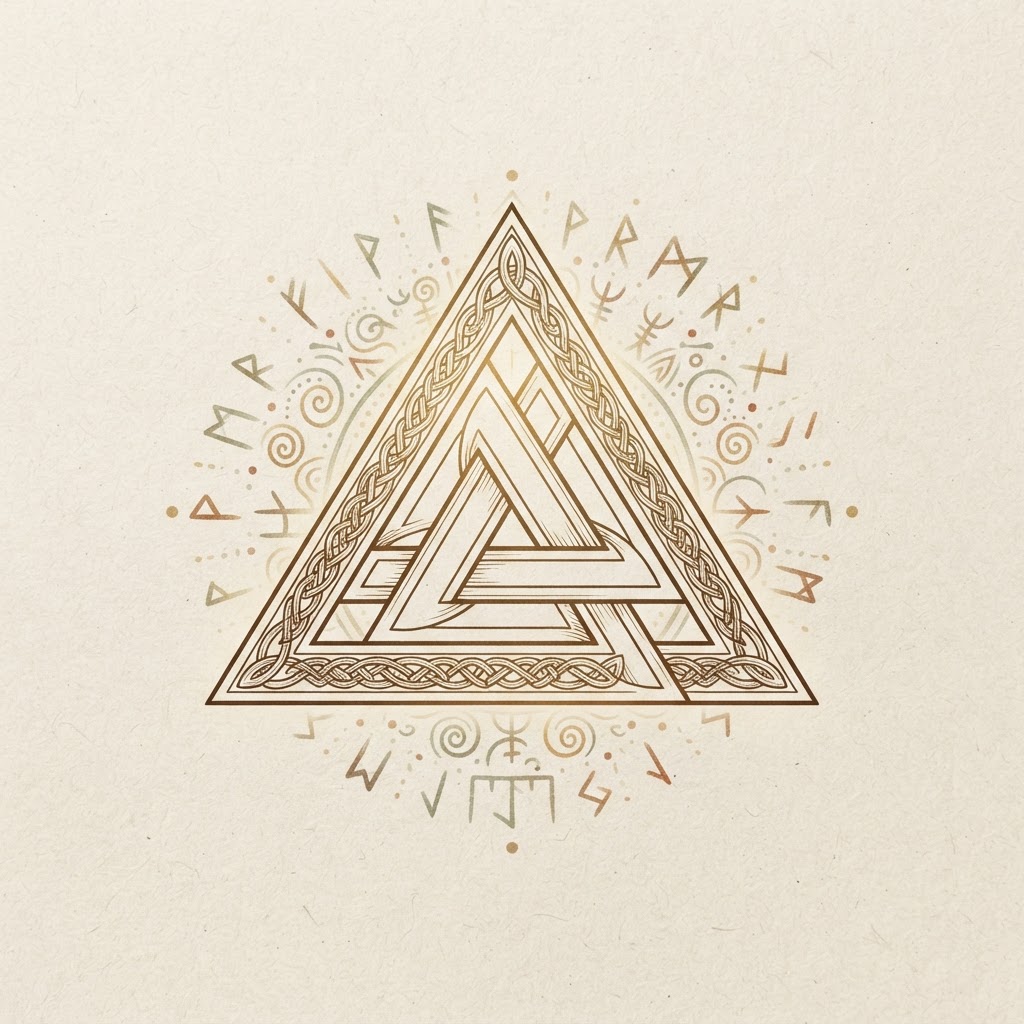
Valknut: Meaning, Origin & Symbolism
Also known as: Hrungnir's Heart, Knot of the Slain, Walknot
Norse/Germanic
Norse/Germanic
Third Eye Chakra
Crown Chakra
Ether/Spirit
Wisdom
Transformation
Courage
Spiritual Connection
An ancient Norse motif of three interlocking triangles strongly associated with Odin, death, and the transition between realms.
Quick Facts
- Category
- Norse/Germanic
- Culture / Origin
- Norse/Germanic
- Geographic Origin
- Scandinavia
- Historical Period
- Migration Period to Viking Age
- Estimated Age
- circa 7th–10th century CE
- Element
- Ether/Spirit
- Planet
- Mercury
- Chakra
- Third Eye, Crown
- Zodiac
- Scorpio, Aquarius
- Deities
- Odin
- Verification
- unverified
What is Valknut?
The Valknut consists of three interlaced triangles, appearing primarily in either unicursal (single continuous line) or tricursal (three separate loops) form. The modern name 'Valknut' was coined in Norway during the 19th century from Old Norse terms meaning 'knot of the slain'. In historical contexts, it is found carved upon Viking Age memorial runestones and grave goods, most notably the Tängelgårda and Stora Hammars stones on Gotland, Sweden, as well as on a bedpost in the Oseberg ship burial. The symbol is repeatedly depicted in close proximity to the god Odin, ravens, wolves, and scenes of sacrificial death or fallen warriors entering the afterlife. Because no direct written contemporary explanation survives from the Viking Age, scholarly interpretation relies on iconographic analysis linking it to Odin's power to bind and unbind the human mind and spirit.
Meaning of Valknut
A sacred funerary and warrior motif signifying the transition between mortality and the halls of the honored dead.
Origin & History
The symbol appeared frequently across Scandinavia on pictorial memorial stones dedicated to fallen warriors. It has been associated by some scholars with Snorri Sturluson's description of the giant Hrungnir's heart, which was said to be made of hard stone with three sharp corners, although its definitive connection to Odin remains the primary scholarly consensus.
Spiritual Meaning
The Valknut symbolizes the transcendence of the soul beyond earthly life and the mysteries of fate. It points to Odin's shamanic capacity to loosen the ties of fear during combat or cast mental bonds upon foes. The nine points formed by the three interlaced triangles frequently represent the Nine Worlds of the Norse cosmos, highlighting the interconnectedness of all planes of existence and the journey of consciousness across cosmological thresholds.
Symbolism
The three interlocked triangles represent the threefold nature of reality—past, present, and future, or body, mind, and spirit—bound inextricably together by wyrd (fate). The nine points evoke the universal structure suspended from Yggdrasil.
Traditional Uses
Historically tied to death, warrior consecration to Odin, and safe passage for the dead into Valhalla or the care of the Allfather.
Modern Spiritual Uses
In contemporary esoteric and Germanic practices, it is seen as an emblem of intellectual clarity, willingness to face mortality, and deep dedication to Odin's mysteries.
Protection Associations
Provides protective resolve in dire straits, though traditionally regarded with awe rather than casual defense.
How the Symbol Is Used
- •Ancestral veneration
- •Runic meditation
- •Modern Norse shamanism (Seidr)
- •Rune carving
Cultural Context
Norse/Germanic — Scandinavia (Migration Period to Viking Age)
Sources & References
- 1.H.R. Ellis Davidson, The Road to Hel
- 2.Rudolf Simek, Dictionary of Northern Mythology
- 3.John Lindow, Norse Mythology: A Guide to the Gods, Heroes, Rituals, and Beliefs
This content is for educational and informational purposes only. Where modern spiritual interpretations are described, they are not presented as ancient historical facts. It is not a substitute for professional medical or spiritual advice.