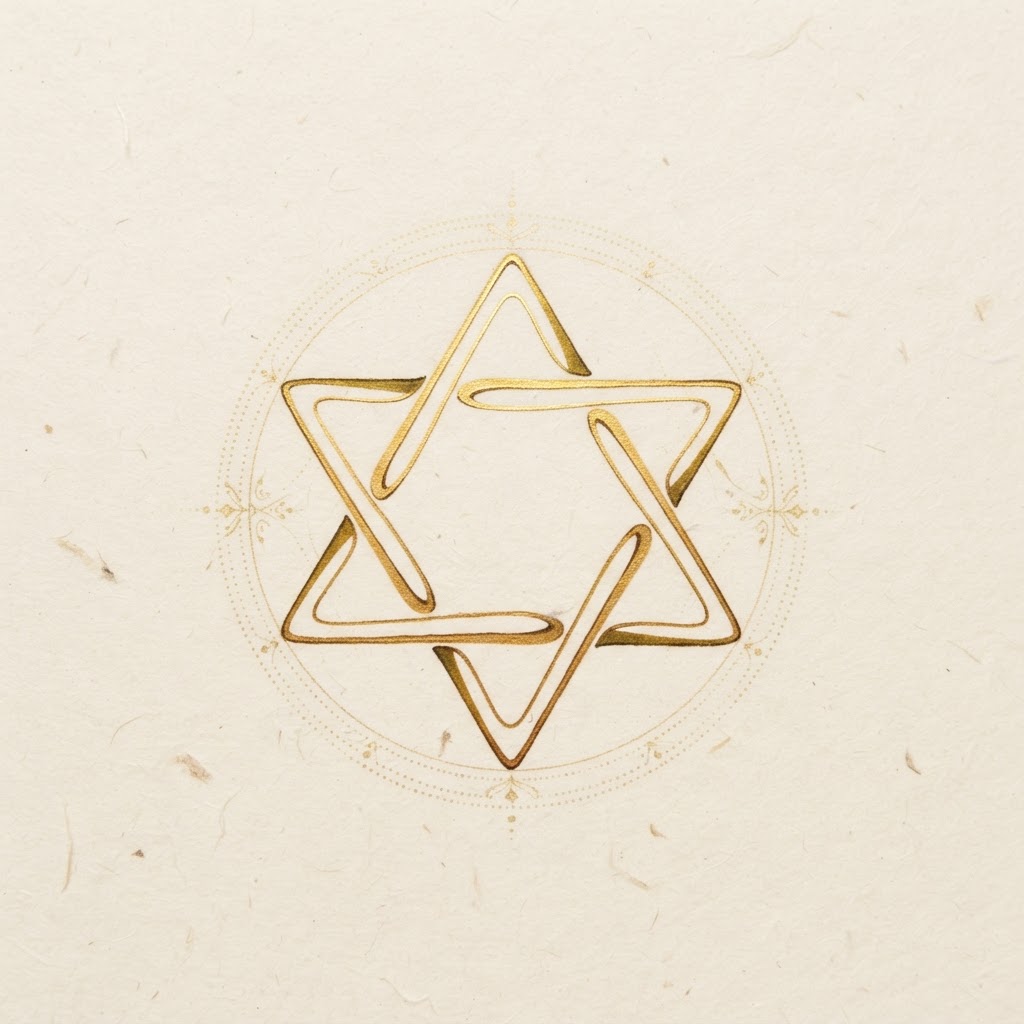
Unicursal Hexagram: Meaning, Origin & Symbolism
Also known as: Single-Stroke Hexagram, Thelemic Hexagram
Mystical/Esoteric
Western Esotericism
Heart Chakra
Third Eye Chakra
Fire
Transformation
Protection
Balance
Unity
A six-pointed geometric star drawn continuously in a single unbroken stroke, popularized in modern Western Hermeticism and Thelema.
Quick Facts
- Category
- Mystical/Esoteric
- Culture / Origin
- Western Esotericism
- Geographic Origin
- United Kingdom
- Historical Period
- Late Modern
- Estimated Age
- late 19th to early 20th century CE
- Element
- Fire
- Planet
- Sun
- Chakra
- Heart, Third Eye
- Deities
- Horus, Ra
- Verification
- unverified
What is Unicursal Hexagram?
The Unicursal Hexagram is a variation of the traditional six-pointed star that can be drawn in one continuous, fluid line rather than two intersecting triangles. While geometric unicursal designs appeared sporadically in mathematical sketches during the Renaissance, the glyph was formally introduced into ritual magic by the Hermetic Order of the Golden Dawn and subsequently adopted by Aleister Crowley as a primary emblem of Thelema, often incorporating a five-petaled rose at its center.
Meaning of Unicursal Hexagram
The perfect balance of microcosm (man) and macrocosm (universe) unified in a single continuous movement.
Origin & History
Although an early version was sketched by Giordano Bruno in the 16th century, the unicursal hexagram gained prominence through the late-19th-century British occult revival. It was documented in the secret papers of the Hermetic Order of the Golden Dawn to facilitate single-stroke tracing of hexagram rituals in confined ceremonial spaces. Aleister Crowley formalized its modern presentation in 1904, pairing it with the five-petaled rose to symbolize the Great Work.
Spiritual Meaning
Because it is drawn without lifting the pen or wand, the Unicursal Hexagram symbolizes the seamless unity between spiritual and material forces. It reflects the realization that polarity and multiplicity are unbroken manifestations of one continuous divine consciousness. The addition of the five-petaled rose at the center represents the union of the microcosm (the pentagram of human will) with the macrocosm (the cosmic hexagram).
Symbolism
The six vertices correspond to the planetary spheres centered around the Sun; its unbroken line signifies the continuous, undivided nature of the cosmos; and the optional central rose indicates beauty and attained enlightenment.
Traditional Uses
Within the Golden Dawn system, it was deployed as a dynamic ritual device to invoke or banish specific planetary and elemental energies without breaking the ritual circle.
Modern Spiritual Uses
Today, it serves as a prominent emblem of personal sovereignty, magical mastery, and the harmonized integration of conscious intent with cosmic will.
Protection Associations
Used in the Lesser and Greater Rituals of the Hexagram to purify the ceremonial space from astral interference.
How the Symbol Is Used
- •Ceremonial Magic
- •Thelema
- •Ritual Invocations
- •Hermeticism
Cultural Context
Western Esotericism — United Kingdom (Late Modern)
Sources & References
- 1.Regardie, Israel. The Golden Dawn: The Original Account of the Teachings, Rites & Ceremonies. Llewellyn Publications, 1989.
- 2.Crowley, Aleister. Magick: Liber ABA, Book 4. Weiser Books, 1997.
This content is for educational and informational purposes only. Where modern spiritual interpretations are described, they are not presented as ancient historical facts. It is not a substitute for professional medical or spiritual advice.