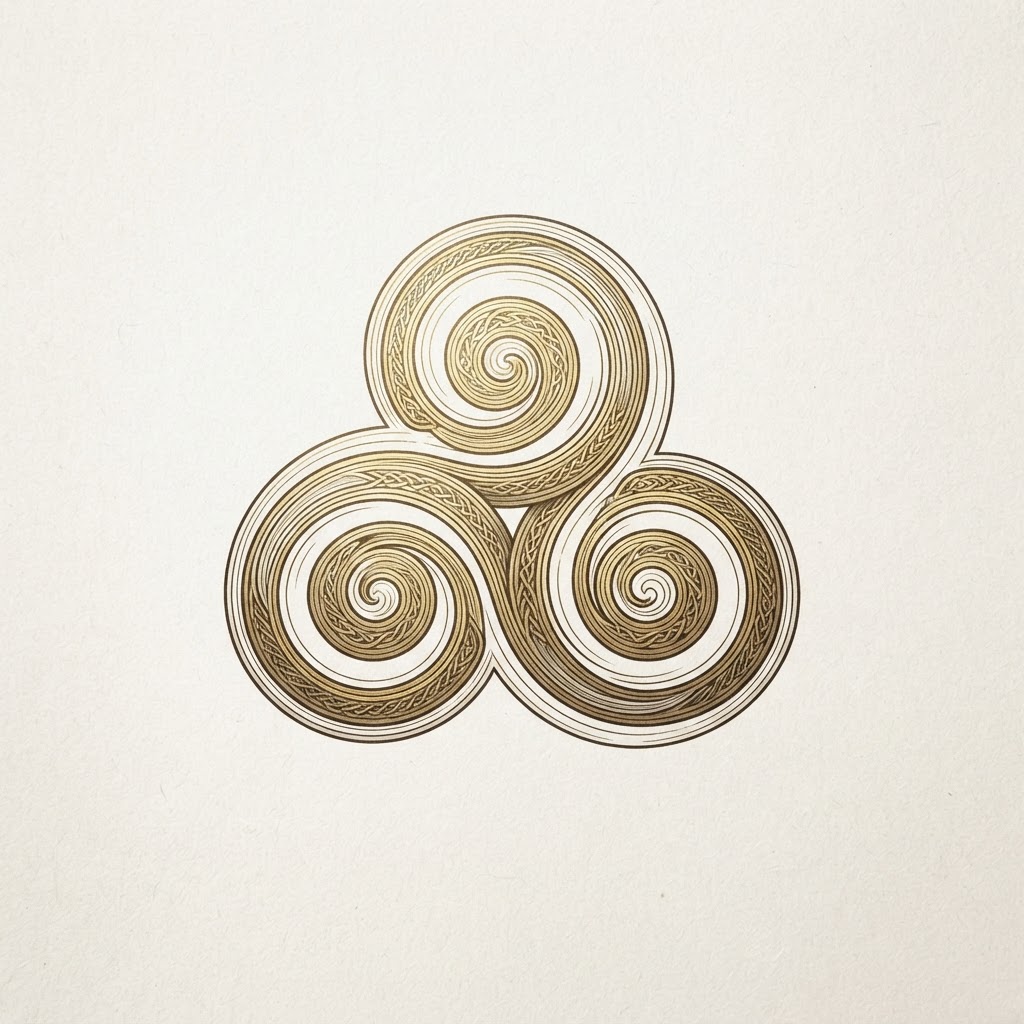
Triskelion: Meaning, Origin & Symbolism
Also known as: Triskele, Triple Spiral
Celtic
Celtic
Third Eye Chakra
Crown Chakra
Ether/Spirit
Transformation
Wisdom
Protection
Balance
An ancient motif composed of three interlocking spirals displaying rotational symmetry, representing cyclical motion and progress.
Quick Facts
- Category
- Celtic
- Culture / Origin
- Celtic
- Geographic Origin
- Ireland and Western Europe
- Historical Period
- Neolithic to Iron Age / Early Medieval
- Estimated Age
- circa 3200 BCE
- Element
- Ether/Spirit
- Planet
- Sun
- Chakra
- Third Eye, Crown
- Zodiac
- Aries, Sagittarius
- Deities
- Manannán mac Lir, The Morrígan, Brigid
- Verification
- unverified
What is Triskelion?
The Triskelion is one of the oldest and most enduring symbols associated with Celtic tradition, though its origins predate the Celts themselves. Characterized by three interconnected spirals or three bent human legs radiating from a common center, the symbol conveys dynamic movement, natural flow, and perpetual motion. It prominently decorates monumental Neolithic architecture in Ireland and later emerged as a foundational artistic element in La Tène Celtic art.
Throughout Celtic cultures, motifs based on the number three held profound significance. The Triskelion was rendered on stone carvings, metalwork, coinage, and weapons, capturing the vitality and interconnectedness of natural phenomena. Rather than standing as a static emblem, its continuous lines encourage the viewer's eye to travel circularly, embodying cycles of growth, transition, and renewal.
With the arrival of Christianity in Celtic lands, the triple spiral was readily adapted to represent the Holy Trinity. Today, it remains a premier insignia of Celtic heritage, chosen by spiritual practitioners and cultural historians alike as an emblem of continuity, balance, and metaphysical expansion.
Meaning of Triskelion
The Triskelion primarily signifies perpetual motion, cyclic evolution, and the triadic nature of cosmic and natural life.
Origin & History
Although famous as a hallmark of Celtic visual culture, the earliest prominent example of the Triskelion appears on the entrance stone of the prehistoric monument at Newgrange in County Meath, Ireland, predating Celtic arrival by millennia. Later, Continental and Insular Celts integrated the motif deeply into their aesthetic vocabulary during the Hallstatt and La Tène periods (circa 500 BCE onward).
In Iron Age Europe, the design was stamped onto coins across Gaul and Britain and forged into high-status bronze torcs and scabbards. It eventually evolved into the regional symbol of the Isle of Man and Sicily (in the form of three conjoined legs) and flourished within Insular Christian illuminated manuscripts such as the Book of Kells.
Spiritual Meaning
Spiritually, the Triskelion embodies the omnipresence of triplicities in existence: past, present, and future; birth, death, and rebirth; and the realms of land, sea, and sky. The continuous, uninterrupted outward spin reflects conscious evolution and the expansion of the human soul through experience.
In modern mystical practices, it is viewed as a guide for navigating transformative thresholds. By honoring three states of being—physical, mental, and spiritual—it serves as an energetic balancer, assisting the seeker in maintaining inner equilibrium while progressing through inevitable external changes.
Symbolism
The three spirals represent threefold realities, continuous dynamic energy, and the rhythm of cosmic cycles. The unified central point signifies the origin and returning anchor of all existence, reminding the observer of unity beneath diversity.
Traditional Uses
Historically, the symbol is linked to the Celtic cosmology of three interrelated realms—Earth, Sea, and Sky—and the triune nature of many Celtic deities such as the Morrígan or Brigid.
Modern Spiritual Uses
Contemporary spiritual practitioners interpret the Triskelion as a sacred tool for personal development, mindfulness, and attunement to feminine wisdom and natural cycles.
Healing Associations
Employed in meditation and energetic alignment to remove blockages and restore rhythmic energetic flow within the subtle body.
Protection Associations
Used historically on shields, scabbards, and talismans to invoke balanced movement, resilience in conflict, and spiritual safe-passage.
How the Symbol Is Used
- •Meditation
- •Pathworking
- •Sacred Geometry
- •Neopagan Rituals
Cultural Context
Celtic — Ireland and Western Europe (Neolithic to Iron Age / Early Medieval)
Sources & References
- 1.Green, Miranda. 'Symbol and Image in Celtic Religious Art.' Routledge, 1989.
- 2.MacKillop, James. 'Dictionary of Celtic Mythology.' Oxford University Press, 2004.
This content is for educational and informational purposes only. Where modern spiritual interpretations are described, they are not presented as ancient historical facts. It is not a substitute for professional medical or spiritual advice.