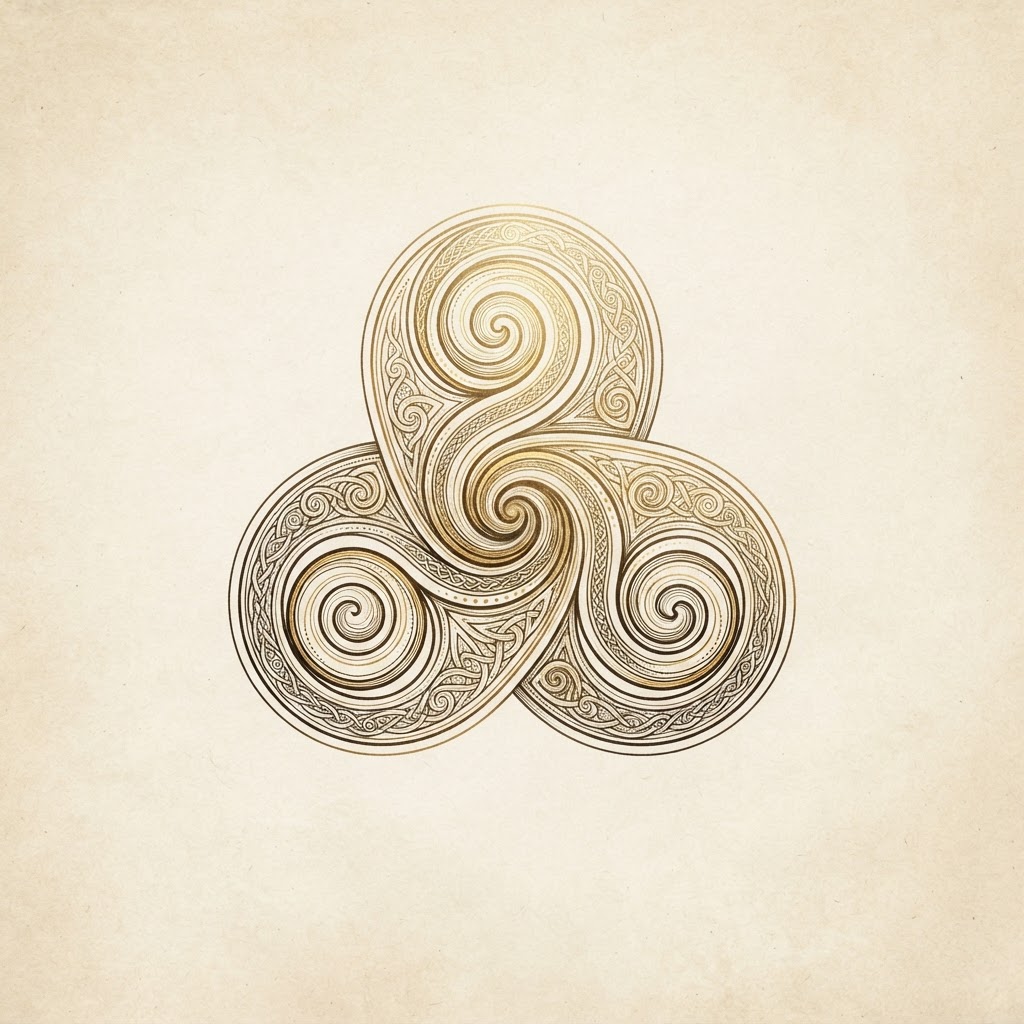
Triskele: Meaning, Origin & Symbolism
Also known as: Triskelion, Triple Spiral
Celtic
Celtic
Solar Plexus Chakra
Third Eye Chakra
Crown Chakra
Ether/Spirit
Transformation
Wisdom
Progression
Balance
An ancient threefold rotational motif representing motion, cycles, and tripartite cosmology.
Quick Facts
- Category
- Celtic
- Culture / Origin
- Celtic
- Geographic Origin
- Ireland and Western Europe
- Historical Period
- Neolithic to Early Medieval
- Estimated Age
- circa 3200 BCE
- Element
- Ether/Spirit
- Planet
- Sun
- Chakra
- Solar Plexus, Third Eye, Crown
- Zodiac
- Aries, Leo, Sagittarius
- Deities
- Brighid, The Dagda, Manannan mac Lir
- Verification
- unverified
What is Triskele?
The Triskele, or Triskelion, is an ancient emblem consisting of three interlocked or radiating spirals that convey dynamic rotational movement. Found abundantly across megalithic and Celtic sites, it represents continuous cycles of nature, time, and cosmic order. Its continuous line signifies eternity and the flow of energy through existence. In insular Celtic art, the motif transitioned into intricate La Tene metalwork and illuminated manuscripts, retaining its essential geometry while taking on layered cultural expressions. It embodies the Celtic veneration of the number three, serving as a visual philosophy of balance and progression.
Meaning of Triskele
Cyclical progression, continuous movement, and the triad of life, death, and rebirth.
Origin & History
While famous examples appear carved into the kerbstones of the Neolithic Newgrange tomb in Ireland predating the historic Celts, the design was enthusiastically adopted and refined by Celtic cultures throughout the Iron Age and Insular art periods. It adorned coinage, shields, scabbards, and later, early Christian artifacts like the Book of Kells, illustrating unbroken visual continuity.
Spiritual Meaning
Spiritually, the Triskele represents the tripartite nature of existence and consciousness. It illustrates that spiritual growth is not linear but an evolving spiral, returning to similar themes with elevated awareness. It serves as a visual focus for meditation on the eternal dance between origin, journey, and destination, reminding practitioners that stillness exists at the center of constant movement.
Symbolism
The three spirals symbolize the three realms (Land, Sea, and Sky), the phases of life (Maiden, Mother, Crone), and the divisions of time (Past, Present, and Future). The central point from which they branch denotes the unmanifest source or divine axis.
Traditional Uses
Historically understood as a cosmic emblem of motion, seasonal transformation, and divine harmony across natural and spiritual realms.
Modern Spiritual Uses
Modern Neo-Pagan and wellness communities view the Triskele as a potent symbol of holistic personal growth, mindfulness in transition, and alignment of mind, body, and spirit.
Healing Associations
Facilitates emotional movement, overcoming inertia, and processing cyclical grief or trauma.
Protection Associations
Used historically on armaments and dwellings to ward off stagnation and negative spiritual forces.
How the Symbol Is Used
- •Meditation
- •Labyrinth walking
- •Altar work
- •Modern Druidry
Cultural Context
Celtic — Ireland and Western Europe (Neolithic to Early Medieval)
Sources & References
- 1.Green, Miranda. 'Symbol and Image in Celtic Religious Art.' Routledge, 1989.
- 2.MacKillop, James. 'Dictionary of Celtic Mythology.' Oxford University Press, 2004.
This content is for educational and informational purposes only. Where modern spiritual interpretations are described, they are not presented as ancient historical facts. It is not a substitute for professional medical or spiritual advice.