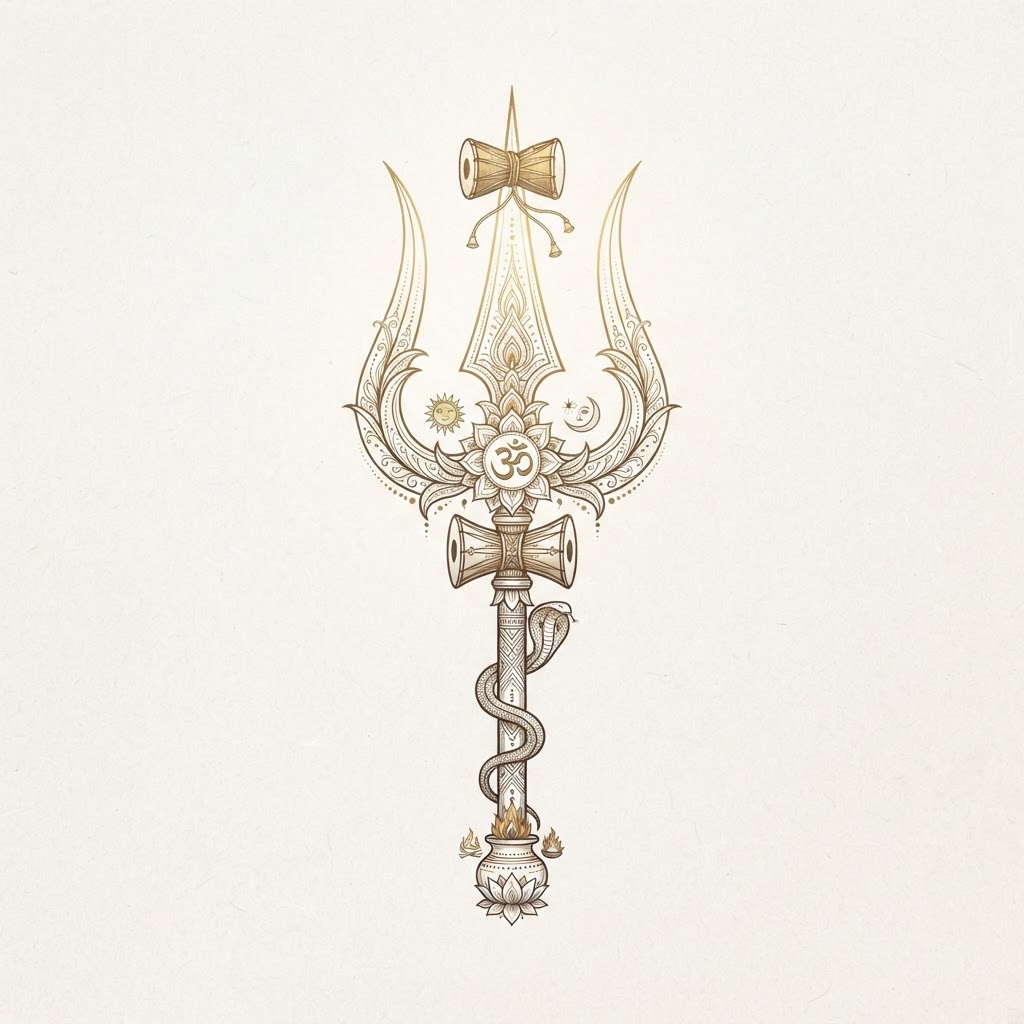
Trishula: Meaning, Origin & Symbolism
Also known as: Trishul, Trident of Shiva
Hindu
Hindu
Third Eye Chakra
Root Chakra
Fire
Protection
Transformation
Courage
Wisdom
The sacred trident of Lord Shiva representing the mastery over cosmic triads and inner ego.
Quick Facts
- Category
- Hindu
- Culture / Origin
- Hindu
- Geographic Origin
- Indian Subcontinent
- Historical Period
- Classical Antiquity
- Estimated Age
- circa 1000 BCE
- Element
- Fire
- Planet
- Mars
- Chakra
- Third Eye, Root
- Zodiac
- Scorpio, Aries
- Deities
- Shiva, Durga, Kali
- Verification
- unverified
What is Trishula?
The Trishula is the divine three-pronged spear wielded primarily by Lord Shiva and Goddess Durga. As one of the most recognized weapons in Hindu iconography, it is both a physical emblem of sovereignty and a profound metaphysical instrument of liberation.
Mounted atop temples or held in the right hand of meditative and fierce deities, the Trishula symbolizes the severing of ignorance and the destruction of the illusion of separateness. It is often depicted with a Damaru (sacred hourglass drum) tied to its shaft, integrating rhythm and creation with destruction.
Rather than representing sheer violence, the weapon signifies the dissolution of cosmic decay so that new spiritual evolution can emerge, acting as a beacon for ascetic renunciation and supreme awareness.
Meaning of Trishula
The divine weapon that destroys the three root poisons: ignorance, ego, and attachment.
Origin & History
The trident appears on early historic punch-marked coins, Kushan coinage, and ancient rock carvings before becoming codified in Shaiva and Shakta canonical iconography during the Gupta Empire.
Shaivite ascetics, including the Nath yogis and Aghoris, carry metal trishulas as tangible markers of their vows, yogic authority, and renunciation of worldly desires.
Spiritual Meaning
In yogic physiology, the Trishula maps the subtle energy body. Its three tines represent Ida, Pingala, and Sushumna nadis culminating at the Ajna chakra.
It indicates that spiritual liberation occurs when polar energies (sun and moon, logic and intuition) are balanced, permitting kundalini shakti to ascend directly up the central spinal channel.
Symbolism
The three tines represent the three gunas (sattva, rajas, tamas), the three times (past, present, future), and the cosmic acts of creation, preservation, and dissolution. The central axis represents transcendent non-dual consciousness.
Traditional Uses
A weapon of divine righteousness used by Shiva to vanquish demonic pride and by Durga to eliminate cosmic threats such as Mahishasura.
Modern Spiritual Uses
A symbol of radical discipline, inner sovereignty, conquering mental chatter, and releasing toxic behavioral patterns.
Healing Associations
Clears energetic blockages in the nadis, assisting in the uncoiling of stagnant vital force.
Protection Associations
Wards off malevolent entities, psychic attacks, and harmful atmospheric influences.
How the Symbol Is Used
- •Shaiva worship
- •Kundalini Yoga
- •Tantric Sadhana
- •Navratri festivals
Cultural Context
Hindu — Indian Subcontinent (Classical Antiquity)
Sources & References
- 1.The Presence of Siva by Stella Kramrisch
- 2.Myths and Symbols in Indian Art and Civilization by Heinrich Zimmer
This content is for educational and informational purposes only. Where modern spiritual interpretations are described, they are not presented as ancient historical facts. It is not a substitute for professional medical or spiritual advice.