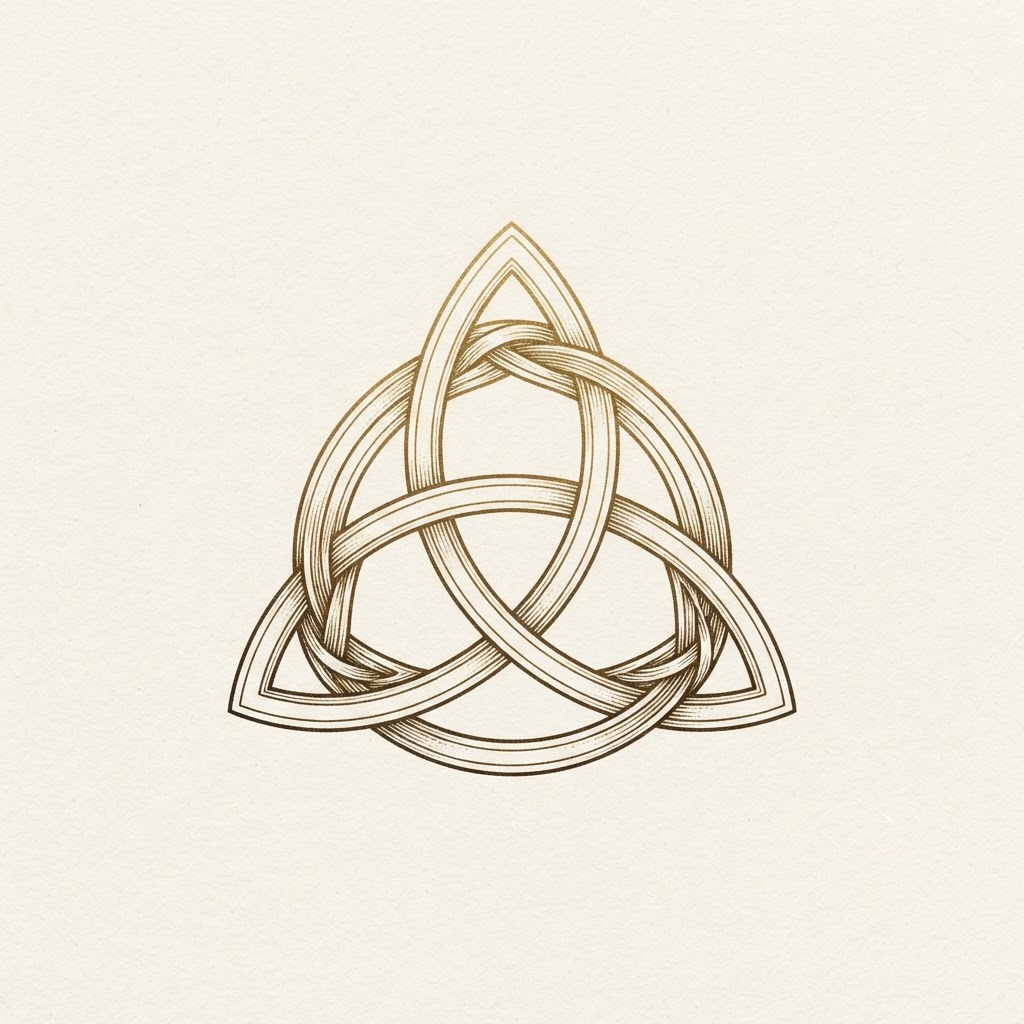
Triquetra: Meaning, Origin & Symbolism
Also known as: Trinity Knot, Trefoil Knot
Celtic
Celtic
Heart Chakra
Crown Chakra
Ether/Spirit
Protection
Love
Balance
Wisdom
A triangular knot composed of three interlaced arcs, universally recognized as a Celtic emblem of eternity and triune unity.
Quick Facts
- Category
- Celtic
- Culture / Origin
- Celtic
- Geographic Origin
- Ireland, Scotland, and Britain
- Historical Period
- Early Medieval
- Estimated Age
- circa 7th–8th Century CE
- Element
- Ether/Spirit
- Planet
- Moon
- Chakra
- Heart, Crown
- Zodiac
- Pisces, Cancer
- Deities
- Brigid, The Morrígan, Danu
- Verification
- unverified
What is Triquetra?
The Triquetra, derived from the Latin word meaning 'three-cornered', is a geometric configuration composed of three overlapping vesicae piscis lenses. Forming an unbroken, interwoven loop, the design has no distinct beginning or end, creating a visual metaphor for eternity and indivisibility. In Insular Celtic art, it often features an intertwined circle weaving through the arcs, underscoring totality and divine connection.
The symbol flourished during the Insular Christian period in Ireland and Britain, when monastic scribes and metalworkers adorned stone high crosses, liturgical chalices, and illuminated codices with endless knotwork. The Triquetra became one of the standard decorative and theological elements, harmonizing native Celtic visual grammar with Christian doctrine.
Today, the Triquetra is widely celebrated both as an authentic emblem of Celtic cultural identity and as a spiritual symbol. It is revered in Neopagan, Wiccan, and Christian contexts alike for its representation of harmonious balance, perpetual love, and the divine interplay of threefold cosmic forces.
Meaning of Triquetra
The Triquetra signifies the eternal, indivisible union of three distinct entities operating as one complete whole.
Origin & History
Although simple threefold knotting patterns appeared in Germanic and Norse contexts, the Triquetra reached its artistic apex within early Christian Insular art of the British Isles. It appears elaborately rendered in masterworks like the Book of Durrow and the Book of Kells, as well as on carved stone monuments across Scotland and Ireland.
While early Insular artists primarily employed the design as decorative framing and theological iconography for the Holy Trinity, early 19th-century romantic revivals repopularized the motif as an unbroken ancient symbol of pre-Christian Celtic unity and nature worship.
Spiritual Meaning
Spiritually, the Triquetra illustrates the principle that all aspects of existence are interwoven and interdependent. It portrays the seamless bridge between the past, present, and future, reminding the practitioner that every thought and deed resonates endlessly through time.
In nature-centered and goddess traditions, it honors the three ages of life—maiden, mother, and crone—as well as the equilibrium between body, mind, and spirit. The unbroken knot reinforces integrity of self and eternal dedication.
Symbolism
The three continuous loops represent triadic unity, eternal existence, and cosmic continuity; when depicted with a central circle, it symbolizes wholeness, protection, and infinite divine grace.
Traditional Uses
In traditional Insular Christian contexts, it represents the Holy Trinity: Father, Son, and Holy Spirit, bound together in divine unity without beginning or end.
Modern Spiritual Uses
Modern interpretations view the Triquetra as a universal talisman of unity, love, personal wholeness, and reverence for nature's threefold cycles.
Healing Associations
Used to balance the mental, emotional, and physical bodies, restoring overall harmony to fragmented states of mind.
Protection Associations
In modern folk magic and talismanic craft, its unbroken line is believed to ward against malevolent forces by ensnaring chaotic energy.
How the Symbol Is Used
- •Handfasting
- •Meditation
- •Knot Magic
- •Altar Devotion
Cultural Context
Celtic — Ireland, Scotland, and Britain (Early Medieval)
Sources & References
- 1.Bain, George. 'Celtic Art: The Methods of Construction.' Dover Publications, 1973.
- 2.Meehan, Aidan. 'Celtic Design: Knotwork.' Thames & Hudson, 1991.
This content is for educational and informational purposes only. Where modern spiritual interpretations are described, they are not presented as ancient historical facts. It is not a substitute for professional medical or spiritual advice.