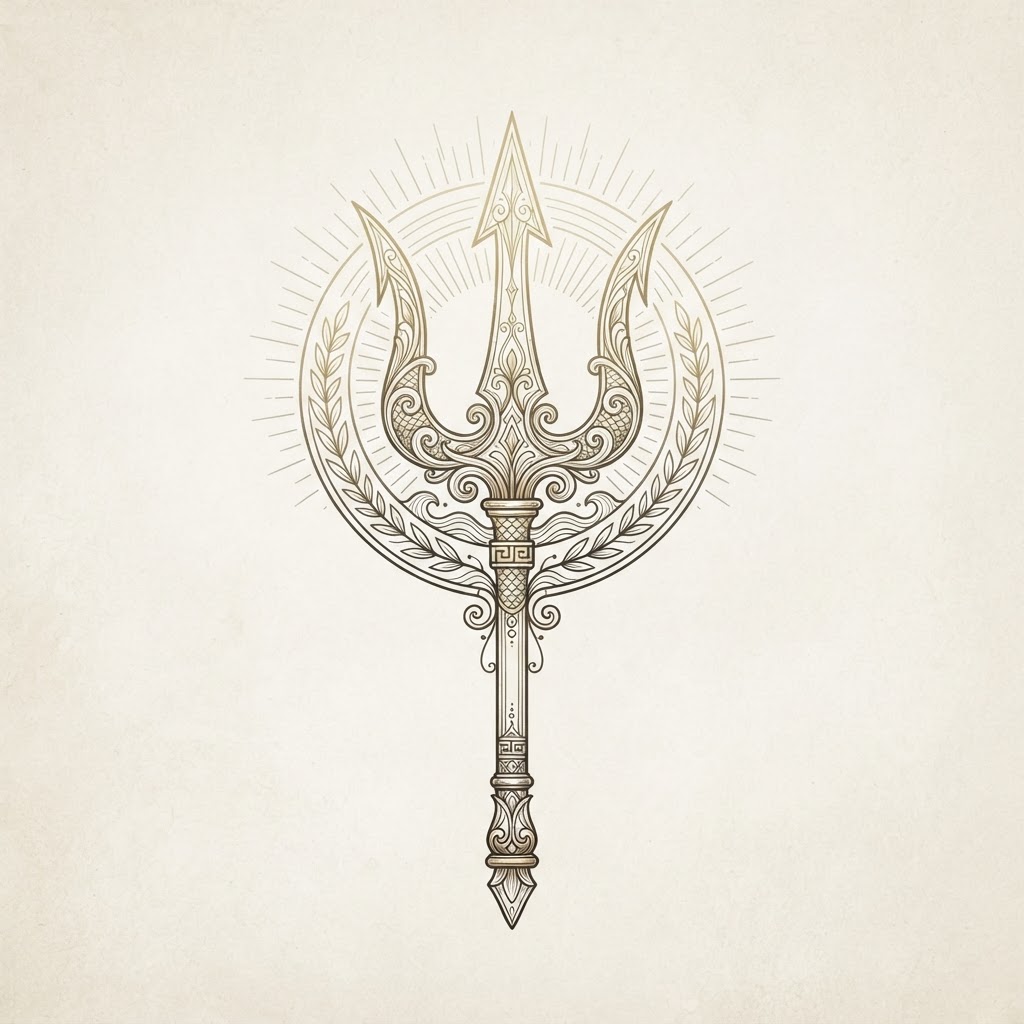
Trident of Poseidon: Meaning, Origin & Symbolism
Also known as: Trident of Neptune, Triaina, Tridens
Greek & Roman
Ancient Greek & Roman
Sacral Chakra
Solar Plexus Chakra
Throat Chakra
Water
Strength
Protection
Transformation
Empowerment
A three-pronged spear symbolizing dominion over the oceans, earth-shaking elemental power, and control of primal waters.
Quick Facts
- Category
- Greek & Roman
- Culture / Origin
- Ancient Greek & Roman
- Geographic Origin
- The Aegean Sea and the Italian Peninsula
- Historical Period
- Bronze Age to Classical Antiquity
- Estimated Age
- circa 1200 BCE
- Element
- Water
- Planet
- Neptune
- Chakra
- Sacral, Solar Plexus, Throat
- Zodiac
- Pisces, Scorpio
- Deities
- Poseidon, Neptune, Amphitrite, Triton
- Verification
- unverified
What is Trident of Poseidon?
The Trident (Greek: Triaina; Latin: Tridens) is a three-pronged fishing spear transformed into the mythological instrument of supreme power held by Poseidon (Neptune), the ruler of the seas, earthquakes, and horses. Forged for him by the Elder Cyclopes during the Titanomachy, the weapon allowed Poseidon to contend against the titans alongside Zeus and Hades.
In classical myth, Poseidon used the Trident to shatter boulders, call forth freshwater springs on the Acropolis of Athens, calm raging storms, or violently shake the foundations of the earth as 'Earth-Shaker' (Enosichthon). Roman gladiators known as retiarii famously wielded the trident in the arena, paired with a weighted net, honoring the sea god's combative legacy.
The three prongs have historically represented the three realms of water: marine seas, terrestrial freshwaters, and atmospheric clouds, or the triadic balance of elemental motion: still water, running streams, and crashing tempest.
Meaning of Trident of Poseidon
The Trident represents sovereign authority over the sea, control of elemental storms, and the power to shake or stabilize the earth.
Origin & History
Derived from the barbed fishing spears used across the Mediterranean, the trident was elevated to divine status early in Greek literature, appearing prominently in Homer's 'Iliad' and Hesiod's 'Theogony'. It was the paramount emblem of maritime city-states like Corinth, which placed it on coinage.
In the Roman Empire, Neptune's trident remained an essential icon of sea trade, naval domination, and harbor protection, being carved at sea gates, lighthouse bases, and maritime monuments throughout the Mediterranean world.
Spiritual Meaning
Spiritually, the Trident represents mastery over the deep, unconscious ocean of the human psyche. The three prongs signify the transmutation of past, present, and future emotional currents, channeling chaotic subconscious instincts into focused will.
It serves as a dynamic tool of spiritual command, demonstrating how the disciplined mind can split the rock of stubborn ego to allow the living waters of inspiration and emotional truth to spring forth.
Symbolism
The three prongs denote the threefold dominion over deep oceans, inland rivers, and subterranean springs, or creation, preservation, and destruction; the long shaft represents directed will and stability.
Traditional Uses
The divine instrument of Poseidon capable of stirring storms, cleaving landscapes, producing fresh springs, and subduing marine monsters.
Modern Spiritual Uses
Used in contemporary metaphysics as a symbol of deep emotional resilience, unconscious exploration, and commanding mastery over personal tides.
Healing Associations
Releasing deep-seated emotional trauma, fluid circulation balance, and resolving subconscious stagnation.
Protection Associations
Protection against drowning, maritime perils, emotional volatility, and seismic or foundational instability.
How the Symbol Is Used
- •Maritime warding
- •Emotional shadow work
- •Water blessing rituals
- •Elemental channeling
Cultural Context
Ancient Greek & Roman — The Aegean Sea and the Italian Peninsula (Bronze Age to Classical Antiquity)
Sources & References
- 1.Hesiod. 'Theogony'. Oxford World's Classics.
- 2.Larson, Jennifer. 'Ancient Greek Cults: A Guide'. Routledge.
This content is for educational and informational purposes only. Where modern spiritual interpretations are described, they are not presented as ancient historical facts. It is not a substitute for professional medical or spiritual advice.