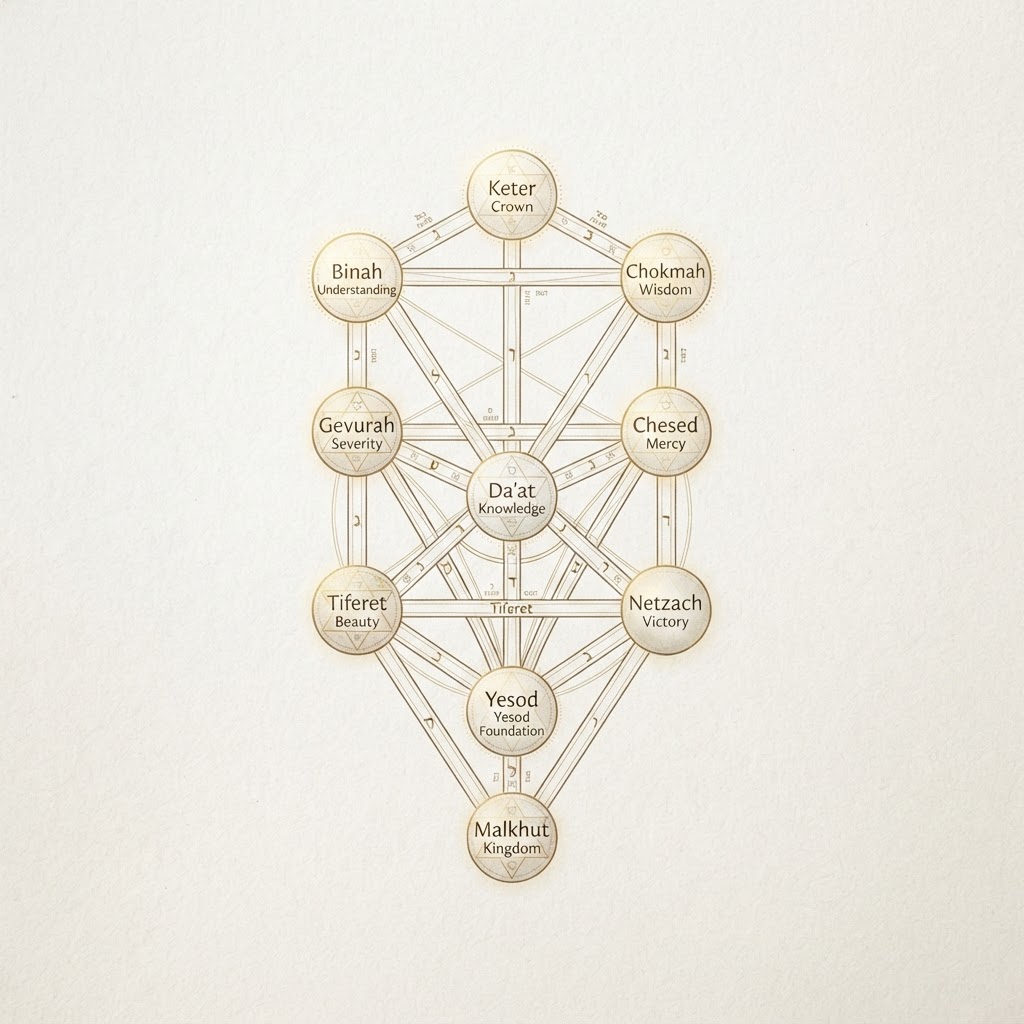
Kabbalistic Tree of Life: Meaning, Origin & Symbolism
Also known as: Etz Chaim, Otz Chiim, Sephirotic Tree
Sacred Geometry
Jewish (Kabbalah) and Western Hermeticism
All Chakra
Ether/Spirit
Wisdom
Transformation
Alignment
Balance
A sacred glyph consisting of ten divine nodes (Sephiroth) connected by twenty-two paths, mapping creation and the human psyche.
Quick Facts
- Category
- Sacred Geometry
- Culture / Origin
- Jewish (Kabbalah) and Western Hermeticism
- Geographic Origin
- Southern France and Spain (Provence and Catalonia)
- Historical Period
- Medieval
- Estimated Age
- circa 12th century CE
- Element
- Ether/Spirit
- Planet
- Sun
- Chakra
- All
- Deities
- YHWH
- Verification
- unverified
What is Kabbalistic Tree of Life?
The Kabbalistic Tree of Life (Etz Chaim) is an intricate esoteric diagram composed of ten divine emanations or spheres, termed Sephiroth (singular: Sephirah), and a hidden eleventh sphere known as Da'at. These spheres are arranged across three vertical pillars—the Pillar of Severity (left), the Pillar of Mercy (right), and the Pillar of Mildness or Balance (center). The ten Sephiroth are interconnected by twenty-two distinct linear channels or paths, each traditionally associated with one of the twenty-two letters of the Hebrew alphabet. Together, these elements constitute the thirty-two Paths of Wisdom through which divine light descends into physical reality and through which human consciousness ascends back to the divine source.
Meaning of Kabbalistic Tree of Life
A systemic map of cosmic creation, divine emanation, and the psychological and spiritual structure of human consciousness.
Origin & History
While the cosmological concept of the ten Sephiroth was first articulated in the ancient Sefer Yetzirah (Book of Formation, circa 2nd–6th century CE), the visual diagrammatic configuration of the Tree of Life with its interconnecting paths crystallized in thirteenth-century Kabbalistic schools with the compilation of the Zohar and the writings of Isaac the Blind and Moses de Leon. It was later systematized in sixteenth-century Safed by Moses Cordovero and Isaac Luria, before being adopted and adapted into Western Hermetic and Christian Kabbalistic traditions by Renaissance scholars such as Giovanni Pico della Mirandola.
Spiritual Meaning
The Tree of Life provides an exhaustive metaphysical roadmap detailing the progression of Divine Light from Ein Sof (the Boundless Nothingness) down through successive energetic stages into Malkhut (the physical realm). For spiritual seekers, it serves as an experiential ladder for internal transformation, balancing intellect, emotion, instinct, and direct will. By meditating on the individual Sephiroth and navigating the paths between them, the mystic integrates polarized internal states and aligns with transcendent divine will.
Symbolism
The right pillar represents expansion and creative force; the left pillar represents constraint and structural form; the central pillar represents equilibrium and consciousness. The ten spheres map stages of consciousness from pure will (Keter) to physical expression (Malkhut).
Traditional Uses
A sacred theological model of how God's singular reality manifests multiplicity in creation and how humans observe the Torah to preserve cosmic harmony.
Modern Spiritual Uses
Used in contemporary metaphysics, transpersonal psychology, and ceremonial magic as an archetypal map of the subconscious and conscious psyche.
Healing Associations
Employed to diagnose and heal psycho-spiritual blockages by identifying imbalances across the archetypal Sephiroth.
Protection Associations
Recited and contemplated to ground erratic emotional forces and align oneself within divine balance.
How the Symbol Is Used
- •Kabbalistic pathworking
- •Hermetic meditation
- •Contemplative prayer
- •Ceremonial ritual
Cultural Context
Jewish (Kabbalah) and Western Hermeticism — Southern France and Spain (Provence and Catalonia) (Medieval)
Sources & References
- 1.Scholem, Gershom. Major Trends in Jewish Mysticism. Schocken Books, 1941.
- 2.Regardie, Israel. The Garden of Pomegranates: Skrying on the Tree of Life. Llewellyn, 1932.
This content is for educational and informational purposes only. Where modern spiritual interpretations are described, they are not presented as ancient historical facts. It is not a substitute for professional medical or spiritual advice.