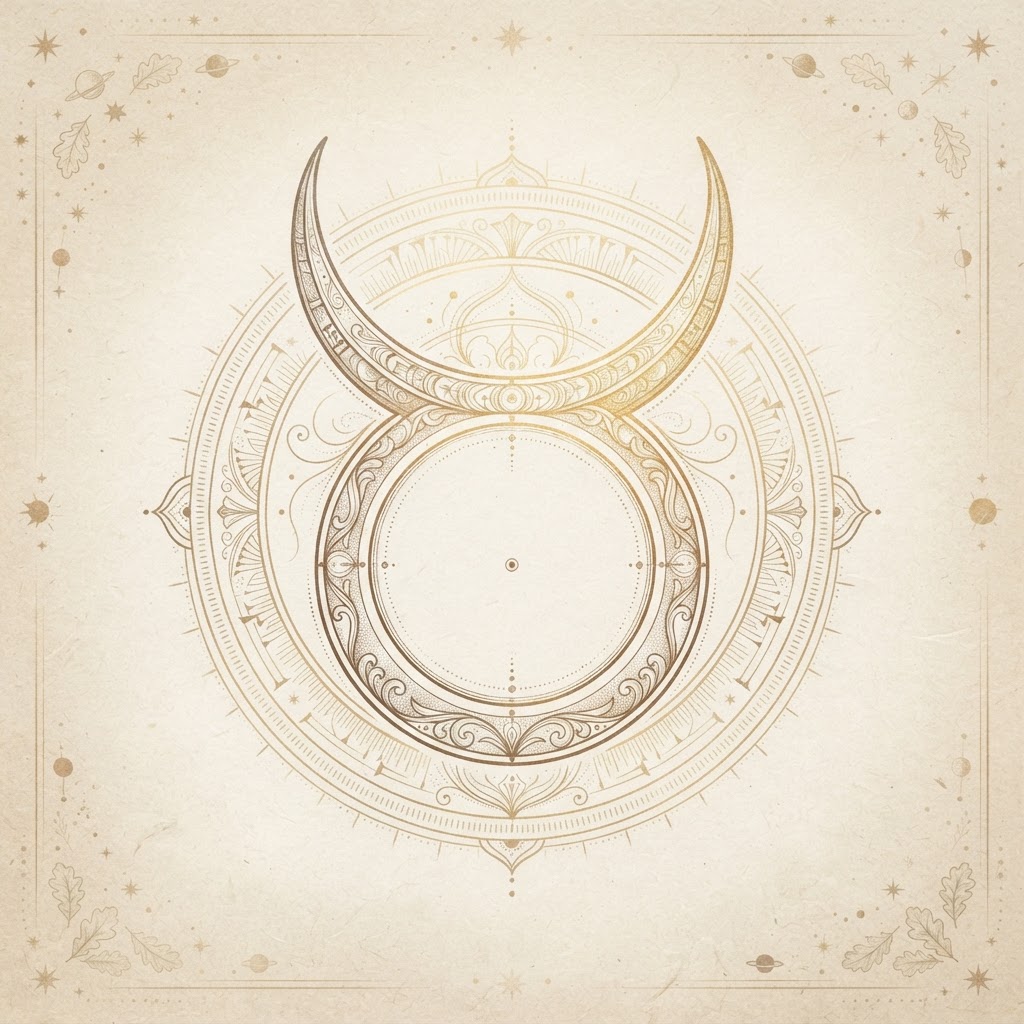
Taurus Glyph: Meaning, Origin & Symbolism
Also known as: The Bull, Sign of the Bull, Taurus Symbol
Zodiac
Babylonian and Greco-Roman
Throat Chakra
Root Chakra
Earth
Abundance
Grounding
Stability
Love
The Taurus glyph depicts a circle topped by an upward crescent, representing the head and horns of the celestial Bull.
Quick Facts
- Category
- Zodiac
- Culture / Origin
- Babylonian and Greco-Roman
- Geographic Origin
- Mesopotamia and Mediterranean
- Historical Period
- Bronze Age to Classical Antiquity
- Estimated Age
- circa 3000 BCE
- Element
- Earth
- Planet
- Venus
- Chakra
- Throat, Root
- Zodiac
- Taurus
- Deities
- Aphrodite, Venus, Hathor, Apis
- Verification
- unverified
What is Taurus Glyph?
The Taurus glyph is composed of a solar circle surmounted by a lunar crescent, widely interpreted as the horns and head of the Bull. This glyph embodies fixed earth energy: grounded, enduring, sensory, and rooted in physical creation. It signifies patience, tangible manifestation, fertility, and alignment with the material realm.
From prehistoric cave paintings to classical Mediterranean cults, the bull represented raw generative power and material abundance. In astrology, Taurus preserves the initial impulse of Aries, grounding it into concrete reality and nurturing steady growth.
Meaning of Taurus Glyph
The Taurus glyph signifies stability, physical abundance, endurance, and the material manifestation of spiritual energy.
Origin & History
Taurus is one of the oldest observed constellations, noted as early as the Upper Paleolithic in Lascaux cave art and prominently marked in the Babylonian astronomical compendiums as MUL.GU4.AN.NA, the Bull of Heaven. This mythological beast featured prominently in the Epic of Gilgamesh.
In classical Greek mythology, Taurus was associated with the white bull that Zeus transformed into to abduct Europa, as well as the sacred Apis bull cult of ancient Egypt, solidifying its association with terrestrial wealth, royalty, and primal fertility.
Spiritual Meaning
Spiritually, Taurus represents the sanctification of matter and the embodiment of spirit into form. The combination of the crescent (mind/soul) resting above the circle (spirit) reflects receptivity to divine wisdom, anchoring higher light into earthly existence.
It teaches patience, stewardship over the physical vessel, and the recognition of the sacred presence within nature and physical incarnation.
Symbolism
The circle represents unmanifest spirit and cyclic wholeness, while the open crescent atop it symbolizes receptive awareness, the horns of the bull, and the vessel holding divine light.
Traditional Uses
Ruled by Venus, traditional astrology sees Taurus as fixed, nocturnal, and earthy. It is associated with agriculture, wealth, material security, steadfastness, and physiological rulership over the neck and vocal cords.
Modern Spiritual Uses
Modern interpretations highlight Taurus as a symbol of mindfulness, somatic healing, grounding amidst chaos, value alignment, and sustainable, steady growth.
Healing Associations
Associated with soothing the nervous system, healing throat-related ailments, and promoting deep physical grounding.
Protection Associations
Employed to ground volatile psychic energy and protect material assets and stability.
How the Symbol Is Used
- •Western Astrology
- •Earth Centered Spirituality
- •Somatic Grounding Practices
- •Talismanic Magic
Cultural Context
Babylonian and Greco-Roman — Mesopotamia and Mediterranean (Bronze Age to Classical Antiquity)
Sources & References
- 1.Marcus Manilius, Astronomica (1st Century CE)
- 2.Vettius Valens, Anthologies (2nd Century CE)
- 3.Dane Rudhyar, The Astrology of Personality
This content is for educational and informational purposes only. Where modern spiritual interpretations are described, they are not presented as ancient historical facts. It is not a substitute for professional medical or spiritual advice.