Taijitu (Yin Yang): Meaning, Origin & Symbolism
Also known as: Yin and Yang, Taiji Symbol, Double Fish Symbol
Taoist/Chinese
Taoist/Chinese
Third Eye Chakra
Crown Chakra
Ether/Spirit
Balance
Wisdom
Harmony
Transformation
The quintessential Taoist emblem representing the dynamic balance, interdependence, and cyclical nature of opposing forces in the cosmos.
Quick Facts
- Category
- Taoist/Chinese
- Culture / Origin
- Taoist/Chinese
- Geographic Origin
- China
- Historical Period
- Song Dynasty (formalized); conceptual roots in Zhou Dynasty
- Estimated Age
- circa 1000 CE (diagram); roots circa 1000 BCE
- Element
- Ether/Spirit
- Planet
- Sun
- Chakra
- Third Eye, Crown
- Deities
- Three Pure Ones, Yuanshi Tianzun
- Verification
- unverified
What is Taijitu (Yin Yang)?
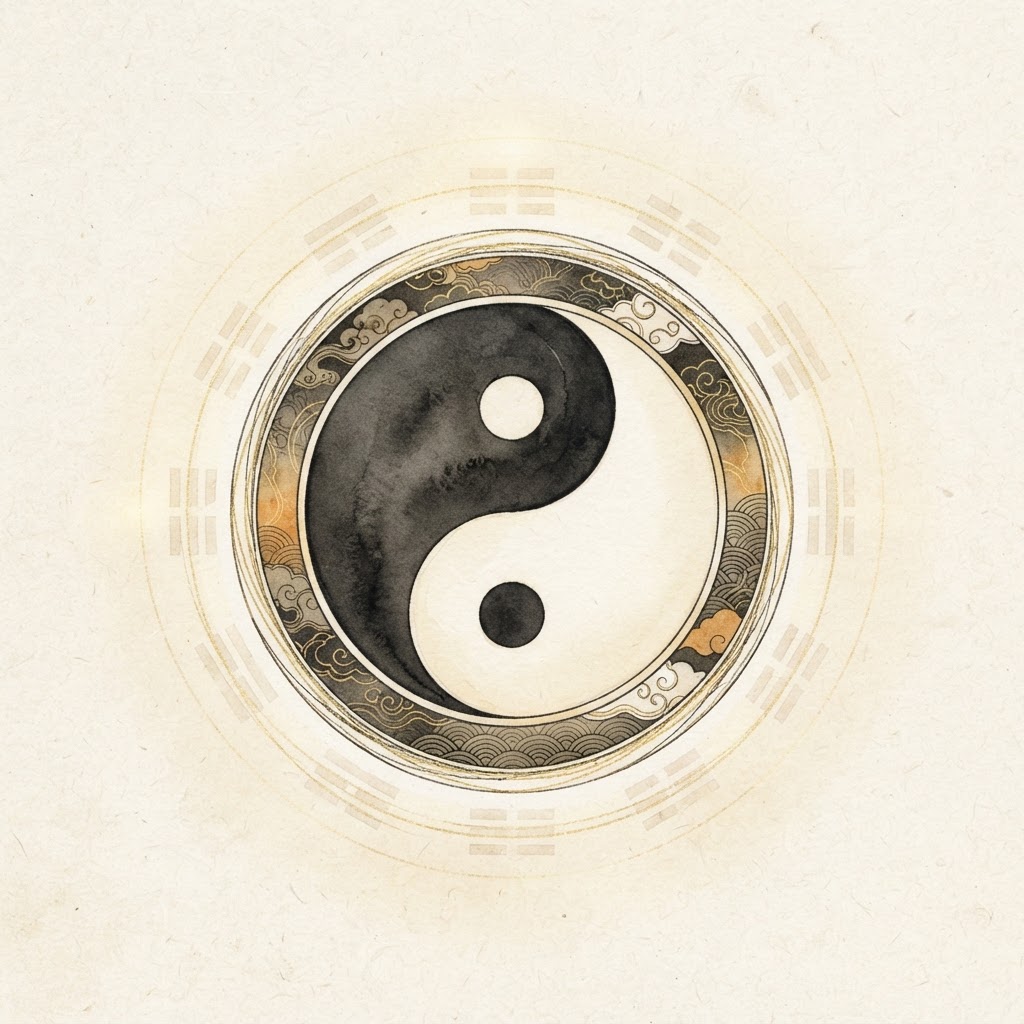
The Taijitu, commonly known in the West as the Yin Yang symbol, is the central visual representation of Taoist cosmology. It depicts a circle divided by an S-shaped curve into two intertwined halves: one dark (Yin) and one light (Yang). Inside each half resides a small dot of the opposing color, illustrating that each force contains the seed of the other and that neither can exist in absolute isolation. In Taoist philosophy, this dynamic interplay generates Qi, the vital breath that sustains all creation.
Historically formalized during the Song Dynasty by Neo-Confucian and Taoist scholars such as Zhou Dunyi, the Taijitu synthesizes centuries of observations regarding the natural world, the cycle of seasons, day and night, and masculine and feminine polarities. Rather than portraying good versus evil, the symbol teaches that harmony arises from equilibrium and perpetual flux. When Yang reaches its peak, Yin begins to rise, and vice versa, reflecting the effortless flow of the Tao.
Today, the Taijitu is celebrated across global spiritual and secular spheres as an enduring motif of balance, non-duality, and holistic health. Within traditional Chinese medicine, martial arts like Tai Chi Chuan, and internal alchemy (Neidan), understanding and cultivating the balance of Yin and Yang forms the cornerstone of longevity, self-cultivation, and spiritual realization.
Meaning of Taijitu (Yin Yang)
The Taijitu signifies the fundamental Taoist principle that all natural phenomena are composed of complementary, interconnected, and interdependent forces that continually transform into one another.
Origin & History
While cosmological theories of Yin and Yang date back to the I Ching (Book of Changes) and the Warring States period, the specific graphic representation known as the Taijitu emerged primarily during the Northern Song Dynasty. Polymath Zhou Dunyi authored the 'Taijitu Shuo' (Explanation of the Diagram of the Supreme Ultimate), integrating cosmological charts from Taoist alchemical lineages into a coherent metaphysical framework.
Over the centuries, the diagram became central to internal alchemy (Neidan) traditions, representing the undifferentiated origin (Wuji) moving into the differentiated state (Taiji). It was incorporated into imperial ritual art, temple architecture, and martial treatises across China.
Spiritual Meaning
Spiritually, the Taijitu points toward the primordial unity that precedes physical manifestation, known in Taoism as Wuji. By observing the alternating dance of Yin and Yang, the spiritual seeker learns non-attachment, equanimity, and the art of Wu Wei (effortless action). It serves as a visual guide for internal alchemy, wherein the practitioner balances the fiery Yang energies of the heart with the watery Yin energies of the kidneys to cultivate the Golden Elixir of immortality.
Furthermore, the small dot of the opposite polarity within each tear-drop serves as a reminder that stagnation is an illusion. Even in the depths of sorrow, darkness, or receptivity (Yin), the seed of vitality and action (Yang) is present; conversely, within supreme activity lies the need for stillness. Contemplating the Taijitu aligns the soul with the rhythmic breathing of the cosmos.
Symbolism
The outer circle represents Wuji, the infinite and undifferentiated Tao. The S-shaped dividing line denotes fluidity, continuous transformation, and mutual generation rather than rigid division. The black section symbolizes Yin—receptivity, darkness, earth, water, femininity, and rest—while the white section denotes Yang—creativity, light, heaven, fire, masculinity, and activity. The contrasting dots emphasize mutual containment and perpetual evolution.
Traditional Uses
In traditional Chinese thought, the Taijitu represents the Supreme Ultimate (Taiji), the mother of the Five Elements (Wuxing) and all Ten Thousand Things. It is not an allegory for moral dualism, but an ontological map of reality used in divination, Taoist liturgy, and classical medicine to diagnose disharmony and restore balance.
Modern Spiritual Uses
In modern wellness and mindfulness circles, the Yin Yang symbol is widely adopted as an emblem of work-life balance, emotional wholeness, the synthesis of conscious and unconscious aspects of the psyche, and holistic well-being.
Healing Associations
Forms the theoretical foundation of Traditional Chinese Medicine and Qigong, guiding the balance of bodily fluids, organ systems, and meridian pathways.
Protection Associations
Used on Taoist amulets (Fulu) to ward off extreme, chaotic, or malevolent energies by enforcing natural balance and repelling spiritual disharmony.
How the Symbol Is Used
- •Tai Chi
- •Qigong
- •Traditional Chinese Medicine
- •Feng Shui
- •Neidan Meditation
Cultural Context
Taoist/Chinese — China (Song Dynasty (formalized); conceptual roots in Zhou Dynasty)
Sources & References
- 1.Robinet, Isabelle. 'Taoism: Growth of a Religion' (1997)
- 2.Zhou Dunyi. 'Taijitu Shuo' (11th Century)
- 3.Kohn, Livia. 'Daoism Handbook' (2000)
This content is for educational and informational purposes only. Where modern spiritual interpretations are described, they are not presented as ancient historical facts. It is not a substitute for professional medical or spiritual advice.