Squaring the Circle: Meaning, Origin & Symbolism
Also known as: Quadrature of the Circle, Philosopher's Stone Emblem, Tetradic Circle
Hermetic
Classical Greek / European Renaissance
Heart Chakra
Crown Chakra
Ether/Spirit
Transformation
Wisdom
Harmony
Integration
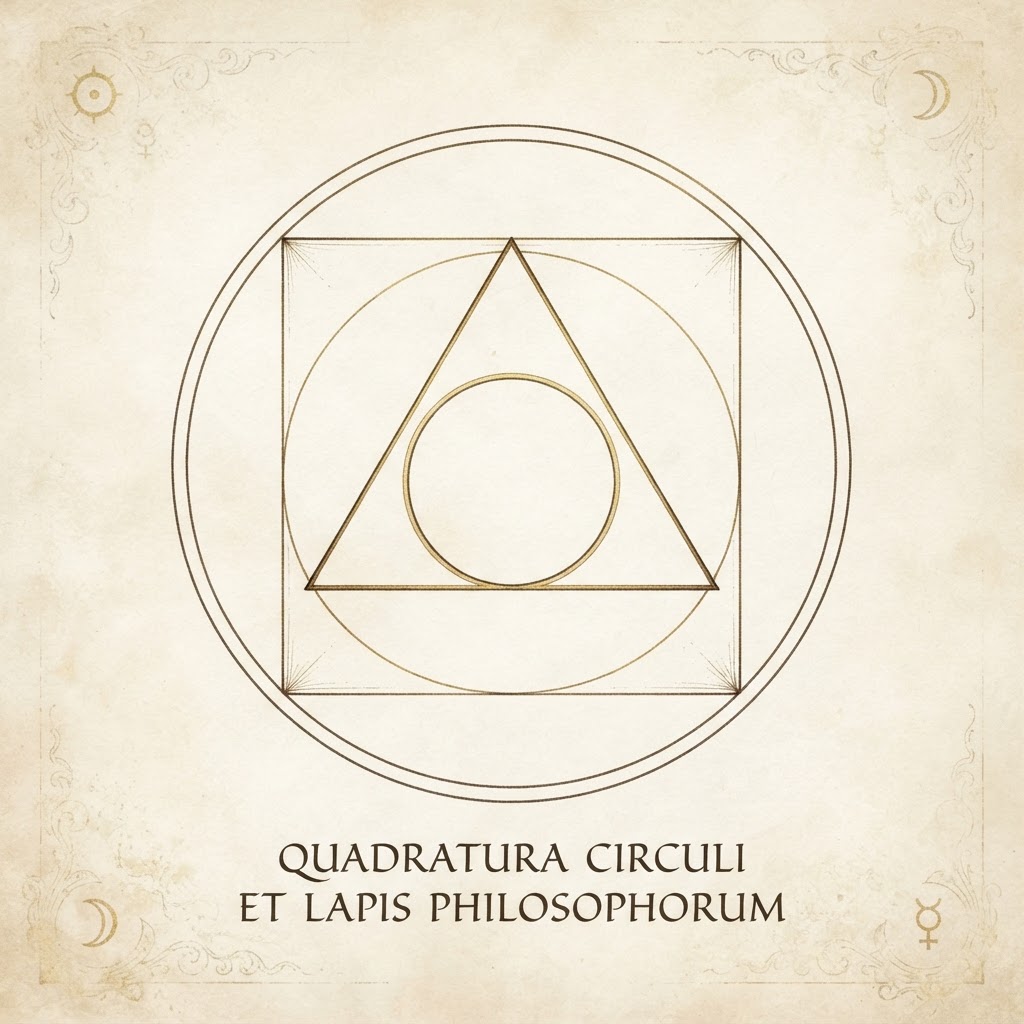
A geometric glyph showing a circle enclosing a square with a triangle and inner circle, representing the realization of the Philosopher's Stone.
Quick Facts
- Category
- Hermetic
- Culture / Origin
- Classical Greek / European Renaissance
- Geographic Origin
- Greece and Europe
- Historical Period
- Classical Antiquity through Renaissance
- Estimated Age
- circa 450 BCE (geometric roots), 1600 CE (Hermetic emblem)
- Element
- Ether/Spirit
- Planet
- Sun
- Chakra
- Heart, Crown
- Deities
- Hermes Trismegistus
- Verification
- unverified
What is Squaring the Circle?
Squaring the Circle is an ancient geometric conundrum transformed by Hermeticists into one of the most profound emblems of spiritual completion. While the mathematical problem involves constructing a square with the exact area of a given circle using only a compass and straightedge, the Hermetic symbol depicts a nested geometry: an outer circle enclosing a square, which in turn encloses a triangle containing a smaller central circle or human figure.
In this framework, the circle represents the infinite divine spirit, the square represents the four elements of physical reality, and the triangle denotes the threefold nature of human consciousness (Body, Soul, and Spirit). To 'square the circle' means to reconcile heaven and earth, unifying transcendent spiritual reality with tangible material existence, which is the exact definition of generating the Philosopher's Stone.
Meaning of Squaring the Circle
The emblem signifies the mystical integration of the infinite divine realm with the structured, finite physical universe.
Origin & History
The mathematical problem of squaring the circle originated in ancient Greece with thinkers such as Anaxagoras and Archimedes. Although proved mathematically impossible in Euclidean geometry by Ferdinand von Lindemann in 1882, ancient and medieval Hermetic philosophers recognized that its impossibility in physical drafting made it a perfect metaphor for spiritual miracles.
The famous visual emblem was celebrated in Michael Maier's 1617 alchemical classic 'Atalanta Fugiens' (Emblem XXI), accompanied by the verse: 'Make of man and woman a circle, then a square, out of this a triangle, make again a circle, and you will have the Stone of the Philosophers.' It was treated as an operative blueprint illustrating how disparate polarities could be permanently unified through divine harmony.
Spiritual Meaning
Spiritually, Squaring the Circle represents the culmination of the Great Work—the complete integration of conscious reality with transcendent spiritual awareness. The square, representing the rigid, dualistic four-cornered world of earthly limitations, must be rounded into the infinite, fluid perfection of the divine circle. Simultaneously, the boundless, ungrounded spirit must find structured, tangible manifestation within the physical plane.
It is the supreme symbol of psychological wholeness. By uniting the square of earthly structure with the circle of divine consciousness, the adept overcomes internal fragmentation. The symbol assures the seeker that material life is not a prison to be escaped, but a sacred canvas meant to express the perfection of the infinite soul.
Symbolism
The outer circle signifies infinite divine source; the square represents the four elements, physical embodiment, and structure; the triangle represents the three spiritual planes or the Tria Prima; the central point or inner circle represents the awakened human divine spark.
Traditional Uses
Interpreted as the visual formula for producing the Lapis Philosophorum (Philosopher's Stone), illustrating the balance of elements through mathematical proportions.
Modern Spiritual Uses
Commonly referenced in transpersonal psychology and sacred geometry as the ultimate visual model of integrated personality and cosmic self-realization.
Healing Associations
Used in meditative visualization to bring harmony between the physical body and subtle spiritual anatomy.
How the Symbol Is Used
- •Sacred Geometry
- •Alchemical Meditation
- •Theurgy
- •Jungian Psychology
Cultural Context
Classical Greek / European Renaissance — Greece and Europe (Classical Antiquity through Renaissance)
Sources & References
- 1.Atalanta Fugiens by Michael Maier (1617)
- 2.Psychology and Alchemy by Carl Gustav Jung
- 3.A Kabbalistic and Hermetic Study of the Monad by Arthur Edward Waite
This content is for educational and informational purposes only. Where modern spiritual interpretations are described, they are not presented as ancient historical facts. It is not a substitute for professional medical or spiritual advice.