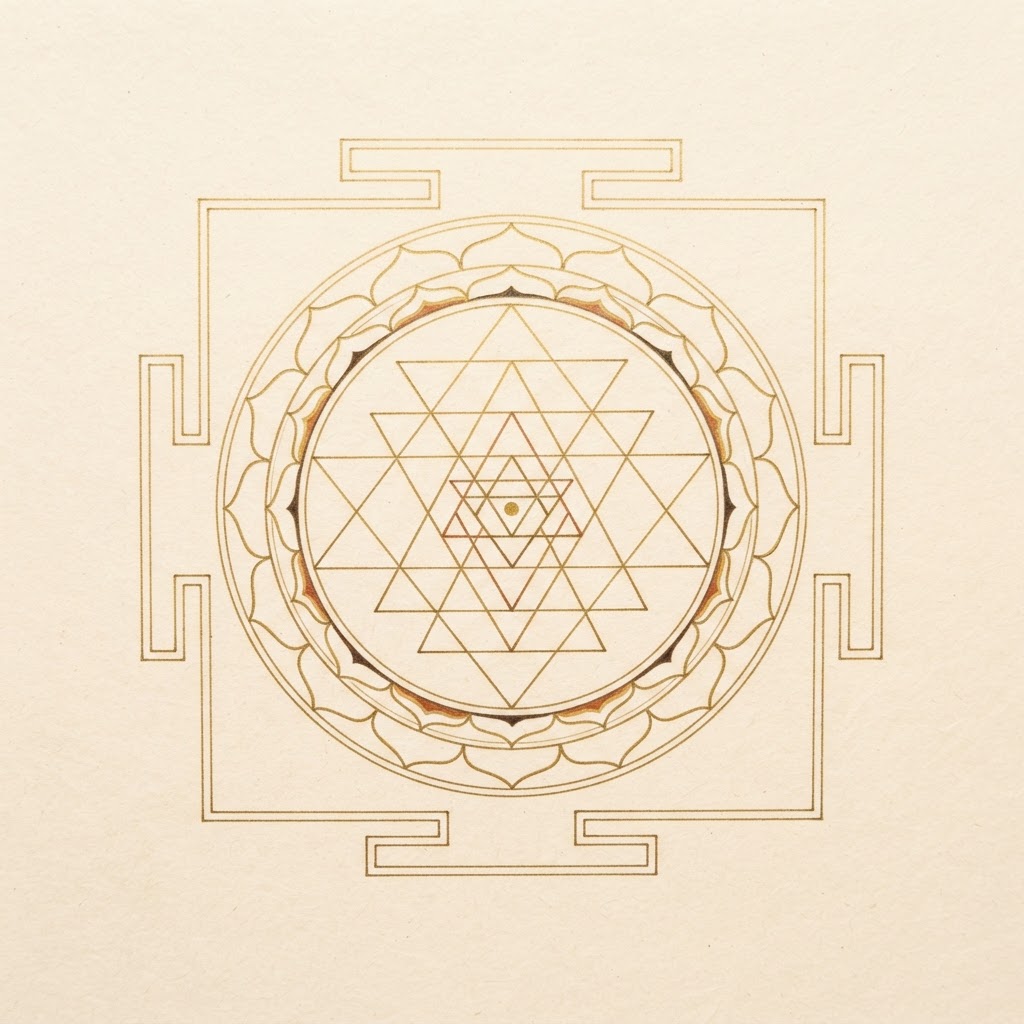
Shri Yantra: Meaning, Origin & Symbolism
Also known as: Sri Chakra, Yantra of Tripura Sundari
Hindu
Hindu
Heart Chakra
Third Eye Chakra
Crown Chakra
Ether/Spirit
Abundance
Spiritual Connection
Harmony
Transformation
The supreme sacred geometric diagram illustrating the non-dual union of masculine and feminine cosmic forces.
Quick Facts
- Category
- Hindu
- Culture / Origin
- Hindu
- Geographic Origin
- India
- Historical Period
- Early Medieval
- Estimated Age
- circa 7th Century CE
- Element
- Ether/Spirit
- Planet
- Venus
- Chakra
- Heart, Third Eye, Crown
- Zodiac
- Taurus, Libra
- Deities
- Tripura Sundari, Lakshmi, Lalita
- Verification
- unverified
What is Shri Yantra?
The Shri Yantra is a complex sacred geometric figure composed of nine interlocking triangles radiating outward from a central focal point called the Bindu. Four upward-pointing triangles represent the primordial masculine energy (Shiva), while five downward-pointing triangles represent the dynamic feminine power (Shakti).
The intersection of these nine primary triangles produces forty-three secondary triangles, encircled by concentric lotus petals and enclosed within an earthly perimeter known as the Bhupura. It is regarded in Tantric traditions as the crown jewel of yantras, capturing the entire architecture of creation.
It is both a cosmic map of universal manifestation and an internal blueprint of the human energetic matrix, employed as a visual vehicle for deep meditation and manifestation.
Meaning of Shri Yantra
The dynamic union of divine consciousness and creative energy manifesting the universe.
Origin & History
While early geometric ritual altars trace back to the Shulba Sutras of the late Vedic period, the precise mathematical configuration of the Shri Yantra flourished in the Shakta tradition of Sri Vidya around the mid-first millennium CE.
Philosophers like Adi Shankara installed the Shri Chakra at primary monastic institutions (mathas) across India, cementing its role as an orthodox spiritual focal point.
Spiritual Meaning
The Shri Yantra guides consciousness from multiplicity back into unity. Meditating from the outer square boundary to the central Bindu represents the involution of awareness into absolute unconditioned source.
It balances left and right hemisphere cognition, aligns subtle energy meridians, and awakens the practitioner's inner realization of abundance and non-separation.
Symbolism
The Bindu represents ultimate divine union; the downward triangles represent Shakti; the upward triangles represent Shiva. The concentric 8 and 16 lotus petals symbolize purity and sensory refinement, while the outer square signifies terrestrial manifestation.
Traditional Uses
The visual form of the Goddess Tripura Sundari; worshiping it is identical to worshiping the Divine Mother herself, yielding spiritual liberation and worldly prosperity.
Modern Spiritual Uses
Used in sacred geometry circles and meditation rooms as a visual tool to elevate focus, balance brainwaves, and cultivate abundance consciousness.
Healing Associations
Stimulates coherence in the biofield, promotes neural integration, and soothes mental exhaustion.
Protection Associations
Establishes a harmonious energetic boundary that shields spaces from discord and psychic turbulence.
How the Symbol Is Used
- •Sri Vidya upasana
- •Sacred geometry meditation
- •Vastu Shastra
- •Tantric puja
Cultural Context
Hindu — India (Early Medieval)
Sources & References
- 1.Tantra: The Path of Ecstasy by Georg Feuerstein
- 2.The Sri Cakra by S. Shankaranarayanan
This content is for educational and informational purposes only. Where modern spiritual interpretations are described, they are not presented as ancient historical facts. It is not a substitute for professional medical or spiritual advice.