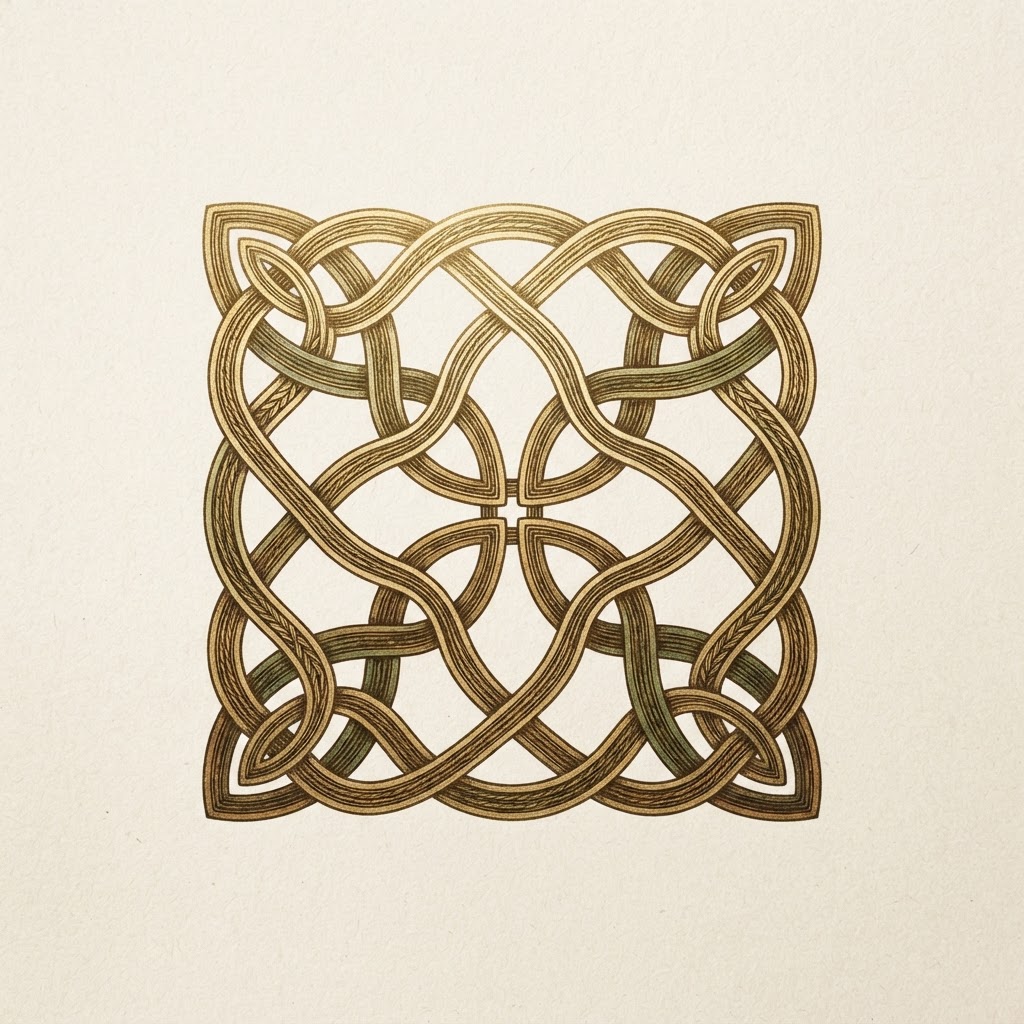
Celtic Shield Knot: Meaning, Origin & Symbolism
Also known as: Knot of Protection, Four-Cornered Knot
Celtic
Celtic
Root Chakra
Solar Plexus Chakra
Earth
Protection
Wisdom
Transformation
An ancient, square-based interlaced knot traditionally forged on shields and talismans to deflect malevolent forces.
Quick Facts
- Category
- Celtic
- Culture / Origin
- Celtic
- Geographic Origin
- Ireland, Scotland, and Northern Europe
- Historical Period
- Early Medieval
- Estimated Age
- circa 6th–9th Century CE
- Element
- Earth
- Planet
- Mars
- Chakra
- Root, Solar Plexus
- Zodiac
- Aries, Scorpio, Capricorn
- Deities
- The Morrígan, Lugh, Ogma
- Verification
- unverified
What is Celtic Shield Knot?
The Celtic Shield Knot is a specialized geometric knotwork motif defined by a tightly woven, four-cornered structure, often formed from a single continuous line that interweaves without termination. While stylized in numerous decorative variations—including rounded corners or crossed centers—its primary visual signature is a robust, four-sided square or diamond outline.
Rooted in both Insular Celtic and Norse decorative practices, the Shield Knot was routinely stamped or carved onto military shields, defensive weapons, home thresholds, and horse harnesses. The sheer complexity of its endless weave served as both a physical decoration and a psychological deterrent.
In both ancient and modern understanding, the Shield Knot stands as an emblem of inviolable boundaries. It provides a visual statement of inner strength, impenetrable spiritual defense, and unshakeable fortitude in the face of conflict or psychic distress.
Meaning of Celtic Shield Knot
The Shield Knot represents comprehensive warding, defensive strength, and impenetrable protection from external harm.
Origin & History
The Shield Knot grew out of earlier protective geomarkers used throughout Northwestern Europe, later codified during the golden age of Celtic interlacing between 600 and 1000 CE. Its practical purpose on shields and leather armor merged seamlessly with apotropaic folk beliefs, where unbroken knots were thought to bind or confuse negative energy.
Historical specimens can be found in stone carvings, grave slabs, and decorated metalwork across the Hiberno-Saxon and Pictish cultural spheres. When engraved on household doorways and sickbeds, it was believed to hold sickness and malevolent spirits at bay.
Spiritual Meaning
Spiritually, the four corners anchor the energies of the four elements, four cardinal directions, and the solid foundations of the manifest world. The looping lines weave an impenetrable psychic boundary, reminding the wearer of their inherent sovereignty.
It is used within spiritual development to seal one's auric field against psychic drainage, intrusive energies, and emotional vulnerability, providing an unshakeable inner fortress.
Symbolism
The four corners represent stability, earth, and dimensional completeness; the continuous loop symbolizes unbreakable energetic integrity and absolute containment.
Traditional Uses
Interpreted historically as a spiritual and martial aegis invoked to safeguard warriors in battle and secure households from misfortune.
Modern Spiritual Uses
Employed in contemporary paganism and crystal work as an amulet for energy protection, auric shielding, and grounding personal power.
Healing Associations
Aids in preventing chronic energy depletion and supports emotional recovery from boundary violations.
Protection Associations
Used extensively to ward against hostile intentions, banish malevolent spirits, and shield sensitive energetic states.
How the Symbol Is Used
- •Warding
- •Talisman Craft
- •Boundary Setting
- •Auric Sealing
Cultural Context
Celtic — Ireland, Scotland, and Northern Europe (Early Medieval)
Sources & References
- 1.Allen, J. Romilly. 'Celtic Art in Pagan and Christian Times.' Methuen & Co., 1904.
- 2.Laing, Lloyd. 'The Archaeology of Late Celtic Britain and Ireland.' Routledge, 1975.
This content is for educational and informational purposes only. Where modern spiritual interpretations are described, they are not presented as ancient historical facts. It is not a substitute for professional medical or spiritual advice.