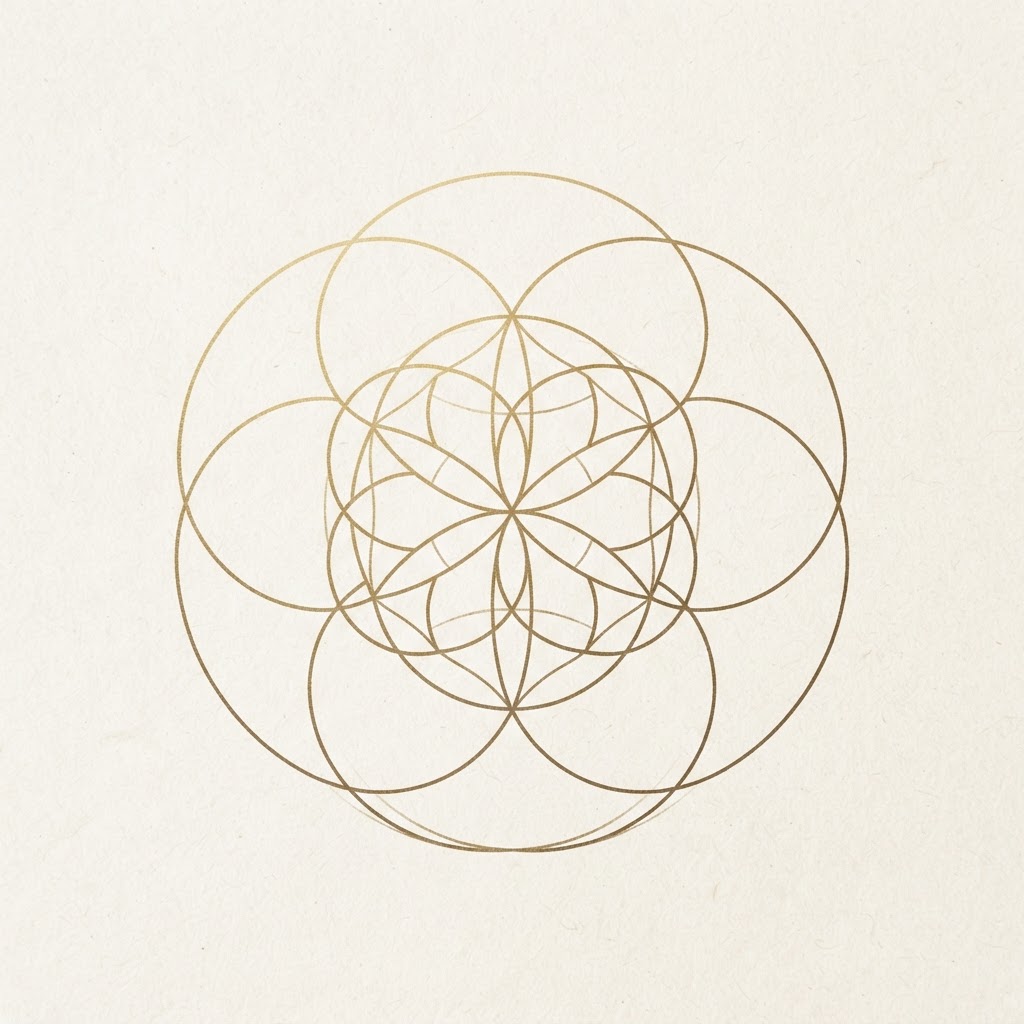
Seed of Life: Meaning, Origin & Symbolism
Also known as: Seven Circles, Pattern of Genesis, Hexagonal Rosette
Sacred Geometry
Universal / Ancient Near Eastern and Mediterranean
Root Chakra
Sacral Chakra
Solar Plexus Chakra
Earth
Creativity
Protection
Harmony
Healing
A universal geometric motif formed by seven overlapping circles arranged in six-fold rotational symmetry.
Quick Facts
- Category
- Sacred Geometry
- Culture / Origin
- Universal / Ancient Near Eastern and Mediterranean
- Geographic Origin
- Mesopotamia, Levant, and the Mediterranean
- Historical Period
- Bronze Age to Classical Antiquity
- Estimated Age
- circa 2000 BCE
- Element
- Earth
- Planet
- Sun
- Chakra
- Root, Sacral, Solar Plexus
- Verification
- unverified
What is Seed of Life?
The Seed of Life is an elementary sacred geometric figure constructed from seven interlocking circles of equal radius. One central circle is surrounded by six intersecting outer circles, with each outer circle centered on the circumference of the primary circle. This configuration produces a central six-petaled rosette surrounded by an outer floral perimeter. It serves as the primary component and preliminary stage of the larger Flower of Life lattice. Because of its structural seven-part division, it is often referred to in esoteric literature as the geometric manifestation of the seven stages of cosmic genesis.
Meaning of Seed of Life
The primordial blueprint of physical manifestation and the seven foundational cycles of creation.
Origin & History
The Seed of Life is one of the most prolific geometric motifs excavated in archaeological sites worldwide. Early examples appear on Bronze Age pottery, Celtic stone carvings, Roman architectural pavements, and early Jewish ossuaries from the Second Temple period. It also featured prominently as an apotropaic folk carving, frequently inscribed on wooden door headers, agricultural barns, and metal talismans across Western and Eastern Europe well through the nineteenth century to protect grain and livestock.
Spiritual Meaning
The Seed of Life represents the original impulse of creation and the unfolding of conscious order from the void. The first circle corresponds to the uncreated Source, while the following six circles mirror the directional expansion of light across the six spatial axes (north, south, east, west, above, and below). It symbolizes biological fertility, cellular genesis, and the birth of consciousness into physical form, reminding the practitioner of the natural ease with which life naturally reproduces, organizes, and flourishes.
Symbolism
The seven circles embody the seven days of Genesis, the seven classical planets, the seven musical tones, and the primary chakras. The six-fold petals symbolize balance, fertility, and organic harmony.
Traditional Uses
Historically understood as a universal apotropaic charm, a solar rosette, and a foundational geometric exercise in drafting.
Modern Spiritual Uses
Regarded as a powerful visual tool for manifesting new beginnings, blessing biological conception, and grounding creative endeavors.
Healing Associations
Used to encourage physical cellular vitality, stress release, and harmonic emotional integration.
Protection Associations
Inscribed across European and Mediterranean cultures as a folk talisman to repel lightning, witchcraft, and decay.
How the Symbol Is Used
- •Manifestation rituals
- •Folk talismanic magic
- •Crystal grid design
- •Sacred drawing
Cultural Context
Universal / Ancient Near Eastern and Mediterranean — Mesopotamia, Levant, and the Mediterranean (Bronze Age to Classical Antiquity)
Sources & References
- 1.Ghyka, Matila. The Geometry of Art and Life. Dover Publications, 1977.
- 2.Hale, Christopher. Sacred Geometry: The Timeless Science of Order and Form. Watkins, 2018.
This content is for educational and informational purposes only. Where modern spiritual interpretations are described, they are not presented as ancient historical facts. It is not a substitute for professional medical or spiritual advice.