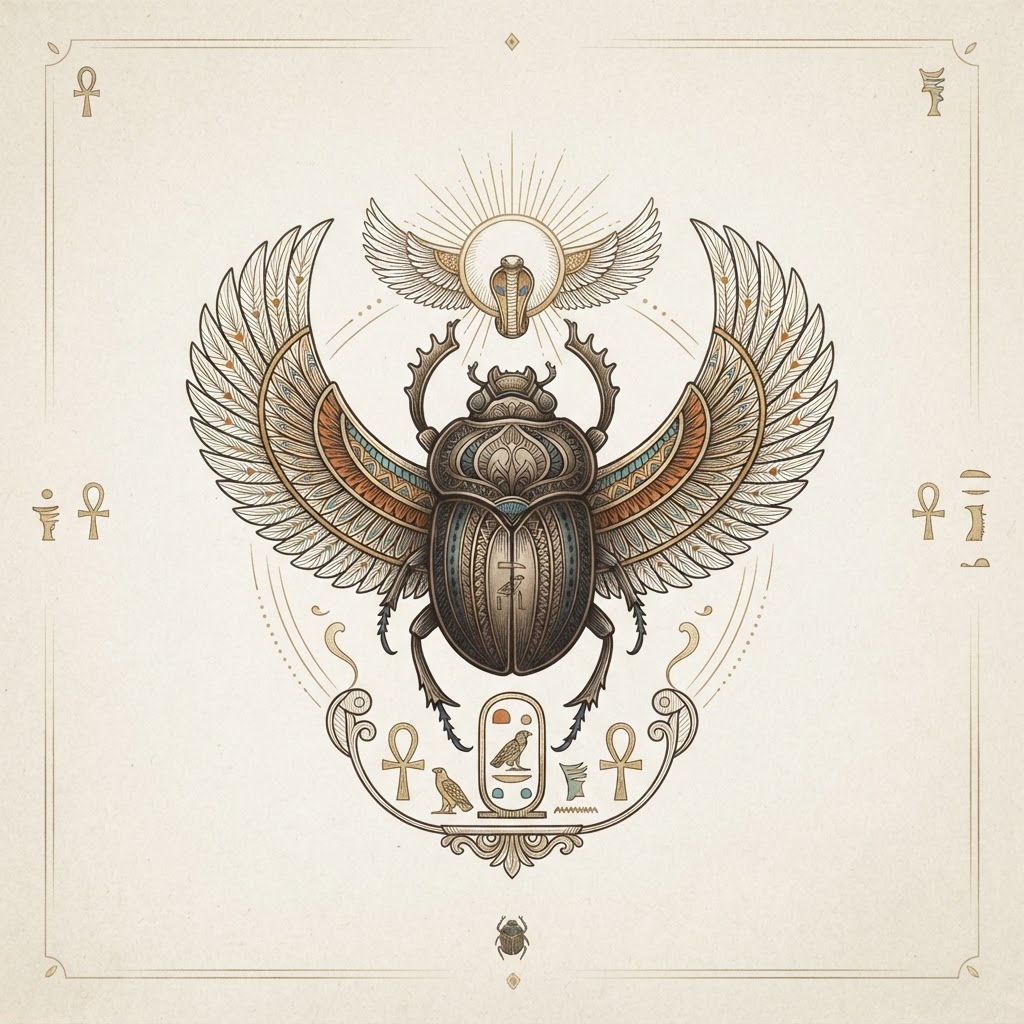
Scarab Beetle: Meaning, Origin & Symbolism
Also known as: Khepri, Kheper, Dung Beetle
Ancient Egyptian
Ancient Egyptian
Solar Plexus Chakra
Heart Chakra
Fire
Transformation
Protection
Vitality
The Scarab is a profound Egyptian symbol of rebirth, spontaneous generation, transformation, and the rising sun.
Quick Facts
- Category
- Ancient Egyptian
- Culture / Origin
- Ancient Egyptian
- Geographic Origin
- Nile River Valley, Egypt
- Historical Period
- Old Kingdom through Roman Period
- Estimated Age
- circa 2600 BCE
- Element
- Fire
- Planet
- Sun
- Chakra
- Solar Plexus, Heart
- Zodiac
- Aries, Leo
- Deities
- Khepri, Ra, Atum
- Verification
- unverified
What is Scarab Beetle?
The Scarab Beetle, modeled on the species Scarabaeus sacer, is one of the most recognizable icons of ancient Egyptian spiritual culture. The Egyptians observed the beetle rolling balls of animal dung across the ground and depositing them in subterranean burrows, from which new beetles later emerged as if spontaneously created.
This behavior was mirrored in cosmic terms: Egyptians saw the scarab rolling the blazing orb of the sun across the sky every morning. Consequently, the scarab became personified as Khepri, the god of the dawn, whose name derives from the Egyptian verb 'kheper,' meaning 'to come into being' or 'to transform'.
Scarabs were produced by the millions in faience, steatite, gold, and carnelian. They served as seals, royal commemorative medallions, and crucial funerary talismans placed over the heart of mummies to protect the soul during the weighing of the heart in the Hall of Ma'at.
Meaning of Scarab Beetle
The Scarab denotes resurrection, self-generation, solar renewal, and eternal transformation.
Origin & History
Scarabs were used in daily life as administrative sealstones inscribed with names, titles, and protective prayers. In funerary practices, large 'Heart Scarabs' inscribed with Chapter 30B of the Book of the Dead were set upon the breast of the deceased.
This magical inscription commanded the heart not to betray its owner or testify against them during judgment before Osiris, ensuring favorable passage into the afterlife.
Spiritual Meaning
In spiritual contexts, the Scarab illustrates that life emerges perpetually from death and decay, symbolizing the eternal cycle of spiritual evolution.
It inspires individuals to find light and revitalization within the depths of darkness, fostering personal metamorphosis and the rebirth of consciousness.
Symbolism
The rolled sphere symbolizes the solar disk and the unfolding universe; the beetle's wings signify divine elevation; its emergence from darkness represents resurrection.
Traditional Uses
Traditionally viewed as a manifestation of Khepri, granting the deceased the power to regenerate their spiritual body (Sah) and traverse the underworld safely.
Modern Spiritual Uses
Modern interpretations frame the scarab as a symbol of personal reinvention, resilience against hardship, and intentional self-manifestation.
Healing Associations
Associated with cellular renewal, cardiac vitality, and emotional cleansing.
Protection Associations
Heart scarabs protected the soul from self-condemnation and judgment during the Weighing of the Heart.
How the Symbol Is Used
- •Ritual magic
- •Talisman making
- •Shadow work
Cultural Context
Ancient Egyptian — Nile River Valley, Egypt (Old Kingdom through Roman Period)
Sources & References
- 1.Andrews, Carol. 'Amulets of Ancient Egypt.' British Museum Press, 1994.
- 2.Shaw, Ian. 'The Oxford History of Ancient Egypt.' Oxford University Press, 2000.
This content is for educational and informational purposes only. Where modern spiritual interpretations are described, they are not presented as ancient historical facts. It is not a substitute for professional medical or spiritual advice.