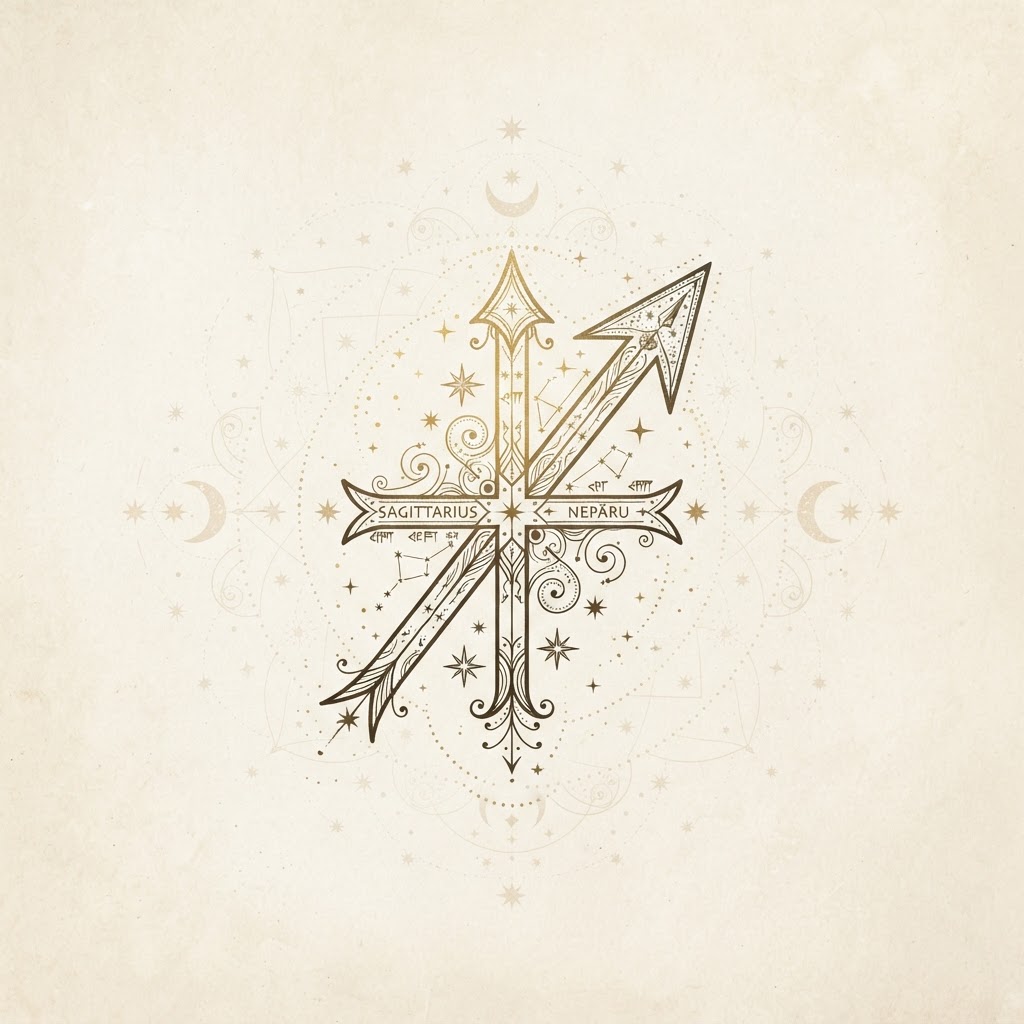
Sagittarius Glyph: Meaning, Origin & Symbolism
Also known as: The Archer, The Centaur, Sagittarius Symbol
Zodiac
Babylonian and Hellenistic
Third Eye Chakra
Solar Plexus Chakra
Fire
Wisdom
Transformation
Vitality
Abundance
The Sagittarius glyph is an upward-angled arrow intersected by a crossbar, symbolizing the drawn bow of the celestial Archer.
Quick Facts
- Category
- Zodiac
- Culture / Origin
- Babylonian and Hellenistic
- Geographic Origin
- Mesopotamia and Mediterranean
- Historical Period
- Classical Antiquity
- Estimated Age
- circa 2000 BCE
- Element
- Fire
- Planet
- Jupiter
- Chakra
- Third Eye, Solar Plexus
- Zodiac
- Sagittarius
- Deities
- Zeus, Jupiter, Chiron, Pabilsag
- Verification
- unverified
What is Sagittarius Glyph?
The Sagittarius glyph is an ascending arrow pointing toward the upper-right, crossed by a horizontal stave representing the bow or the centaur's physical anchor. As mutable fire, Sagittarius personifies philosophical questing, expansive horizons, truth-seeking, and optimism.
Depicted mythologically as a centaur or archer aiming toward the galactic center, the symbol conveys the human aspiration to transcend animalistic confines and loose the arrow of wisdom toward higher spiritual planes.
Meaning of Sagittarius Glyph
The Sagittarius glyph represents the pursuit of higher truth, philosophical expansion, aspiration, and boundless exploration.
Origin & History
Sagittarius traces to the Babylonian Pabilsag, a winged centaur god with a scorpion's tail and drawn bow, representing swiftness and divine retribution. In Hellenistic times, it became linked with the wise centaur Chiron or Crotus, son of Pan and inventor of archery.
Standing in the dense star fields toward the Milky Way's core, the Archer was venerated across ancient cultures as an emblem of foreign journeying, broad philosophical discovery, and celestial guidance.
Spiritual Meaning
Esoterically, the arrow symbolizes focused intention released toward divine realization. The horizontal bar keeps the arrow anchored in material reality, ensuring that grand visions remain grounded in lived ethical application.
It inspires faith in cosmic providence, celebrating life as a grand pilgrimage of the soul seeking unity with universal law.
Symbolism
The arrow denotes focused spiritual aspiration and forward trajectory, while the intersecting crossbar represents the material bow and the animal nature grounded on earth.
Traditional Uses
Ruled by Jupiter, Sagittarius is diurnal, hot, and dry. It governs religion, jurisprudence, long-distance voyages, prophecy, academic higher learning, and anatomically rules the hips, thighs, and sciatic nerve.
Modern Spiritual Uses
Modern astrologers view Sagittarius as the archetypal seeker, embodying cross-cultural understanding, optimism, existential inquiry, and personal freedom.
Healing Associations
Associated with liver health, mobility of hips and thighs, and dispelling depressive pessimism.
Protection Associations
Used historically to protect long-distance voyagers and safeguard seekers of philosophical truth.
How the Symbol Is Used
- •Western Astrology
- •Philosophical Contemplation
- •Pilgrimages
- •Vision Questing
Cultural Context
Babylonian and Hellenistic — Mesopotamia and Mediterranean (Classical Antiquity)
Sources & References
- 1.Marcus Manilius, Astronomica
- 2.Ptolemy, Tetrabiblos
- 3.Dane Rudhyar, The Astrological Houses
This content is for educational and informational purposes only. Where modern spiritual interpretations are described, they are not presented as ancient historical facts. It is not a substitute for professional medical or spiritual advice.