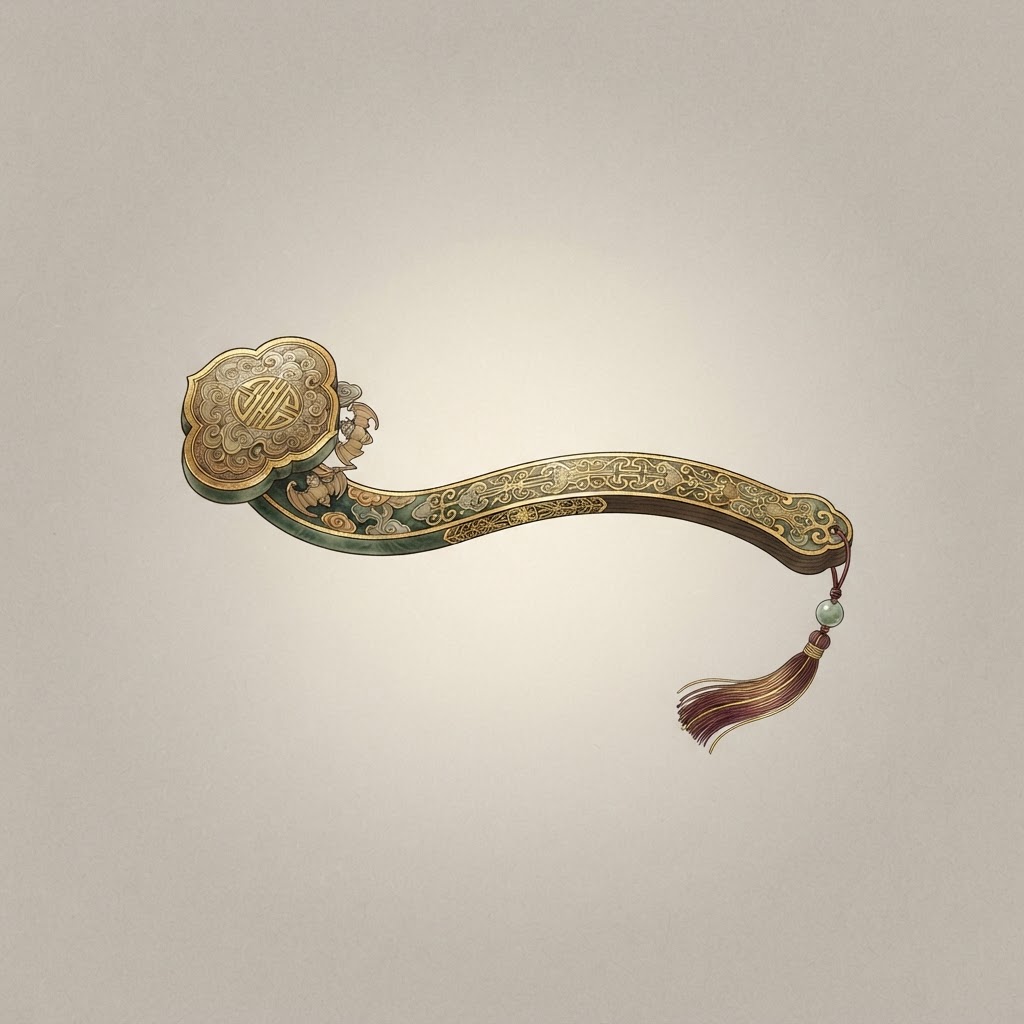
Ruyi Scepter: Meaning, Origin & Symbolism
Also known as: As-You-Wish Scepter, Ceremonial Scepter
Taoist/Chinese
Taoist/Chinese
Solar Plexus Chakra
Crown Chakra
Earth
Manifestation
Prosperity
Wisdom
Harmony
An ornamental curved scepter symbolizing supreme authority, good fortune, and the fulfillment of one's spiritual desires.
Quick Facts
- Category
- Taoist/Chinese
- Culture / Origin
- Taoist/Chinese
- Geographic Origin
- China
- Historical Period
- Han to Qing Dynasties
- Estimated Age
- circa 200 CE
- Element
- Earth
- Planet
- Jupiter
- Chakra
- Solar Plexus, Crown
- Deities
- Three Pure Ones, Caishen (God of Wealth)
- Verification
- unverified
What is Ruyi Scepter?
The Ruyi is an ornamental, curved scepter with an S-shaped handle and a head modeled after a cloud or a sacred Lingzhi mushroom. Its name translates literally to 'as you wish' or 'according to your will,' expressing its core role as an emblem of successful manifestation, spiritual sovereignty, and auspicious authority. Initially starting as a humble backscratcher and later evolving into a scholar's pointer, the Ruyi was adopted by Taoist masters and imperial monarchs as an emblem of sacred authority and moral integrity. Crafted from jade, gold, lacquer, or rare woods, the Ruyi is often held by celestial deities in traditional iconography. It represents not the brute enforcement of will, but rather the ease of manifestation that occurs when human intention aligns effortlessly with the Tao.
Meaning of Ruyi Scepter
The effortless realization of noble intentions, high authority, and continuous good fortune.
Origin & History
While early prototypes served practical purposes during the Han dynasty, the Ruyi developed into a revered courtly and spiritual object during the Six Dynasties period. Taoist scholars held it during philosophical debates (Qingtanh) to signal their right to speak. By the Qing Dynasty, the Ruyi reached the pinnacle of its artistic prestige, routinely presented to the emperor, royal consorts, and visiting diplomats as an offering of auspicious blessings and imperial favor.
Spiritual Meaning
The Ruyi signifies the alignment of individual intention with divine universal flow. It embodies the truth that when one's heart desires harmony and follows natural law, obstacles dissolve naturally, allowing life to unfold 'as one wishes' without coercive force.
Symbolism
The head of the scepter, shaped like a Lingzhi mushroom or cloud, represents immortality and celestial connection, while the gentle curves of the handle mirror flexibility and flowing water.
Traditional Uses
Held by high dignitaries, scholars, and religious masters to signify moral authority, high office, and auspicious harmony.
Modern Spiritual Uses
Used in modern interiors and offices to attract clear leadership presence, career advancement, and smooth project manifestation.
Healing Associations
Serves as an archetype for releasing mental conflict and bringing peace to an overactive, willful ego.
Protection Associations
Placed in prominent locations to avert bureaucratic obstacles and dispel disharmonious interactions.
How the Symbol Is Used
- •Feng Shui
- •Daoist Liturgy
- •Scholarly Contemplation
Cultural Context
Taoist/Chinese — China (Han to Qing Dynasties)
Sources & References
- 1.Kieschnick, John. The Impact of Buddhism on Chinese Material Culture. Princeton University Press, 2003.
- 2.Eberhard, Wolfram. A Dictionary of Chinese Symbols. Routledge, 1986.
This content is for educational and informational purposes only. Where modern spiritual interpretations are described, they are not presented as ancient historical facts. It is not a substitute for professional medical or spiritual advice.