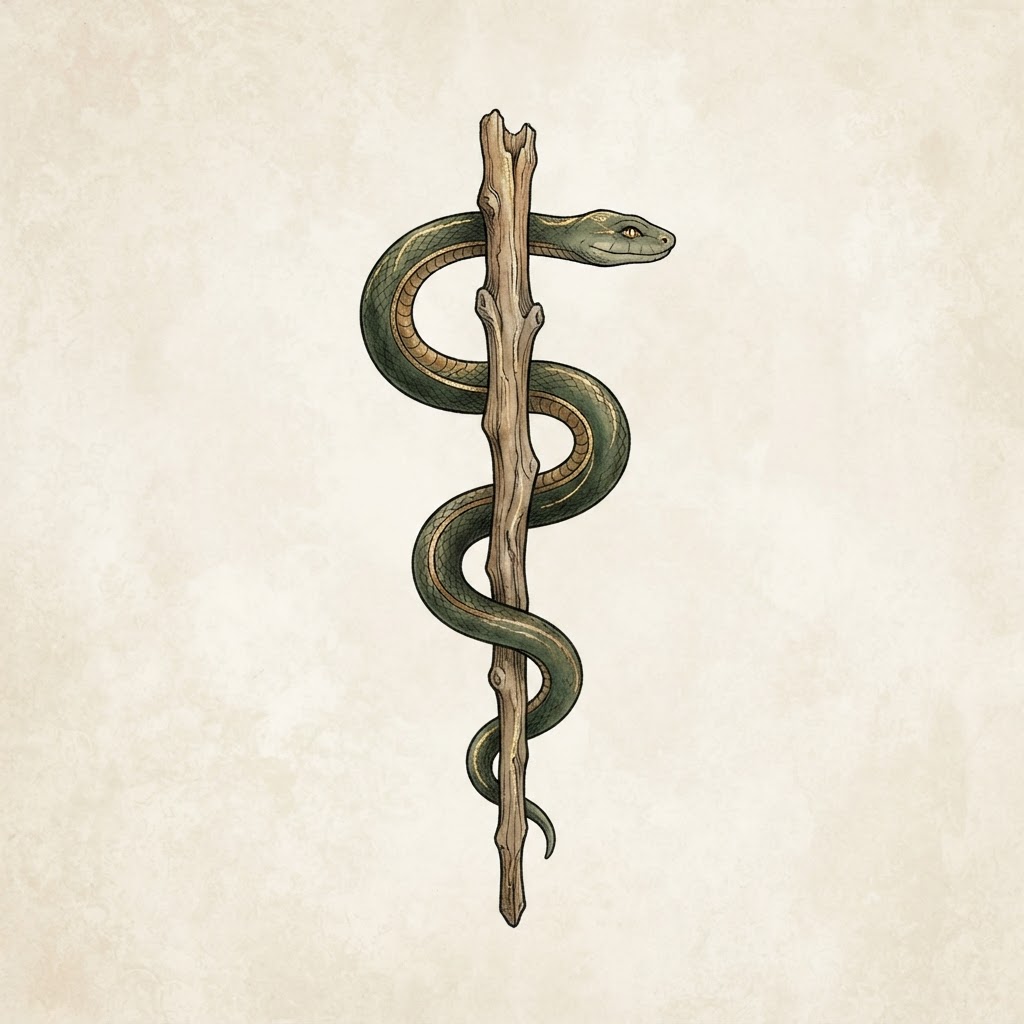
Rod of Asclepius: Meaning, Origin & Symbolism
Also known as: Staff of Asclepius, Asklepian Rod
Greek & Roman
Ancient Greek & Roman
Root Chakra
Heart Chakra
Earth
Healing
Transformation
Vitality
Wisdom
An ancient Greek symbol featuring a single serpent entwined around a rough wooden staff, representing healing, medicine, and renewal.
Quick Facts
- Category
- Greek & Roman
- Culture / Origin
- Ancient Greek & Roman
- Geographic Origin
- Greece and the Mediterranean Basin
- Historical Period
- Classical Antiquity
- Estimated Age
- circa 1200 BCE - 500 BCE
- Element
- Earth
- Planet
- Sun
- Chakra
- Root, Heart
- Zodiac
- Virgo, Ophiuchus
- Deities
- Asclepius, Apollo, Hygieia, Aesculapius
- Verification
- unverified
What is Rod of Asclepius?
The Rod of Asclepius is an ancient Greek emblem consisting of a single serpent coiled around a rough wooden staff. It is the authentic classical attribute of Asclepius, the Greco-Roman god of medicine, healing, and physicians. Unlike the two-snaked Caduceus, the Rod of Asclepius has remained the primary historical emblem of medical practitioners since antiquity.
Historically, the symbol derived from the practices of the Asclepeia—sanctuary complexes where pilgrims sought divine healing and dream incubation. The non-venomous Aesculapian snake was kept free-roaming in these shrines, serving as an intermediary between the mortal realm and divine restorative forces. The staff itself represents the physician's itinerant journey and foundational support.
Today, the Rod of Asclepius remains widely recognized globally as the preeminent insignia of legitimate medical institutions, including the World Health Organization, maintaining its unbroken lineage of meaning spanning nearly three millennia.
Meaning of Rod of Asclepius
The Rod of Asclepius fundamentally represents the restorative arts of medicine, ethical physician care, and physical healing.
Origin & History
The worship of Asclepius arose in Thessaly and spread across the Greek world, reaching Epidaurus, which became the god's foremost sanctuary. Healing rituals known as 'enkoimesis' involved suppliants sleeping in holy chambers, where Asclepius or his sacred serpents were believed to visit them in dreams with remedies.
When a severe plague struck Rome in 293 BCE, the Roman Senate consulted the Sibylline Books and dispatched an embassy to Epidaurus. Legend states that a sacred serpent slithered onto the Roman ship and chose Tiber Island as its home, leading to the foundation of the Temple of Aesculapius and cementing the staff's reverence in Roman culture.
Spiritual Meaning
Spiritually, the Rod of Asclepius embodies the integration of chthonic earth energies with celestial wisdom. The serpent sheds its skin, signifying spiritual metamorphosis, resurrection, and the eternal cycle of life emerging from decay.
The central wooden staff acts as an axis mundi, anchoring cosmic restorative light into physical form, reminding the seeker that spiritual wholeness requires grounding, endurance, and alignment between higher consciousness and earthly biology.
Symbolism
The wooden staff denotes physical support, moral integrity, and the wandering pilgrimage of the healer; the entwined serpent symbolizes rejuvenation, vitality, wisdom, and the dual nature of medicine as both venom and cure.
Traditional Uses
In classical theology, the rod belonged to Asclepius, conveying his divine authority to restore balance to humors and resurrect the sick through sacred knowledge and communion with nature.
Modern Spiritual Uses
Modern holistic and wellness disciplines view the symbol as an archetype of self-healing, cellular renewal, and the balance of physical and metaphysical equilibrium.
Healing Associations
Central to traditional medicine, energy healing, therapeutic alignment, and recovery from trauma or chronic illness.
Protection Associations
Used historically as an apotropaic charm against pestilence, sudden death, and infectious disease.
How the Symbol Is Used
- •Dream incubation
- •Holistic medicine
- •Esoteric healing meditations
- •Apotropaic wards
Cultural Context
Ancient Greek & Roman — Greece and the Mediterranean Basin (Classical Antiquity)
Sources & References
- 1.Edelstein, Emma J. and Ludwig Edelstein. 'Asclepius: Collection and Interpretation of the Testimonies'. Johns Hopkins University Press.
- 2.Hart, Gerald D. 'Asclepius: The God of Medicine'. Royal Society of Medicine Press.
This content is for educational and informational purposes only. Where modern spiritual interpretations are described, they are not presented as ancient historical facts. It is not a substitute for professional medical or spiritual advice.