The Rebis: Meaning, Origin & Symbolism
Also known as: The Hermetic Androgyne, Res Bis, The Divine Hermaphrodite
Alchemical
European Renaissance
Heart Chakra
Third Eye Chakra
Crown Chakra
Ether/Spirit
Transformation
Wisdom
Love
A profound alchemical emblem depicting an integrated, dual-headed figure that symbolizes the reconciliation of all opposites.
Quick Facts
- Category
- Alchemical
- Culture / Origin
- European Renaissance
- Geographic Origin
- Central and Western Europe
- Historical Period
- Late Medieval to Renaissance
- Estimated Age
- circa 1417 CE
- Element
- Ether/Spirit
- Chakra
- Heart, Third Eye, Crown
- Zodiac
- Gemini, Libra
- Deities
- Hermaphroditos, Ardhanarishvara
- Verification
- unverified
What is The Rebis?
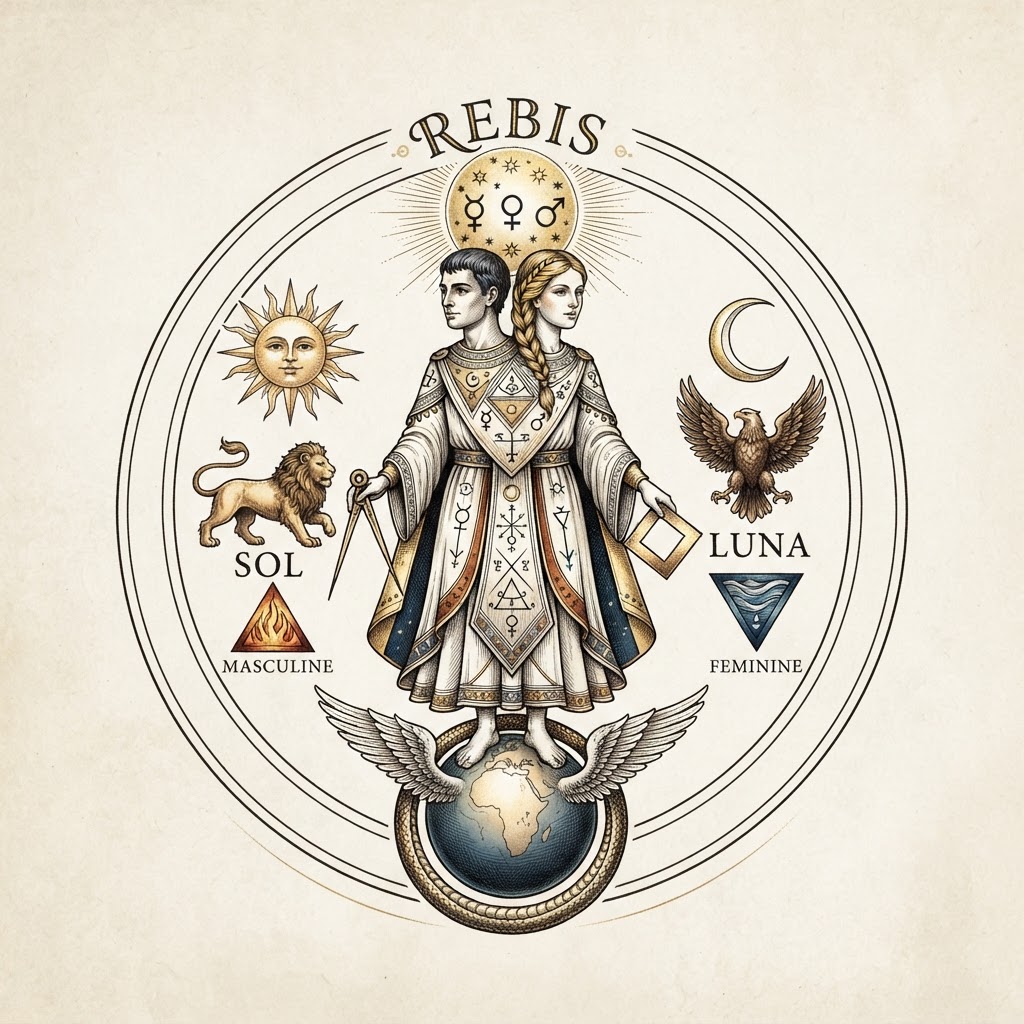
The Rebis, derived from the Latin 'res bis' meaning 'two-fold matter', is an iconic emblem from late Renaissance alchemy. It is conventionally illustrated as an integrated human figure with two heads—one male, one female—standing upon a dragon or a winged globe and holding symbolic instruments like a compass and square.
The Rebis represents the triumphant climax of the Great Work, symbolizing the reconciliation and transcended union of all earthly and cosmic dualities: solar and lunar, conscious and unconscious, active and receptive. It portrays humanity returned to its original, spiritually undivided wholeness.
Meaning of The Rebis
The complete unification of polar opposites into a transcendent spiritual whole.
Origin & History
The symbol achieved wide recognition following its inclusion in Heinrich Khunrath's 'Amphitheatrum Sapientiae Aeternae' (1609) and the earlier 'Theoria Philosophiae Hermeticae'. It traces back conceptually to Platonic myths of original human wholeness and Hermetic views on the androgynous nature of God.
Throughout the 16th and 17th centuries, the Rebis was engraved into foundational alchemical compendiums as an allegorical roadmap for the psychic integration necessary to create the Philosopher's Stone.
Spiritual Meaning
Spiritually, the Rebis signifies the inner Mysterium Coniunctionis—the sacred marriage of inner anima and animus, conscious ego and unconscious shadow. It marks the attainment of spiritual androgyny, wherein one transcends gendered or dualistic cognitive limitations.
It is the state of divine poise, where personal conflict ceases and the soul perceives the singular divine essence operating behind all dualistic phenomena.
Symbolism
The male head represents the Sun, sulfur, and conscious rationality; the female head represents the Moon, mercury, and intuitive feeling. The winged sphere or dragon beneath represents conquered chaos and mastered prima materia.
Traditional Uses
Historically understood as the ultimate chemical and spiritual fusion required to produce the Philosopher's Stone.
Modern Spiritual Uses
In depth psychology and contemporary wellness, it represents wholeness, balance between masculine and feminine energies, and deep internal self-acceptance.
Healing Associations
Associated with resolving inner conflict, healing relational trauma, and integrating fragmented aspects of identity.
Protection Associations
Used to guard against psychological fragmentation, cognitive dissonance, and inner polarization.
How the Symbol Is Used
- •Shadow work
- •Archetypal meditation
- •Polarity balancing
Cultural Context
European Renaissance — Central and Western Europe (Late Medieval to Renaissance)
Sources & References
- 1.Khunrath, Heinrich, Amphitheatrum Sapientiae Aeternae
- 2.Jung, C. G., Mysterium Coniunctionis
- 3.Roob, Alexander, Alchemy & Mysticism
This content is for educational and informational purposes only. Where modern spiritual interpretations are described, they are not presented as ancient historical facts. It is not a substitute for professional medical or spiritual advice.