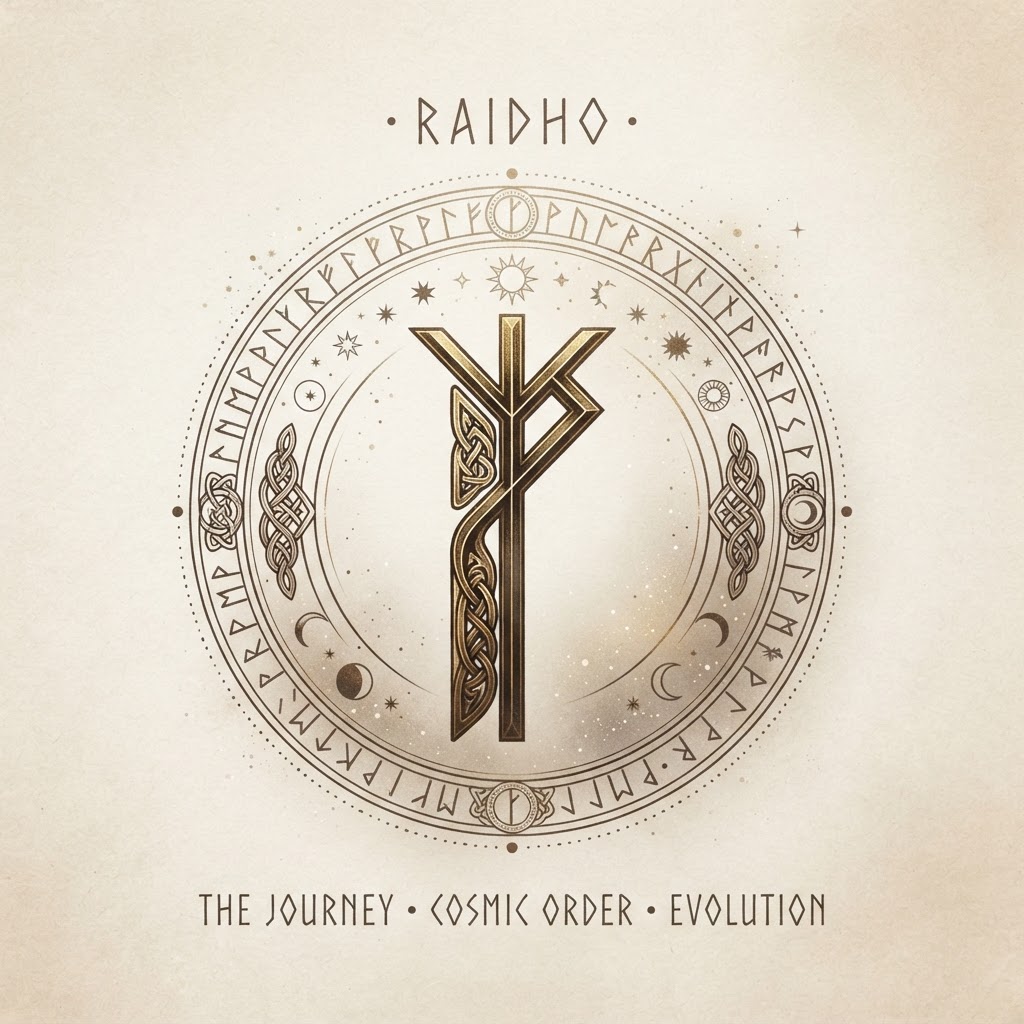
Raidho: Meaning, Origin & Symbolism
Also known as: Rad, Reidh, Raido
Elder Futhark Runes
Germanic
Solar Plexus Chakra
Root Chakra
Air
Direction
Balance
Transformation
Wisdom
The rune of the journey, cosmic order, right action, and personal evolution along life's path.
Quick Facts
- Category
- Elder Futhark Runes
- Culture / Origin
- Germanic
- Geographic Origin
- Northern Europe
- Historical Period
- Migration Period
- Estimated Age
- circa 150 CE
- Element
- Air
- Planet
- Jupiter
- Chakra
- Solar Plexus, Root
- Zodiac
- Sagittarius
- Deities
- Thor, Forseti, Njord
- Verification
- unverified
What is Raidho?
Raidho is the fifth rune of the Elder Futhark, translating to 'riding' or 'wagon-travel.' Beyond literal transit on horseback or cart, it governs the cyclical, ordered motion of the cosmos, the changing of seasons, and the rhythmic progression of time.
In Northern thought, Raidho is closely tied to cosmic law, custom, and the concept of doing what is just and in accordance with order. It represents the path taken by the soul, demanding that one's inner moral compass align with outward actions.
Raidho is rhythm itself: the trot of a horse, the beat of a drum, the steady movement of the stars. It provides structural momentum, transforming chaotic desire into purposeful, directed progression.
Meaning of Raidho
Riding, journey, vehicle, natural law, rhythm, and purposeful travel.
Origin & History
Reconstructed from Proto-Germanic *raidō, the glyph is frequently found on amulets intended to preserve travelers from perils on long journeys through wilderness and hostile territories.
The Anglo-Saxon rune poem describes 'Rad' as comfortable for the warrior seated indoors, but arduous for him who rides upon a stout horse over the mile-paths, capturing both the ideal of organized motion and its real physical toll.
Spiritual Meaning
Spiritually, Raidho represents the initiation of purposeful movement along one's wyrd (destiny). It advises active participation in one's evolution rather than passive drifting.
It speaks to living in harmony with cosmic rhythms and internal cycles. When life appears disordered, Raidho acts as a guiding compass, aligning personal will with universal order and ethical balance.
Symbolism
The glyph suggests a stylized bent leg in the act of striding, or a rider upon a mount, illustrating focused trajectory, steady pace, and dynamic balance.
Traditional Uses
Historically signaled physical travel, horse voyages, legal negotiations, and the restoration of orderly affairs after conflict.
Modern Spiritual Uses
Used modernly for spiritual journeying, astral travel, ensuring safe vacations, and re-establishing routine during periods of chaos.
Healing Associations
Relieving circulatory issues, aligning spinal posture, restoring biological circadian rhythms.
Protection Associations
Protecting vehicles, travelers, and navigating safely through unfamiliar territories.
How the Symbol Is Used
- •Astral Travel
- •Shamanic Journeying
- •Travel Talismans
- •Divination
Cultural Context
Germanic — Northern Europe (Migration Period)
Sources & References
- 1.The Anglo-Saxon Rune Poem
- 2.Runes: Reading the Past by R.I. Page
- 3.Taking Up the Runes by Diana L. Paxson
This content is for educational and informational purposes only. Where modern spiritual interpretations are described, they are not presented as ancient historical facts. It is not a substitute for professional medical or spiritual advice.