Philosopher's Stone: Meaning, Origin & Symbolism
Also known as: Lapis Philosophorum, The Elixir, Tincture
Alchemical
Greco-Egyptian and European Medieval
Crown Chakra
Solar Plexus Chakra
Ether/Spirit
Transformation
Wisdom
Healing
The supreme goal of Western alchemy, capable of transmuting base metals into gold and granting spiritual immortality.
Quick Facts
- Category
- Alchemical
- Culture / Origin
- Greco-Egyptian and European Medieval
- Geographic Origin
- Near East and Europe
- Historical Period
- Medieval to Renaissance
- Estimated Age
- circa 300 CE
- Element
- Ether/Spirit
- Planet
- Sun
- Chakra
- Crown, Solar Plexus
- Zodiac
- Leo
- Deities
- Apollo, Hermes Trismegistus
- Verification
- unverified
What is Philosopher's Stone?
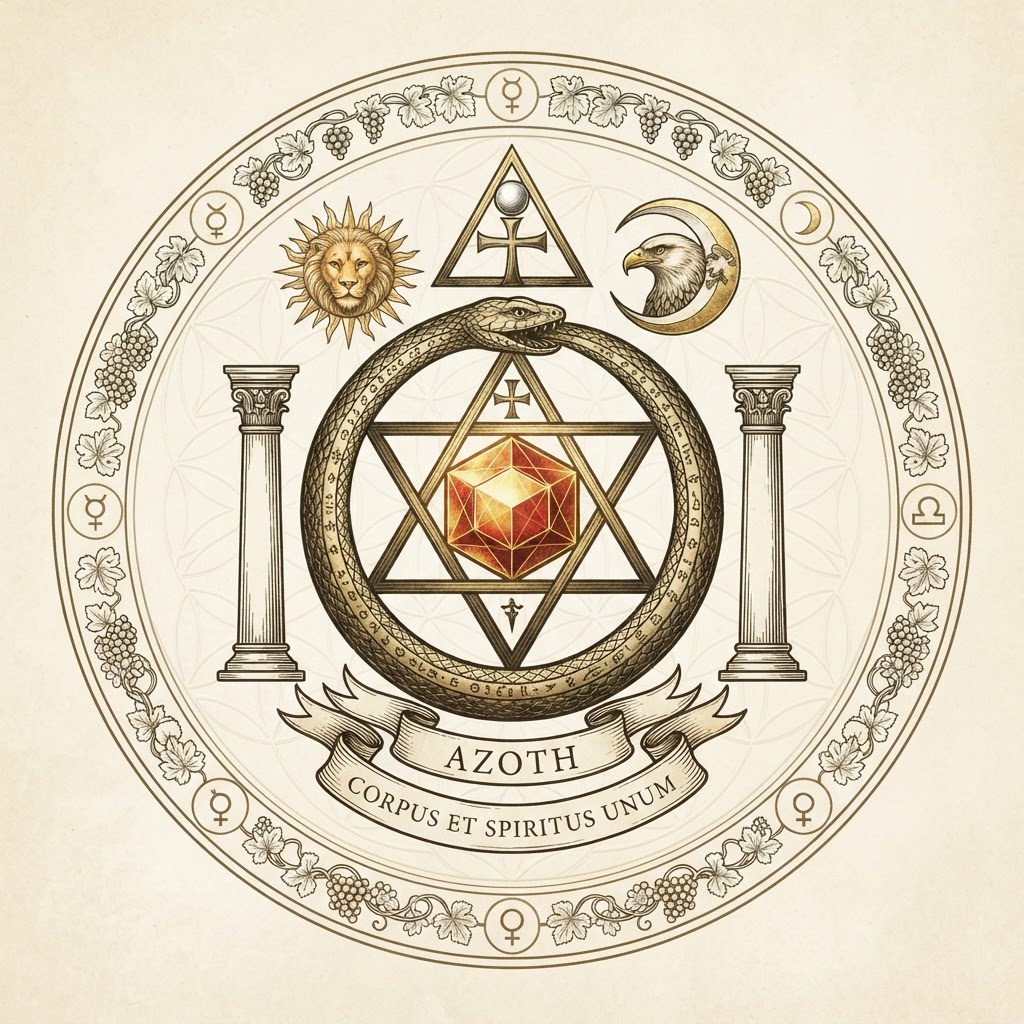
The Philosopher's Stone is the paramount symbol of Western alchemy, frequently depicted geometrically as the Squared Circle or visually as an uncorrupted diamond, crowned rebis, or radiant red stone. It represents the ultimate outcome of the Magnum Opus (Great Work), possessing the legendary power to transmute base metals like lead into pure gold and to generate the Elixir of Life.
Beyond metallurgy, the Stone embodies absolute spiritual perfection and the complete illumination of human consciousness. It represents the purification of base human experience into divine self-realization, resolving all earthly contradictions and polarities into an indestructible, harmonized core.
Meaning of Philosopher's Stone
The ultimate agent of transmutation, purification, and spiritual perfection.
Origin & History
The concept originated in Greco-Roman Egypt through the works of early alchemists like Zosimos of Panopolis, later receiving sophisticated elaboration in the Islamic Golden Age through thinkers like Jabir ibn Hayyan. European medieval scholars later inherited these Arabic manuscripts, standardizing the pursuit of the 'Lapis'.
While early practitioners experimented with physical substances to create real transmutations, mystical alchemists increasingly treated the Stone as an allegorical code for spiritual illumination and internal regeneration.
Spiritual Meaning
On a spiritual level, the Stone represents Christ consciousness, divine integration, and the attainment of gnosis. It reflects the enlightened soul that has passed through the stages of purification—nigredo (blackness), albedo (whiteness), and rubedo (redness).
Achieving the Stone implies transcending worldly duality, transmuting inner vices into virtues, and establishing a direct, permanent connection with the divine essence.
Symbolism
Geometric renderings of the Stone often feature a circle inside a square, inside a triangle, inside a circle, symbolizing the integration of the four elements, heaven, earth, and spiritual totality.
Traditional Uses
The historical hermetic view held that the Stone was a physical powder or substance capable of curing all diseases and perfecting any imperfect substance in nature.
Modern Spiritual Uses
Modern esotericists regard it as a metaphor for self-actualization, psychic balance, and the conscious awakening to one's highest divine purpose.
Healing Associations
Seen as the universal medicine (Panacea), traditionally believed to eradicate all diseases and restore spiritual wholeness.
Protection Associations
Symbolically serves to preserve physical vitality and safeguard spiritual clarity against cognitive illusions.
How the Symbol Is Used
- •Spiritual alchemy
- •Inner work
- •Hermetic meditation
Cultural Context
Greco-Egyptian and European Medieval — Near East and Europe (Medieval to Renaissance)
Sources & References
- 1.Jabir ibn Hayyan, Kitab al-Kimya
- 2.Jung, C. G., Psychology and Alchemy
- 3.Principe, Lawrence M., The Secrets of Alchemy
This content is for educational and informational purposes only. Where modern spiritual interpretations are described, they are not presented as ancient historical facts. It is not a substitute for professional medical or spiritual advice.