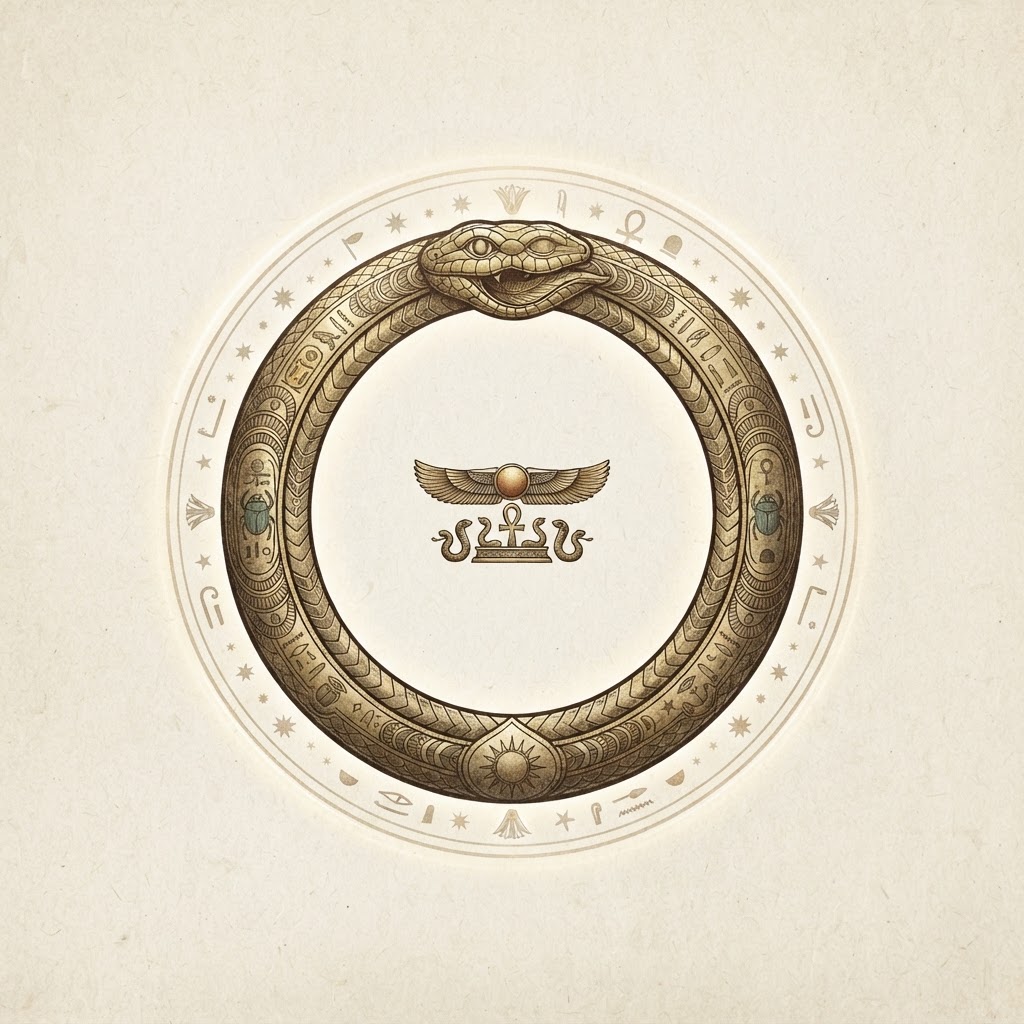
Ouroboros: Meaning, Origin & Symbolism
Also known as: Uroboros, Tail-Devourer
Alchemical
Hellenistic Egyptian
Root Chakra
Crown Chakra
Ether/Spirit
Transformation
Wisdom
Protection
An ancient emblem depicting a serpent or dragon devouring its own tail, symbolizing eternity and cyclic renewal.
Quick Facts
- Category
- Alchemical
- Culture / Origin
- Hellenistic Egyptian
- Geographic Origin
- Ancient Egypt and the Mediterranean
- Historical Period
- Classical Antiquity
- Estimated Age
- circa 13th Century BCE
- Element
- Ether/Spirit
- Planet
- Saturn
- Chakra
- Root, Crown
- Zodiac
- Scorpio
- Deities
- Hermes Trismegistus, Atum, Quetzalcoatl
- Verification
- unverified
What is Ouroboros?
The Ouroboros is one of the oldest and most widely recognized alchemical and esoteric motifs, depicting a serpent or dragon swallowing its own tail to form a closed circle. In Western alchemy, it famously appears in the Alexandrian text 'Chrysopoeia of Cleopatra' with the enigmatic Greek inscription 'Hen to Pan', meaning 'One is All'. The symbol portrays the eternal cycle of destruction, rebirth, and the continuity of life.
Within alchemical philosophy, the Ouroboros represents the prima materia—the base material of creation that is simultaneously the end product of the Great Work. It embodies the hermetic axiom that nature contains within itself the ability to dissolve, regenerate, and purify, demonstrating that the beginning and the end are fundamentally unified.
Meaning of Ouroboros
The eternal cycle of destruction and regeneration, signifying that all things originate from unity and inevitably return to it.
Origin & History
Although early iterations appear in the Enigmatic Book of the Netherworld in the tomb of Tutankhamun, the Ouroboros became deeply integrated into Greek and Hellenistic alchemical manuscripts during late antiquity. It served as a visual shorthand for chemical recycling processes, such as continuous distillation and sublimation.
By the Middle Ages and Renaissance, the symbol had transitioned into European alchemy, where it was extensively illustrated in treatises to represent the transmutation of base metals and the pursuit of immortality.
Spiritual Meaning
Spiritually, the Ouroboros signifies the immortality of the soul and the cyclical nature of consciousness. It suggests that personal evolution involves discarding outmoded ego structures and regenerating inner life through spiritual awareness.
In psychological alchemy, as articulated by Carl Jung, it represents the preconscious state of psychic totality, where opposites are contained in harmonious equilibrium before differentiation occurs.
Symbolism
The circular shape symbolizes infinity, wholeness, and perfection, while the acts of consuming and regenerating simultaneously signify the union of opposites, such as death and life or creation and destruction.
Traditional Uses
Historically, it was viewed as a physical and metaphysical model of the cosmos, illustrating the principle that matter cannot be created or destroyed, only transmuted.
Modern Spiritual Uses
Today, it is frequently embraced as a symbol of sustainability, self-sufficiency, continuous personal transformation, and holistic self-healing.
Healing Associations
Associated with cellular regeneration, recovering wholeness after trauma, and restoring natural bodily rhythms.
Protection Associations
Used historically on amulets to ward off temporal chaos and psychic disintegration by establishing sacred boundaries.
How the Symbol Is Used
- •Hermetic meditation
- •Shadow work
- •Jungian active imagination
Cultural Context
Hellenistic Egyptian — Ancient Egypt and the Mediterranean (Classical Antiquity)
Sources & References
- 1.Chrysopoeia of Cleopatra
- 2.Jung, C. G., Collected Works, Vol. 14: Mysterium Coniunctionis
- 3.Edinger, Edward F., Anatomy of the Psyche
This content is for educational and informational purposes only. Where modern spiritual interpretations are described, they are not presented as ancient historical facts. It is not a substitute for professional medical or spiritual advice.