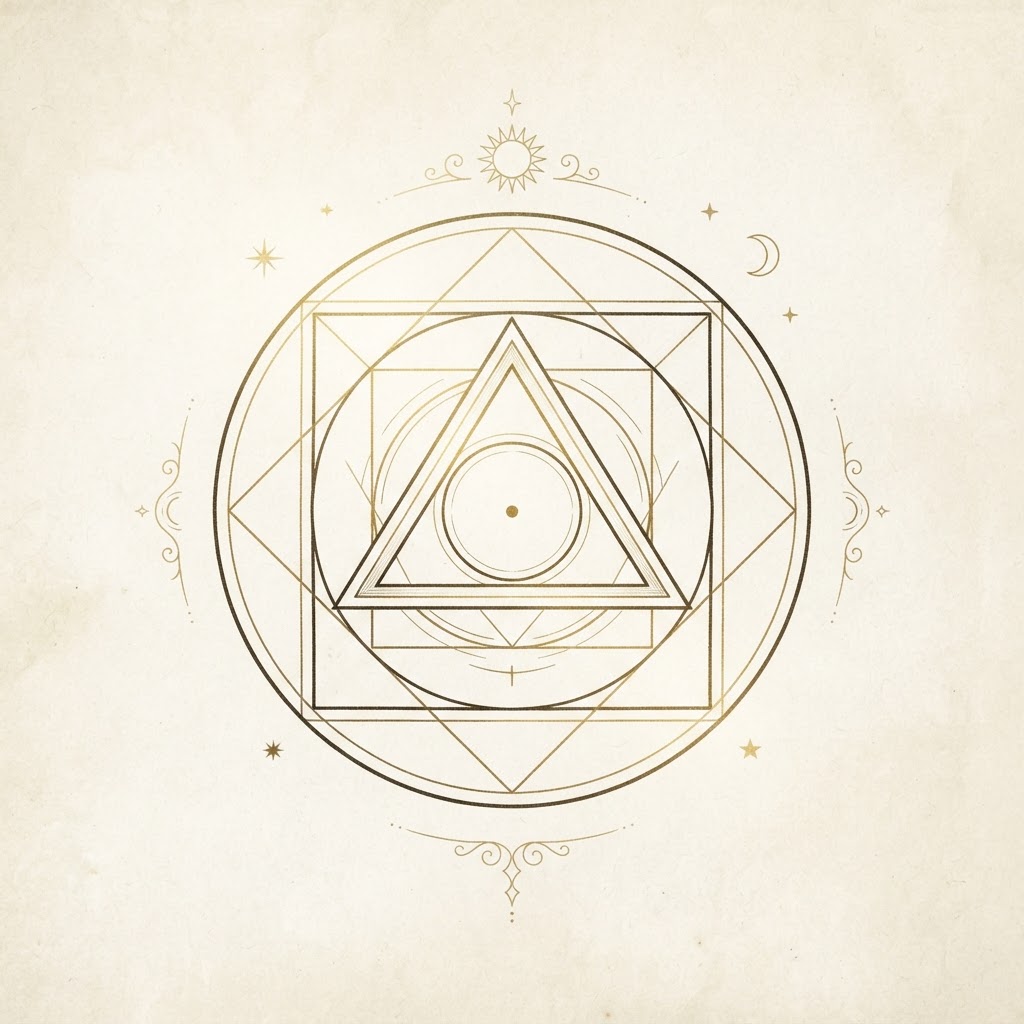
Alchemical Symbol of the Philosopher's Stone: Meaning, Origin & Symbolism
Also known as: Squared Circle, Lapis Philosophorum, Quadratura Circuli
Mystical/Esoteric
Western Alchemical Tradition
Root Chakra
Heart Chakra
Crown Chakra
All Chakra
Ether/Spirit
Transformation
Wisdom
Harmony
Spiritual Growth
A geometric glyph of a circle inside a square, inside a triangle, inside an outer circle, depicting the ultimate spiritual Magnum Opus.
Quick Facts
- Category
- Mystical/Esoteric
- Culture / Origin
- Western Alchemical Tradition
- Geographic Origin
- Western and Central Europe
- Historical Period
- Renaissance to Early Modern Era
- Estimated Age
- circa 1617 CE
- Element
- Ether/Spirit
- Planet
- Sun
- Chakra
- Root, Heart, Crown, All
- Deities
- Hermes Trismegistus
- Verification
- unverified
What is Alchemical Symbol of the Philosopher's Stone?
The Alchemical Symbol of the Philosopher's Stone—frequently rendered as the Squared Circle—is a complex geometric mandala that visually codifies the completion of the Great Work (Magnum Opus). Attributed famously to the 17th-century alchemist Michael Maier in his work 'Atalanta Fugiens', it shows an outer circle enclosing a triangle, which encloses a square, which encloses an innermost circle with a central point.
This glyph is not merely a recipe for transmuting lead into physical gold; it serves as a supreme visual metaphor for spiritual enlightenment. It encapsulates the transmutation of fragmented, mortal human consciousness into an immortal, refined state of divine illumination.
Meaning of Alchemical Symbol of the Philosopher's Stone
The successful completion of spiritual transformation and the integration of body, soul, and spirit.
Origin & History
The mathematical puzzle of squaring the circle dates to ancient Greek geometry, but alchemists transformed the geometric impossibility into a profound mystical allegory. In 1617, Michael Maier published Emblem XXI in 'Atalanta Fugiens' with the directive: 'Make a circle out of a man and a woman, out of this a square, out of this a triangle, make a circle and you will have the Philosopher's Stone.'
Carl Jung later recognized this exact progression in the mandalas produced by psychological patients, demonstrating that the diagram represents the universal human striving toward psychic individuation and inner wholeness.
Spiritual Meaning
The emblem represents the reconciliation of all cosmic paradoxes. By moving between linear geometric shapes (squares and triangles) and circular forms, it depicts how temporal earthly life can be harmonized with timeless divine eternity.
It challenges the practitioner to transmute their base emotional instincts (lead) into the pure spiritual light of conscious awareness (philosophical gold).
Symbolism
The outer circle represents divine wholeness; the triangle signifies the threefold nature of reality (Sulfur, Mercury, Salt; or Body, Soul, Spirit); the square represents the four elements; and the inner circle is the perfected spiritual self.
Traditional Uses
The theoretical and operative blueprint for generating the Philosopher's Stone, granting perpetual health, spiritual illumination, and metallic transmutation.
Modern Spiritual Uses
An archetype of psychological integration, inner alchemy, and achieving self-mastery by bringing light to subconscious shadow aspects.
Healing Associations
Assists in profound psychic recovery, shadow work, and harmonizing fractured emotional complexes.
Protection Associations
Used meditatively to construct an impenetrable internal spiritual sanctuary unaffected by external chaos.
How the Symbol Is Used
- •Spiritual Alchemy
- •Jungian Shadow Work
- •Hermetic Contemplation
- •Sacred Geometry
Cultural Context
Western Alchemical Tradition — Western and Central Europe (Renaissance to Early Modern Era)
Sources & References
- 1.Michael Maier, 'Atalanta Fugiens'
- 2.Carl Jung, 'Mysterium Coniunctionis'
This content is for educational and informational purposes only. Where modern spiritual interpretations are described, they are not presented as ancient historical facts. It is not a substitute for professional medical or spiritual advice.