Ankh: Meaning, Origin & Symbolism
Also known as: Crux Ansata, Key of Life, Breath of Life
Mystical/Esoteric
Ancient Egypt
Heart Chakra
Sacral Chakra
Water
Healing
Protection
Spiritual Growth
Love
An ancient Egyptian hieroglyphic glyph representing eternal life, vitality, and the fusion of masculine and feminine principles.
Quick Facts
- Category
- Mystical/Esoteric
- Culture / Origin
- Ancient Egypt
- Geographic Origin
- Nile River Valley, Egypt
- Historical Period
- Early Dynastic Period to Hellenistic Era
- Estimated Age
- circa 3150 BCE
- Element
- Water
- Planet
- Sun
- Chakra
- Heart, Sacral
- Deities
- Isis, Osiris, Ra, Anubis
- Verification
- unverified
What is Ankh?
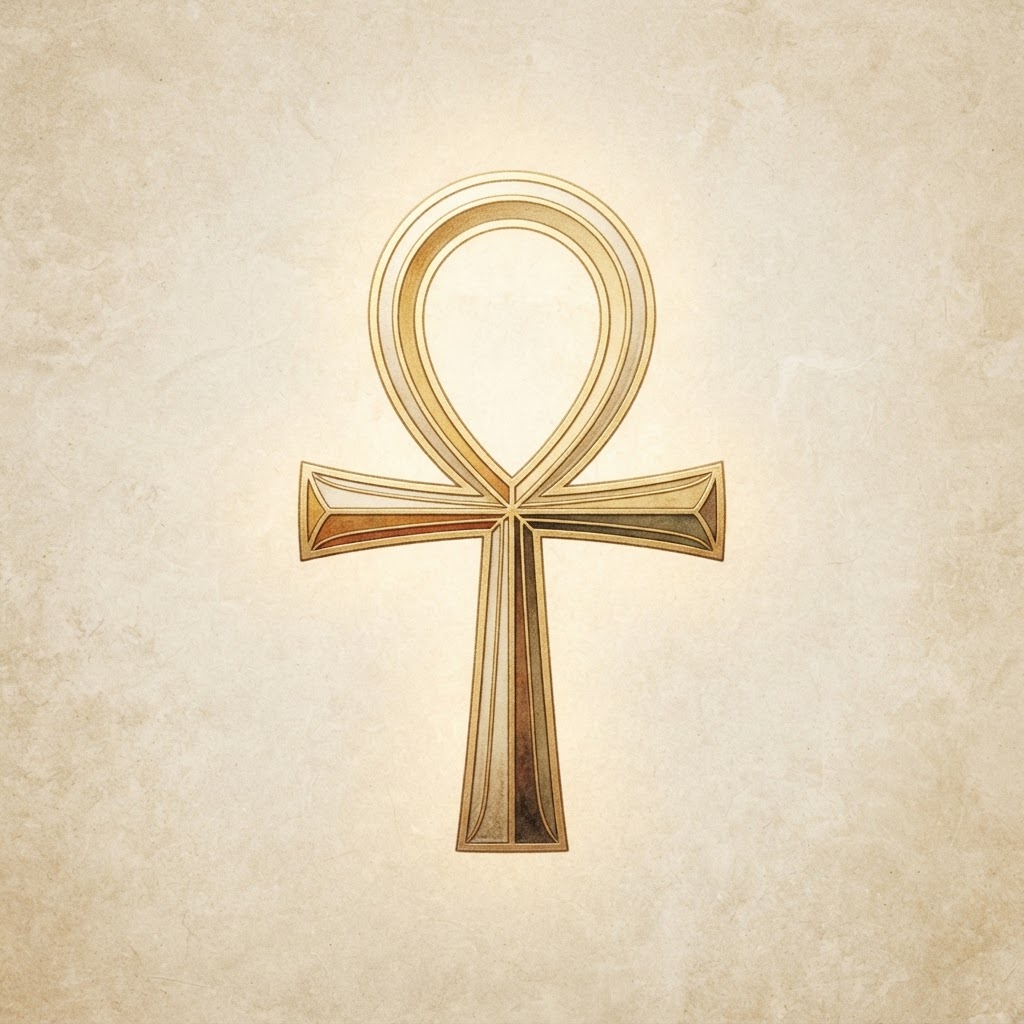
The Ankh is one of the most enduring symbols in human history, characterized by a cross topped with an oval loop. In ancient Egyptian language and cosmology, the glyph signifies 'life' (ankh) or the 'breath of life'. Egyptian gods are overwhelmingly depicted holding the Ankh by its loop or presenting it to the mouths of pharaohs, imparting the life-giving vitality needed for both earthly sovereignty and eternal survival in the afterlife.
Its distinct design brings together vertical and horizontal axes, capped by a continuous loop. In esoteric philosophy, it represents the key that unlocks the mysteries between the mortal physical world and the transcendent immortal dimensions.
Meaning of Ankh
Eternal physical and spiritual life, vitality, and divine breath.
Origin & History
The Ankh appears continuously across thousands of years of Egyptian monuments, papyri, sarcophagi, and everyday amulets from the 1st Dynasty forward. It was carried as a protective personal talisman by commoners and royalty alike.
With the arrival of Christianity in Hellenistic Egypt, Coptic Christians adopted the symbol as the 'Crux Ansata' (cross with a handle) due to its formal similarity to the Christian cross, allowing the ancient concept of eternal life to transition smoothly into early Christian art and theology.
Spiritual Meaning
The Ankh teaches that human consciousness is fundamentally immortal, extending far beyond the horizon of physical dissolution. It embodies the union of celestial spiritual forces descending into earthly form.
Esoterically, it symbolizes the generation of life through polar balance: the oval loop symbolizes the receptive feminine matrix, while the shaft and crossbeam represent masculine generative strength.
Symbolism
The oval loop represents the unending sun or female womb. The horizontal bar signifies earthly horizon, and the vertical shaft represents the descent of divine cosmic spirit into material reality.
Traditional Uses
A royal and divine emblem conveying supernatural vitality, regenerative protection, and guaranteed safe transition into the eternal fields of Aaru.
Modern Spiritual Uses
Celebrated as a universal talisman of spiritual vitality, inner resurrection, and reverence for ancestral Egyptian wisdom.
Healing Associations
Visualized during pranic breathwork to amplify vital life force (prana/chi) and rejuvenate exhausted energy reserves.
Protection Associations
Universally employed on ancient mirrors, chests, and tombs to safeguard physical well-being and protect the Ka and Ba souls.
How the Symbol Is Used
- •Kemetic Spirituality
- •Energy Healing
- •Amulet Crafting
- •Breathwork
Cultural Context
Ancient Egypt — Nile River Valley, Egypt (Early Dynastic Period to Hellenistic Era)
Sources & References
- 1.Richard H. Wilkinson, 'Reading Egyptian Art'
- 2.E. A. Wallis Budge, 'The Gods of the Egyptians'
This content is for educational and informational purposes only. Where modern spiritual interpretations are described, they are not presented as ancient historical facts. It is not a substitute for professional medical or spiritual advice.