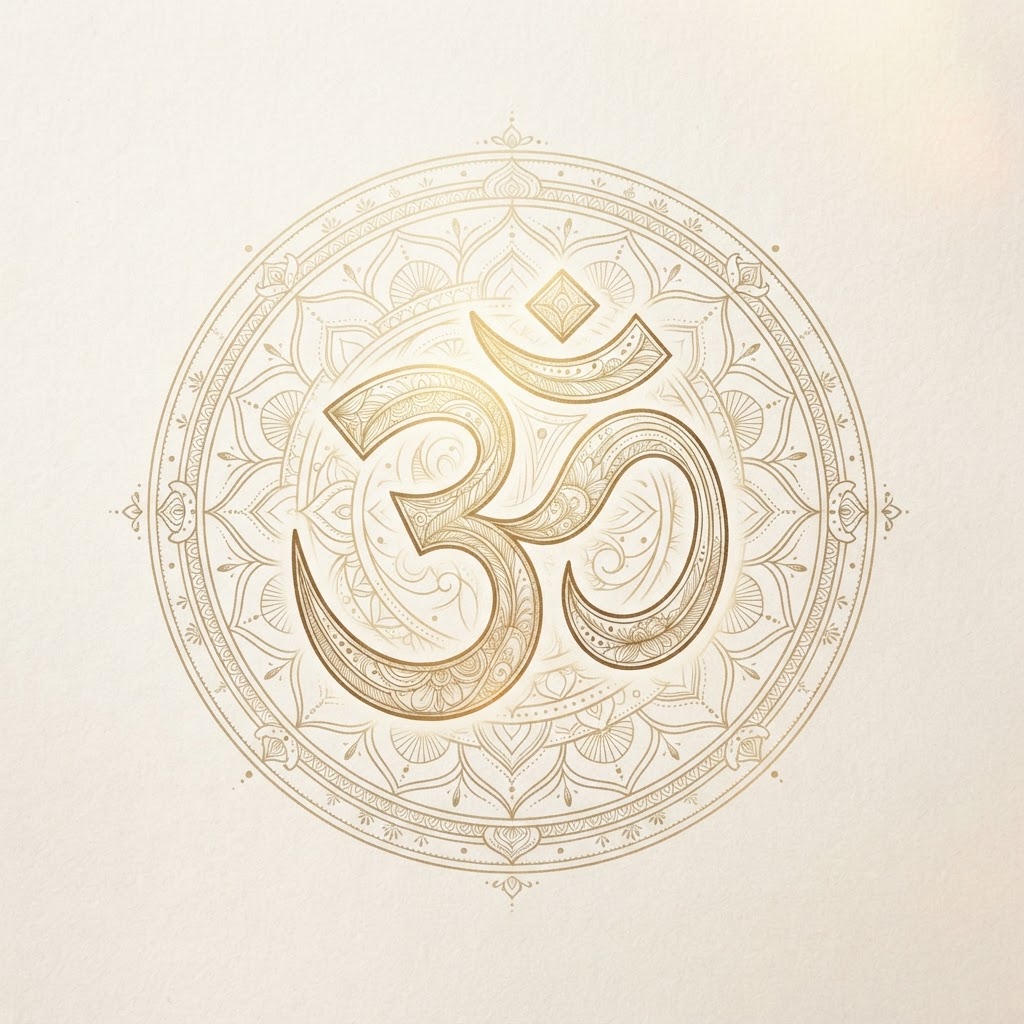
Om: Meaning, Origin & Symbolism
Also known as: Aum, Pranava, Omkara
Yogic
Vedic / Hindu
Third Eye Chakra
Crown Chakra
All Chakra
Ether/Spirit
Wisdom
Transformation
Peace
Spiritual Awakening
The primordial sound and sacred syllable representing the ultimate reality and the universe in Indian spiritual traditions.
Quick Facts
- Category
- Yogic
- Culture / Origin
- Vedic / Hindu
- Geographic Origin
- Ancient India
- Historical Period
- Vedic Period
- Estimated Age
- circa 1500 BCE
- Element
- Ether/Spirit
- Planet
- Sun
- Chakra
- Third Eye, Crown, All
- Deities
- Brahma, Vishnu, Shiva, Ganesha
- Verification
- unverified
What is Om?
Om, spelled phonetically as Aum, is regarded as the most fundamental sacred syllable and visual emblem in Indian philosophy and yogic traditions. Representing the vibrational frequency through which the cosmos was manifested, it encapsulates the entirety of existence from creation to dissolution. In textual representations, its visual glyph consists of three curves, a semicircle, and a dot, each corresponding to distinct states of consciousness and manifestation. Within yogic paths, chanting or meditating upon Om acts as a bridge uniting individual consciousness with the transcendent Brahman. It is commonly invoked at the beginning and end of prayers, rituals, and yoga sessions to establish cosmic resonance and interior stillness.
Meaning of Om
The primordial cosmic sound that generated the universe and embodies ultimate reality (Brahman).
Origin & History
Om first appears in the foundational corpus of the Vedas, particularly the Upanishads such as the Mandukya, Chandogya, and Katha Upanishads. The Mandukya Upanishad dedicates its entirety to analyzing the syllables A-U-M as representing the waking, dreaming, and deep sleep states of consciousness, alongside the fourth transcendent state (Turiya). Over millennia, Om became the foundational sonic seed (Bija) across Hinduism, Buddhism, and Jainism, deeply embedded in classical Patanjali Ashtanga Yoga as Ishvara Pranidhana (surrender to the divine).
Spiritual Meaning
Spiritually, Om is the vibration of pure consciousness. Chanting Om harmonizes the practitioner's subtle energetic body with the overarching macrocosmic vibration, dissolving the illusion of separation between the self and the cosmos. The silent pause after chanting Om represents Turiya, the unconditioned consciousness beyond time and space.
Symbolism
The large lower curve signifies the waking state (Jagrat), the upper curve symbolizes deep sleep (Sushupti), and the middle curve represents the dream state (Swapna). The dot (Bindu) signifies the absolute, enlightened state of consciousness (Turiya), while the crescent below the dot represents Maya (illusion), which veils the absolute truth from the waking mind.
Traditional Uses
Traditionally, Om is the verbal icon of Ishvara (God) and the sonic incarnation of the Vedas. Vedic recitation mandates its pronunciation before any sacred mantra to purify speech and align the mind with divine order (Rita).
Modern Spiritual Uses
In modern global yoga, Om is often interpreted as a universal symbol of mindfulness, inner peace, cosmic interconnectedness, and spiritual centering, used widely to begin and conclude asana practices.
Healing Associations
Sonic resonance is believed to calm the nervous system, balance endocrine function, and relieve mental stress.
Protection Associations
Used to shield the practitioner from psychic disturbances and purify ritual spaces.
How the Symbol Is Used
- •Japa Meditation
- •Pranayama
- •Hatha Yoga
- •Vedic Chanting
Cultural Context
Vedic / Hindu — Ancient India (Vedic Period)
Sources & References
- 1.Mandukya Upanishad
- 2.The Yoga Sutras of Patanjali
- 3.P. Radhakrishnan, The Principal Upanishads
This content is for educational and informational purposes only. Where modern spiritual interpretations are described, they are not presented as ancient historical facts. It is not a substitute for professional medical or spiritual advice.