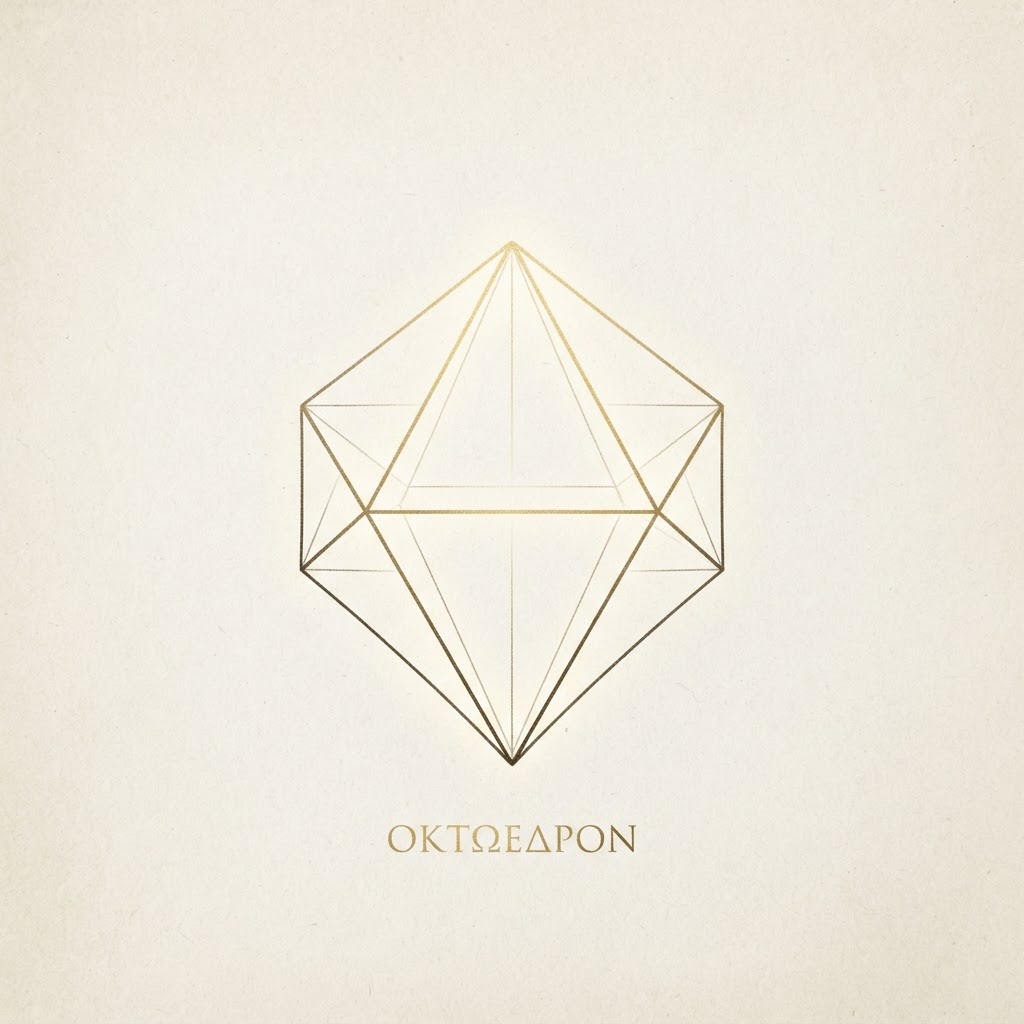
Octahedron: Meaning, Origin & Symbolism
Also known as: Platonic Air Solid, Regular Octahedron
Sacred Geometry
Classical Greek
Heart Chakra
Air
Harmony
Wisdom
A Platonic solid formed by eight equilateral triangular faces meeting at six vertices, resembling two pyramids joined at their bases.
Quick Facts
- Category
- Sacred Geometry
- Culture / Origin
- Classical Greek
- Geographic Origin
- Ancient Greece
- Historical Period
- Classical Antiquity
- Estimated Age
- circa 5th century BCE
- Element
- Air
- Planet
- Mercury
- Chakra
- Heart
- Zodiac
- Gemini, Libra, Aquarius
- Deities
- Hermes, Thoth
- Verification
- unverified
What is Octahedron?
The regular octahedron is an eight-sided polyhedron composed of equilateral triangular faces, twelve equal edges, and six vertices. Visually resembling two four-sided pyramids connected at their square bases, it serves as the exact geometric dual of the cube.
When the center points of a cube's faces are interconnected, an octahedron is formed within, highlighting an intrinsic mathematical dialogue between Earth and Air. It rotates effortlessly along three symmetrical axes, projecting balance and fluidity in spatial organization.
Meaning of Octahedron
The primordial element of Air; mental clarity, integration of dualities, and balanced motion.
Origin & History
Plato's 'Timaeus' established the octahedron as the geometric archetype of the element Air. Plato reasoned that its intermediate size, weight, and mobility placed it naturally between the sharp intensity of the tetrahedron (Fire) and the fluidity of the icosahedron (Water).
Renaissance artists and mathematicians, including Leonardo da Vinci and Luca Pacioli in 'De Divina Proportione' (1509), illustrated the octahedron extensively, celebrating its exquisite balance and proportional harmony.
Spiritual Meaning
The octahedron represents equilibrium, intellectual discernment, and harmonious communication between upper and lower realms. Its mirrored pyramid structure reflects the Hermetic axiom 'As above, so below', demonstrating that higher spiritual planes and physical dimensions continually reflect one another.
Practitioners meditate with the octahedron to calm cognitive distortions, foster compassionate objectivity, and reconcile internal contradictions.
Symbolism
Two pyramids joined at their base represent the meeting and harmonious reconciliation of celestial inspiration and earthly manifestation.
Traditional Uses
The classical geometric vessel of the element Air, representing mobility, intellectual discernment, and subtle atmospheric movement.
Modern Spiritual Uses
Used in energy healing to calibrate the Heart chakra, balance the emotional body, and facilitate compassionate interpersonal communication.
Healing Associations
Supports respiratory equilibrium, cognitive calm, and releases congested heart energy.
Protection Associations
Employed in visualization to deflect mental projections and psychical turbulence from hostile environments.
How the Symbol Is Used
- •Pranayama Integration
- •Heart Chakra Clearing
- •Merkaba Vehicle Visualization
Cultural Context
Classical Greek — Ancient Greece (Classical Antiquity)
Sources & References
- 1.Pacioli, Luca. De Divina Proportione. Venice, 1509.
- 2.Lawlor, Robert. Sacred Geometry: Philosophy and Practice. Thames & Hudson, 1982.
This content is for educational and informational purposes only. Where modern spiritual interpretations are described, they are not presented as ancient historical facts. It is not a substitute for professional medical or spiritual advice.