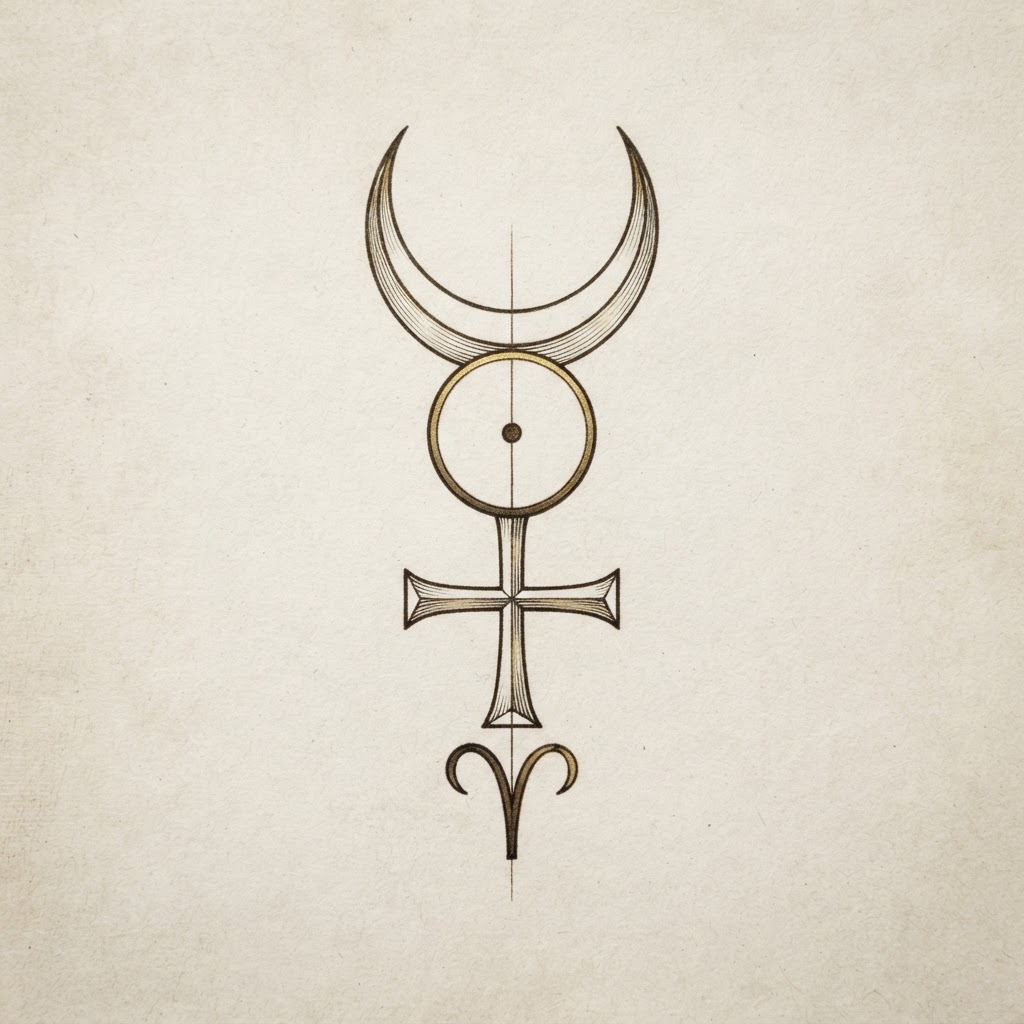
Monas Hieroglyphica: Meaning, Origin & Symbolism
Also known as: The Hieroglyphic Monad, John Dee's Monad, The Glyphic Unity
Hermetic
Renaissance Hermeticism
Third Eye Chakra
Crown Chakra
Ether/Spirit
Wisdom
Integration
Transformation
A complex glyph designed by Elizabethan polymath John Dee to represent the mystical unity of all creation through sacred geometry.
Quick Facts
- Category
- Hermetic
- Culture / Origin
- Renaissance Hermeticism
- Geographic Origin
- England / Western Europe
- Historical Period
- Renaissance
- Estimated Age
- 1564 CE
- Element
- Ether/Spirit
- Planet
- Mercury
- Chakra
- Third Eye, Crown
- Zodiac
- Aries
- Deities
- Hermes, Apollo
- Verification
- unverified
What is Monas Hieroglyphica?
The Monas Hieroglyphica is an intricate Hermetic symbol conceived and published in 1564 by the English mathematician, astrologer, and occultist John Dee. In a dense treatise of the same title, Dee claimed this single composite glyph held the mystical keys to astronomy, alchemy, geometry, linguistics, and cabala. It was constructed to illustrate the foundational unity of the cosmos, showing how all sciences and spiritual paths emanate from a singular geometric and metaphysical source.
The glyph is structurally composed of four primary visual elements: the crescent representing the Moon, the circle with a central point denoting the Sun, the horizontal and vertical intersecting lines of the Cross representing the four elements, and the rounded horns at the base symbolizing Aries and the element of Fire. Dee posited that this symbol acted as an active cosmic sigil capable of initiating an intellectual and spiritual metamorphosis in the mind of anyone who deeply contemplated its proportions.
Meaning of Monas Hieroglyphica
The Monas Hieroglyphica signifies the fundamental unity of existence, reconciling the planetary, elemental, and spiritual forces within a single geometric character.
Origin & History
John Dee composed his text 'Monas Hieroglyphica' in a twelve-day period of intense spiritual inspiration in Antwerp, dedicating the work to Holy Roman Emperor Maximilian II. Dee was an advisor to Queen Elizabeth I and a leading intellectual figure who sought a universal symbolic language that could reconcile religious schisms, restore scientific truth, and reveal the hidden architecture of nature.
The Monas rapidly caught the attention of leading Renaissance thinkers, Rosicrucians, and occultists. It prominently reappeared fifty years later in the foundational Rosicrucian manifestos, specifically on the title page of the 'Chymical Wedding of Christian Rosenkreutz' (1616), permanently cementing its position as one of the most intellectually revered and enigmatic emblems in European Hermetic history.
Spiritual Meaning
On a spiritual level, Dee's Monad serves as a contemplative doorway into divine non-duality. It reveals that the disparate pieces of reality—the feminine lunar intuition, the masculine solar consciousness, the material struggles of the elemental cross, and the creative fires of renewal—are not isolated phenomena, but unified expressions of the divine Monad, the eternal One.
Meditation upon the Monas is meant to facilitate spiritual re-integration. By tracing how its lines and circles branch out from and collapse back into the central mathematical point, the practitioner trains their consciousness to perceive the divine blueprint structuring both external cosmic events and internal psychic developments, leading to spiritual gnosis.
Symbolism
The top crescent represents the Moon and receptive intuition; the central circled dot represents the Sun and radiant spirit; the cross represents the four material elements and mortality; the bottom semicircles represent Aries, the primordial spark, and alchemical fire.
Traditional Uses
In Dee's original framework, the Monas represents the cosmic alphabet from which all divine letters, planetary spheres, and chemical processes are derived, proving the unity of nature and scripture.
Modern Spiritual Uses
Modern esotericists regard it as a potent symbol of sacred geometry, holistic integration, and the unification of mind, spirit, and matter in personal evolution.
Healing Associations
Used in modern esoteric meditation to re-integrate fragmented cognitive states and achieve holistic mental clarity.
How the Symbol Is Used
- •Hermetic Cabala
- •Sacred Geometry
- •Esoteric Meditation
- •Alchemical Study
Cultural Context
Renaissance Hermeticism — England / Western Europe (Renaissance)
Sources & References
- 1.Monas Hieroglyphica by John Dee (1564)
- 2.The Rosicrucian Enlightenment by Frances Yates
- 3.John Dee's Five Books of Mystery by Joseph Peterson
This content is for educational and informational purposes only. Where modern spiritual interpretations are described, they are not presented as ancient historical facts. It is not a substitute for professional medical or spiritual advice.