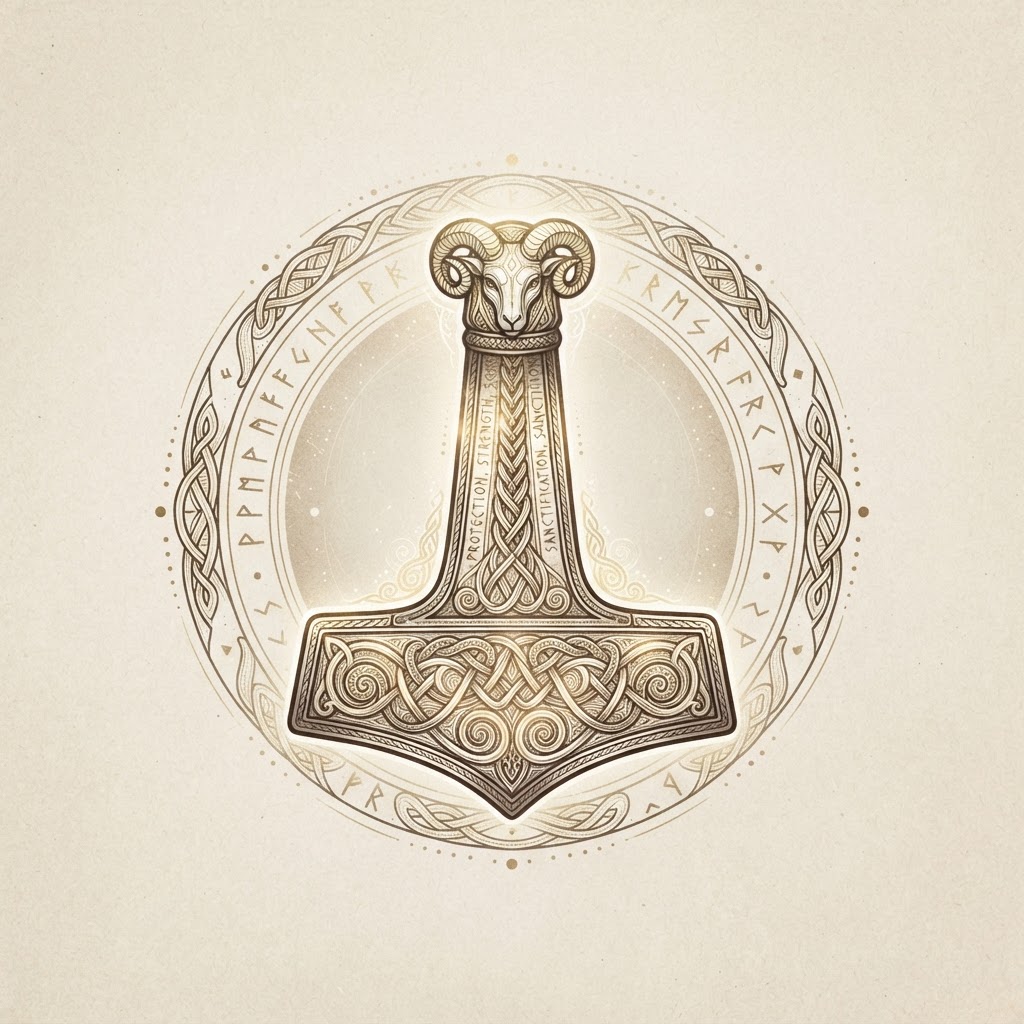
Mjölnir: Meaning, Origin & Symbolism
Also known as: Thor's Hammer, Mjolnir, Ukonvasara (comparative)
Norse/Germanic
Norse/Germanic
Root Chakra
Solar Plexus Chakra
Fire
Protection
Strength
Grounding
Consecration
The formidable hammer of the thunder god Thor, embodying divine protection, strength, and the sanctification of sacred boundaries.
Quick Facts
- Category
- Norse/Germanic
- Culture / Origin
- Norse/Germanic
- Geographic Origin
- Northern Europe, Scandinavia
- Historical Period
- Viking Age
- Estimated Age
- circa 8th–11th century CE
- Element
- Fire
- Planet
- Jupiter
- Chakra
- Root, Solar Plexus
- Zodiac
- Aries, Sagittarius
- Deities
- Thor
- Verification
- unverified
What is Mjölnir?
Mjölnir is one of the most prominent symbols of the Norse world, representing the devastating yet protective weapon wielded by Thor, the god of thunder, storms, and fertility. Crafted by the dwarven brothers Sindri and Brokkr, the hammer possessed supernatural attributes: it never missed its target, possessed boundless destructive force, and would invariably return to Thor's hand like a boomerang. Beyond warfare, the hammer served a vital liturgical function as an instrument of consecration. In Old Norse society, miniature hammer pendants were worn by men and women alike as protective amulets, asserting devotion to traditional ways, especially during the Christianization period. Archaeologically, hundreds of Mjölnir pendants have been unearthed across Scandinavia, the British Isles, and Eastern Europe, crafted from silver, iron, and bronze.
Meaning of Mjölnir
The supreme weapon of Thor representing divine protection, cosmic order over chaos, and ritual hallowing.
Origin & History
Mjölnir finds extensive mention in the Poetic Edda and Snorri Sturluson's Prose Edda. In historical practice, Thor was venerated as the defender of Midgard (the realm of humanity) and Asgard. During the late Viking Age, the popularity of wearing Mjölnir amulets surged dramatically, likely as a defiant cultural counter-response to Christian crucifixes.
Spiritual Meaning
Spiritually, Mjölnir signifies the descending power of divine will breaking through ignorance and spiritual stagnation. Just as lightning clears the air and brings rain to nourish the earth, the hammer represents fierce grace—the force that dissolves obstacles, establishes firm spiritual boundaries, and blesses life transitions such as births, marriages, and boundary settlements.
Symbolism
The distinctive T-shape with a short handle reflects the mythological accident during its forging when Loki disrupted the work. The heavy head symbolizes unyielding divine strength, while the balance of the weapon denotes the equilibrium between natural destruction and seasonal fertility.
Traditional Uses
Historically, Mjölnir was invoked to ward off evil wights, bless marriages to ensure progeny, and sanctify gravesites against desecration, functioning as the ultimate symbol of social and cosmic stability.
Modern Spiritual Uses
In modern Heathenry and contemporary spirituality, Mjölnir serves as a talisman of personal resilience, physical vitality, unyielding courage, and ancestral alignment.
Healing Associations
Bestows vitality, physical endurance, and rejuvenation of personal resolve.
Protection Associations
Wards against malevolent entities, banishes chaotic forces, and shields the wearer against spiritual and physical harm.
How the Symbol Is Used
- •Blót ceremonies
- •Amulet making
- •Modern Asatru rituals
- •Space clearing
Cultural Context
Norse/Germanic — Northern Europe, Scandinavia (Viking Age)
Sources & References
- 1.Snorri Sturluson, Prose Edda
- 2.H.R. Ellis Davidson, Gods and Myths of Northern Europe
- 3.Rudolf Simek, Dictionary of Northern Mythology
This content is for educational and informational purposes only. Where modern spiritual interpretations are described, they are not presented as ancient historical facts. It is not a substitute for professional medical or spiritual advice.