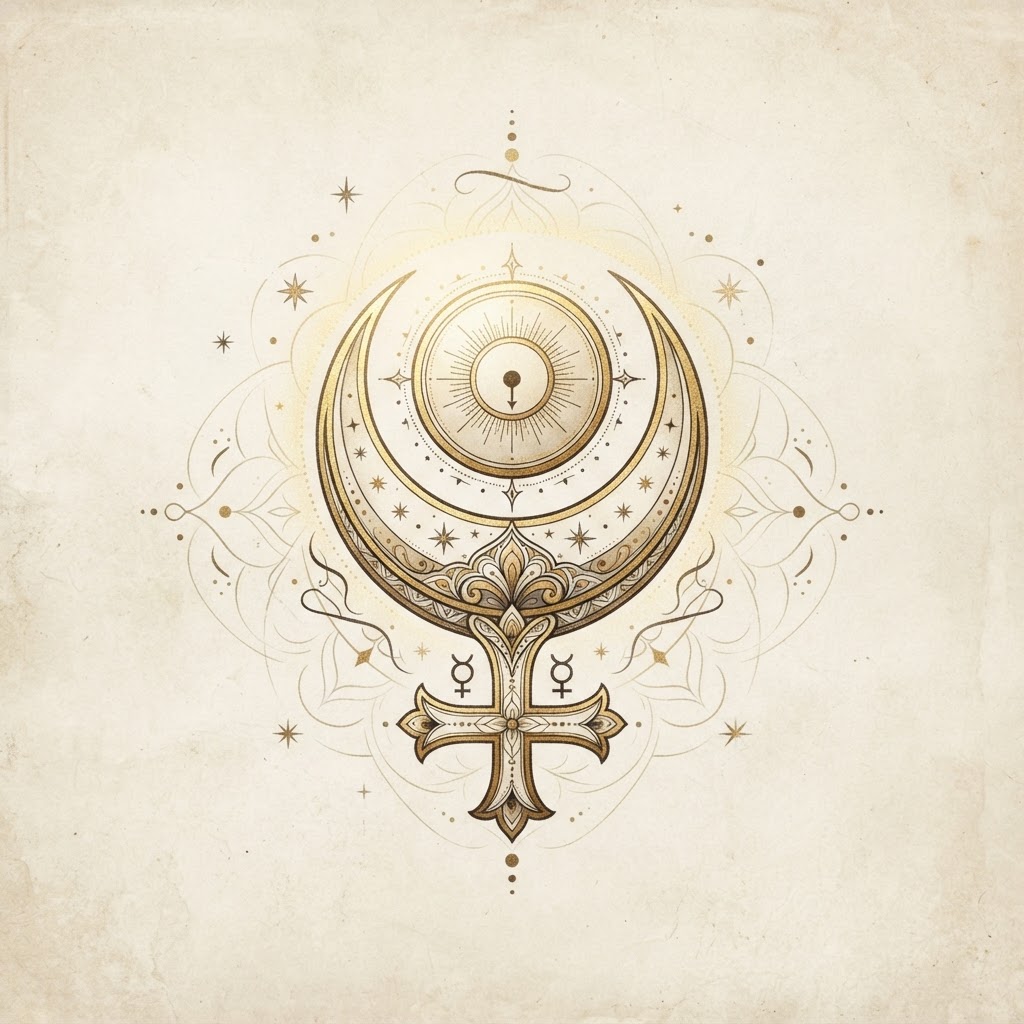
Alchemical Mercury: Meaning, Origin & Symbolism
Also known as: Quicksilver, Hydrargyrum, Philosophical Mercury
Alchemical
European Alchemical
Throat Chakra
Third Eye Chakra
Water
Wisdom
Transformation
One of the three prime alchemical principles, representing the fluid, communicative, and transmutative spirit of matter.
Quick Facts
- Category
- Alchemical
- Culture / Origin
- European Alchemical
- Geographic Origin
- Europe and the Mediterranean
- Historical Period
- Renaissance
- Estimated Age
- circa 16th Century
- Element
- Water
- Planet
- Mercury
- Chakra
- Throat, Third Eye
- Zodiac
- Gemini, Virgo
- Deities
- Hermes, Mercury, Thoth
- Verification
- unverified
What is Alchemical Mercury?
Alchemical Mercury is one of the Tria Prima (Three Primes) formulated by Renaissance physician Paracelsus, alongside Sulfur and Salt. Represented by a glyph combining a crescent moon, a central circle, and a bottom cross, Mercury embodies the universal spirit, intellect, and animating breath that flows through all matter.
Mercury represents liquidity, volatility, and mediation. It is the fluid principle capable of bridging spiritual realms and material forms, serving as the essential solvent that dissolves fixed structures so they can be reassembled into a more elevated spiritual state.
Meaning of Alchemical Mercury
The principle of fluidity, spirit, and transmutative intellect in all physical and metaphysical structures.
Origin & History
Although quicksilver had been mined and utilized since antiquity, Paracelsus redefined its metaphysical significance in the 16th century by establishing the Three Primes framework. Mercury was identified not merely as liquid metal, but as a cosmic and bodily constituent responsible for sensory perception and fluid processes.
Throughout the Renaissance, the astrological and alchemical glyphs for the planet and the substance were united, solidifying Mercury's association with mobility, eloquence, and intellectual fluidity.
Spiritual Meaning
Spiritually, Mercury symbolizes the fluid intellect that navigates between the unconscious and conscious mind, or between the sacred and profane. It represents open-mindedness, intuition, and receptive awareness.
It is the inner mediator that facilitates profound self-inquiry, breaking down dogmatic mental attachments so that new spiritual insights can take root.
Symbolism
The crescent represents the soul's receptivity, the circle signifies divine eternity, and the cross grounds the spiritual forces firmly in the physical realm of the four elements.
Traditional Uses
Historically considered the life-giving vapor and spirit connecting the soul (Sulfur) to the dense body (Salt).
Modern Spiritual Uses
Understood in modern wellness circles as mental adaptability, clear communication, and the conscious processing of thoughts and emotional impulses.
Healing Associations
Associated with nervous system regulation, cognitive enhancement, and balanced bodily fluids.
Protection Associations
Employed to ward off rigid dogmatism, mental stagnation, and energetic blockages.
How the Symbol Is Used
- •Hermetic breathwork
- •Chakra balancing
- •Meditative journaling
Cultural Context
European Alchemical — Europe and the Mediterranean (Renaissance)
Sources & References
- 1.Paracelsus, Archidoxes of Magic
- 2.Burckhardt, Titus, Alchemy: Science of the Cosmos, Science of the Soul
This content is for educational and informational purposes only. Where modern spiritual interpretations are described, they are not presented as ancient historical facts. It is not a substitute for professional medical or spiritual advice.