Luoshu: Meaning, Origin & Symbolism
Also known as: Luo Shu, Lo Shu Square, Nine Halls Diagram, Scroll of the Luo River
Taoist/Chinese
Taoist/Chinese
Solar Plexus Chakra
Root Chakra
Earth
Wisdom
Harmony
Protection
Balance
An ancient 3x3 mathematical magic square forming the spatial and temporal foundation of advanced Taoist divination and Feng Shui.
Quick Facts
- Category
- Taoist/Chinese
- Culture / Origin
- Taoist/Chinese
- Geographic Origin
- China
- Historical Period
- Xia to Han Dynasty
- Estimated Age
- circa 2000 BCE (legendary); formalized circa 3rd Century BCE
- Element
- Earth
- Planet
- Saturn
- Chakra
- Solar Plexus, Root
- Deities
- Yu the Great, Nine Emperors (Jiuhuang)
- Verification
- unverified
What is Luoshu?
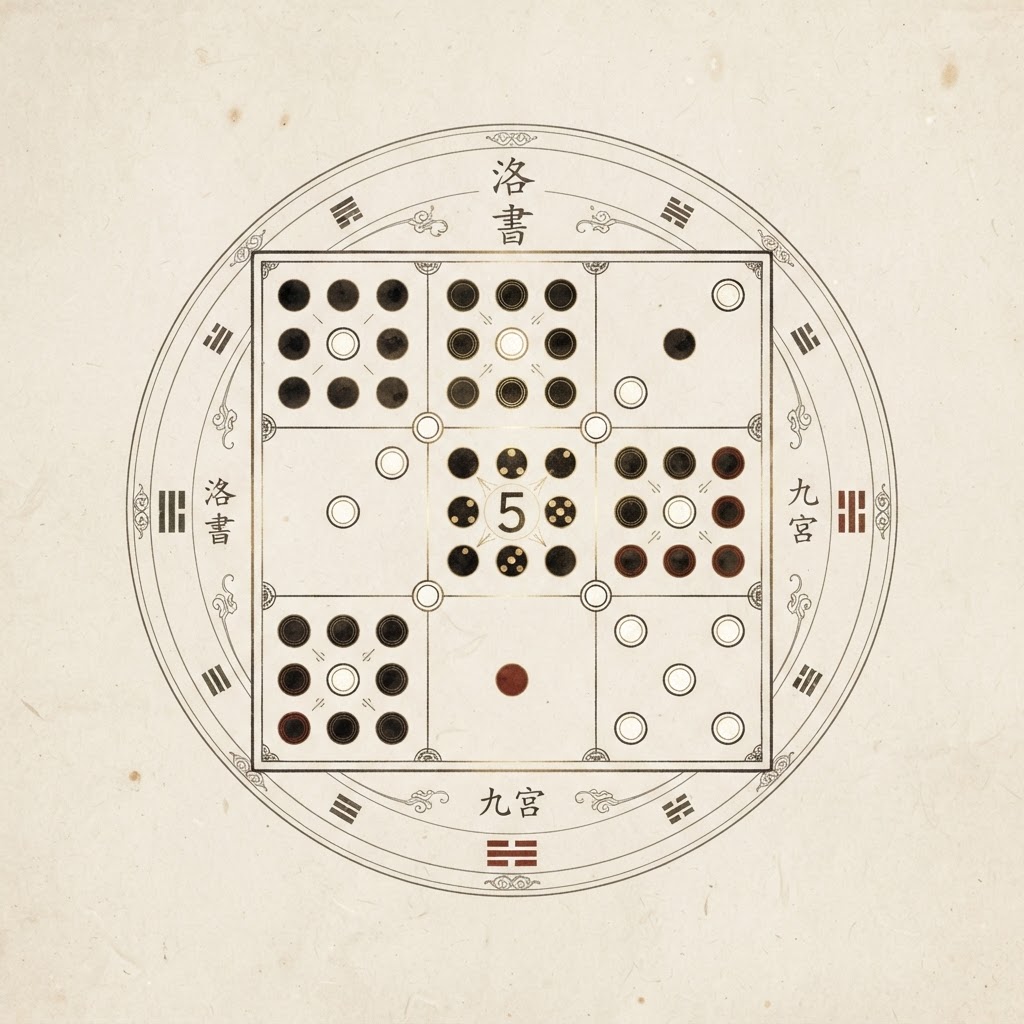
The Luoshu, or 'Luo River Writing', is an ancient geometric and numerical diagram consisting of a 3x3 grid containing the numbers 1 through 9. Its defining mathematical property is that the sum of the numbers in any horizontal, vertical, or diagonal row always equals 15. In Taoist metaphysics, this mathematical harmony mirrors the immutable order underpinning the seemingly chaotic shifts of the universe.
Each sector of the Luoshu corresponds to a cardinal or intercardinal compass direction, a specific trigram from the Later Heaven Bagua, an element from the Wuxing cycle, and an astrological palace. The central number 5 serves as the pivot, representing Earth, stability, and primordial presence around which the remaining eight numbers dance.
In practical spiritual systems, the Luoshu is the engine of Xuan Kong Flying Star Feng Shui, Chinese astrology (Nine Star Ki), and military divination. Taoist priests enact its pattern during sacred rituals through the 'Pace of Yu' (Yubu), walking the numerical path of the Luoshu to transcend mundane dimensions and access celestial realms.
Meaning of Luoshu
The Luoshu represents the dynamic, time-based unfolding of cosmic Qi and mathematical balance across the physical dimensions of space.
Origin & History
According to ancient legend, the Luoshu was discovered by Emperor Yu the Great while working to control catastrophic floods along the Yellow and Luo Rivers. A divine turtle emerged from the waters carrying a unique dot pattern inscribed upon its shell. Observing the pattern, Yu derived the mathematical principles needed to channel the floodwaters and systematically organize China into nine administrative provinces.
Historical records such as the 'Yi Jing' commentaries and Han Dynasty astronomical texts document the deep reverence paid to the Luoshu. It became integrated with the imperial Mingtang (Bright Hall) architectural layouts and served as a foundational model for state rituals, seasonal calendars, and sacred cosmology.
Spiritual Meaning
Spiritually, the Luoshu reveals the hidden sacred geometry and divine order governing temporal reality. It illustrates that within the ever-shifting cycles of time and fortune, an underlying mathematical symmetry maintains equilibrium. The central number 5 acts as the still, unmoving core—the spiritual heart—around which the dualities of even (Yin) and odd (Yang) numbers revolve.
For the Taoist mystic, navigating the sequence of the Luoshu is an esoteric internal journey. By walking or visualizing the path of the numbers (the Flying Star path), the adept absorbs the celestial qualities of the Nine Stars of Ursa Major, transmuting bodily energies and unifying the inner microcosm with celestial order.
Symbolism
The numbers 1 through 9 represent distinct energetic qualities. Odd numbers (1, 3, 7, 9) symbolize active Yang celestial energy and occupy the cardinal directions; even numbers (2, 4, 6, 8) symbolize receptive Yin terrestrial energy and occupy the corners. The number 5 sits at the center, balancing heaven and earth.
Traditional Uses
Traditionally interpreted as the energetic blueprint of the physical world in time. Used to calculate fluctuating fortunes in architecture, personal destiny, weather, and the spiritual influences of the Northern Dipper constellations.
Modern Spiritual Uses
In contemporary metaphysics and sacred geometry, the Luoshu is studied as an archetypal magic square illustrating the universal laws of balance, resonance, and energetic flow within spaces.
Healing Associations
Associated with balancing the nine physical openings and major bodily zones in classical acupuncture paradigms.
Protection Associations
Used in traditional Feng Shui audits to locate energetic afflictions (such as the Five Yellow star) and place cures to protect inhabitants from misfortune.
How the Symbol Is Used
- •Flying Star Feng Shui
- •Nine Star Ki Astrology
- •Yubu (Pace of Yu)
- •Qimen Dunjia
Cultural Context
Taoist/Chinese — China (Xia to Han Dynasty)
Sources & References
- 1.Ho, Peng Yoke. 'Chinese Mathematical Astrology' (2003)
- 2.Cammann, Schuyler. 'The Magic Square of Three in Old Chinese Philosophy' (1961)
- 3.Walters, Derek. 'The Complete Guide to Chinese Astrology' (2005)
This content is for educational and informational purposes only. Where modern spiritual interpretations are described, they are not presented as ancient historical facts. It is not a substitute for professional medical or spiritual advice.