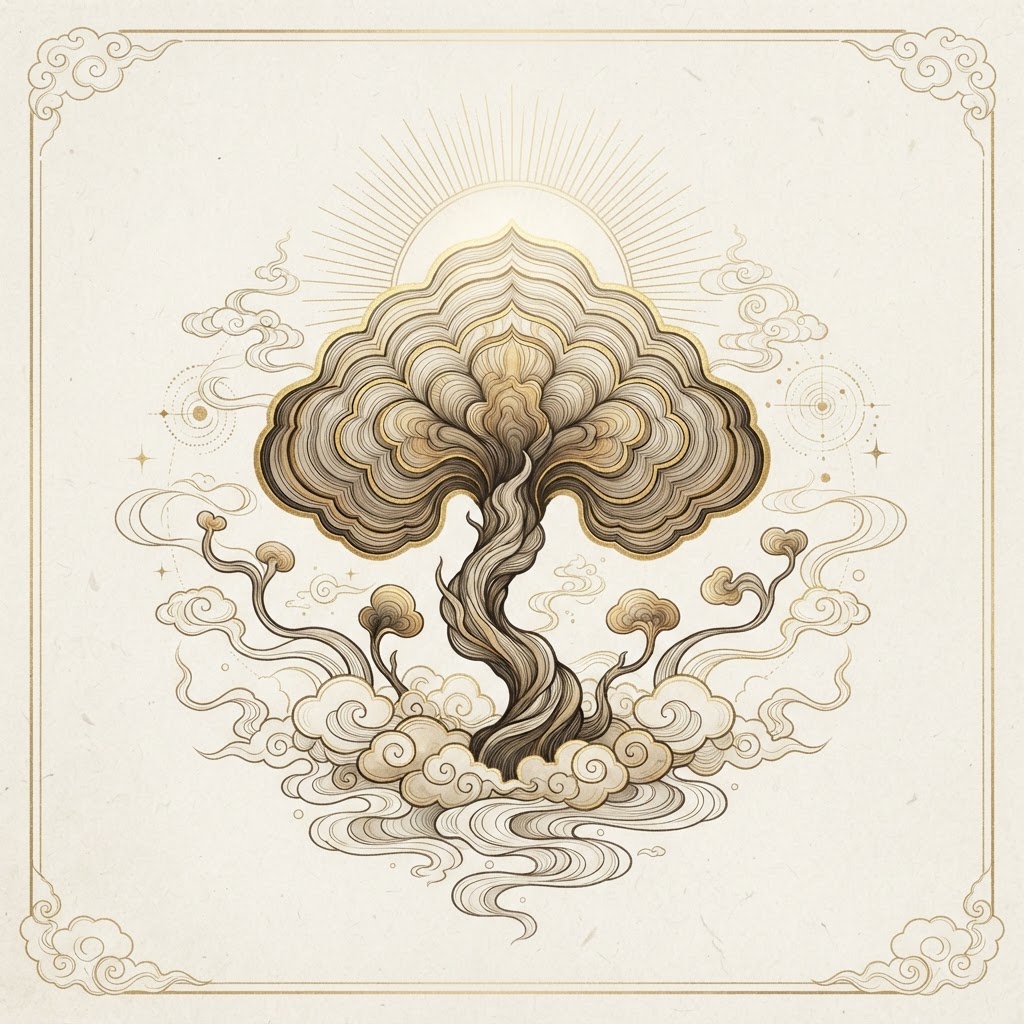
Lingzhi: Meaning, Origin & Symbolism
Also known as: Mushroom of Immortality, Reishi, Divine Herb, Fungus of Spiritual Potency
Taoist/Chinese
Taoist/Chinese
Heart Chakra
Crown Chakra
Wood
Longevity
Healing
Wisdom
Transformation
The sacred bracket fungus symbolizing bodily longevity, spiritual immortality, and the attainment of the Tao.
Quick Facts
- Category
- Taoist/Chinese
- Culture / Origin
- Taoist/Chinese
- Geographic Origin
- China
- Historical Period
- Warring States to present
- Estimated Age
- 2200+ years
- Element
- Wood
- Chakra
- Heart, Crown
- Deities
- Shouxing, Ge Hong, Eight Immortals
- Verification
- unverified
What is Lingzhi?
Lingzhi (Ganoderma lucidum), traditionally translated as the 'Herb of Spiritual Potency' or 'Mushroom of Immortality', holds a preeminent place in Taoist medicine, folklore, and internal alchemy. Recognizable by its lacquered, kidney-shaped cap and woody texture, this rare polypore mushroom has been revered for millennia across China as the supreme natural tonic for extending life and clarifying consciousness.
In Taoist iconography, Lingzhi is frequently depicted alongside legendary immortals (Xian), the God of Longevity (Shouxing), and spirit animals like the crane and deer. It was believed to grow upon the mythical Penglai Islands and high mist-shrouded sacred peaks where immortals dwelled, absorbing the purest celestial and terrestrial Qi over hundreds of years.
Beyond its botanical reality, the Lingzhi became an archetypal symbol of transcendence and imperial grace. Its distinct, swirling cloud-like contours inspired the design of decorative art, imperial architecture, and ritual scepters like the Ruyi throughout imperial Chinese history.
Meaning of Lingzhi
Lingzhi represents physical longevity, superior vitality, and the ultimate Taoist goal of spiritual immortality.
Origin & History
Textual references to Lingzhi date back to the 3rd century BCE, appearing in the 'Classic of Mountains and Seas' (Shan Hai Jing) and the 'Shennong Bencao Jing' (Divine Farmer's Materia Medica), where it was classified as the highest among superior herbs—capable of prolonging life without toxic side effects.
During the Qin and Han dynasties, Emperor Qin Shi Huang and Emperor Wu of Han dispatched expeditions into the eastern seas to search for the miraculous mushroom. Alchemical masters like Ge Hong (283–343 CE) described extensive methods for gathering and ingesting various types of Lingzhi to achieve physical levitation and bodily incorruptibility.
Spiritual Meaning
To the Taoist adept, Lingzhi is the physical embodiment of condensed, purified Shen (spirit) and Jing (vital essence). Ingesting or meditating upon Lingzhi reminds the practitioner that the materials for spiritual awakening are rooted in nature's quiet, patient transformations. It grows on decaying wood, symbolizing the alchemical triumph of life and renewal over decay and death.
Spiritually, it represents the pacification of the five emotional spirits, allowing the practitioner to cultivate an unshakeable, peaceful presence. It is considered a living bridge between the dense material earth and the rarefied, radiant heavens.
Symbolism
The glossy, tiered concentric growth rings symbolize the accumulation of cosmic wisdom over time. Its umbrella-like canopy represents divine shelter and celestial favor, while its resemblance to curling clouds links it to celestial ascension and effortless flow.
Traditional Uses
Historically treated as an auspicious omen when discovered in nature or in palaces, signaling a righteous ruler and celestial favor. In herbalism, it tonifies Heart Qi, calms the spirit, and preserves youthfulness.
Modern Spiritual Uses
In contemporary herbal medicine and integrative wellness, Lingzhi (Reishi) is celebrated as an adaptogen that promotes immunity, reduces chronic stress, supports restful sleep, and fosters mental clarity.
Healing Associations
Regarded in Traditional Chinese Medicine as the ultimate tonic for the immune system, heart regulation, deep vitality, and stress relief.
Protection Associations
Used to guard the spirit (Shen) from nightmares, emotional volatility, and unseen malevolent spiritual intrusions.
How the Symbol Is Used
- •Taoist Internal Alchemy (Neidan)
- •Traditional Chinese Medicine
- •Daoist Dietary Regimens (Bigu)
- •Qigong
Cultural Context
Taoist/Chinese — China (Warring States to present)
Sources & References
- 1.Ge Hong. 'Baopuzi' (4th Century CE)
- 2.Unschuld, Paul U. 'Shen Nong Ben Cao Jing' (Trans. 2021)
- 3.Pregadio, Fabrizio. 'The Great Clarity: Daoism and Alchemy in Early Medieval China' (2006)
This content is for educational and informational purposes only. Where modern spiritual interpretations are described, they are not presented as ancient historical facts. It is not a substitute for professional medical or spiritual advice.