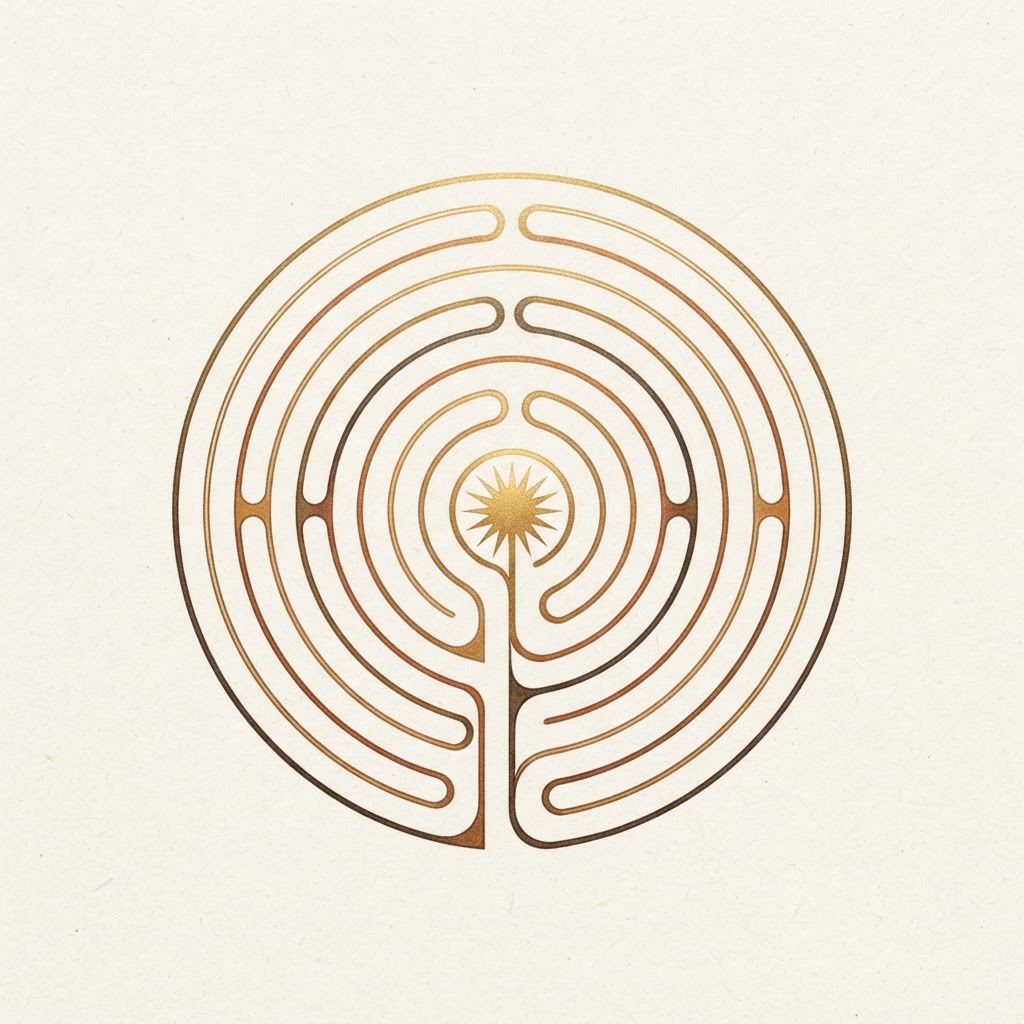
Labyrinth of Crete: Meaning, Origin & Symbolism
Also known as: Cretan Labyrinth, Knossos Maze, Classical Labyrinth
Greek & Roman
Minoan & Ancient Greece
Root Chakra
Crown Chakra
Earth
Wisdom
Transformation
Clarity
Protection
A seven-circuit concentric unicursal pathway symbolizing the inner spiritual quest, rebirth, and orientation.
Quick Facts
- Category
- Greek & Roman
- Culture / Origin
- Minoan & Ancient Greece
- Geographic Origin
- Crete and Greece
- Historical Period
- Bronze Age to Classical Antiquity
- Estimated Age
- circa 1600 BCE
- Element
- Earth
- Planet
- Moon
- Chakra
- Root, Crown
- Zodiac
- Cancer, Virgo
- Deities
- Ariadne, Dionysus, Daedalus, Theseus
- Verification
- unverified
What is Labyrinth of Crete?
The Labyrinth of Crete is a classical unicursal design consisting of seven concentric circuits winding around a central chamber. Unlike a puzzle maze with dead ends and branching choices, a true labyrinth contains a single non-branching path guiding the traveler from the perimeter directly to the center and back out.
In mythology, the architect Daedalus designed the labyrinth at Knossos to imprison the half-man, half-bull Minotaur. The Athenian hero Theseus entered its depths, slew the monster, and traced his way back to safety using a ball of golden thread given to him by Princess Ariadne.
The Cretan labyrinth pattern was struck onto Knossos coins in the 5th century BCE and carved onto rocks, floors, and amulets throughout the Roman and Hellenistic worlds.
Meaning of Labyrinth of Crete
The Labyrinth represents a continuous journey of initiation, finding one's way through challenge, and the search for inner truth.
Origin & History
Archaeological excavations at the Minoan palace complex of Knossos revealed a vast, labyrinthine network of multi-storied chambers, storage magazines, and courtyards, giving rise to the later classical myth. The word 'labyrinth' may connect to the Minoan labrys (double axe).
The seven-circuit design became a cross-cultural archetypal template, inscribed on Roman mosaics and later adapted into Christian cathedral pavements during the Middle Ages.
Spiritual Meaning
Spiritually, the Labyrinth is a sacred pilgrimage mapped onto geometry. Walking its path represents entering the deep subconscious to confront the Minotaur—the unintegrated shadow self—and returning renewed.
Ariadne's thread symbolizes divine intuition, remembrance of the soul's origin, and the spiritual anchor that prevents one from becoming lost in worldly confusion.
Symbolism
The seven concentric paths correspond to the seven ancient planets or layers of being; the singular path shows faith in the unfolding process; the center represents self-realization.
Traditional Uses
Commemorated as the legendary testing ground of heroic virtue where Theseus proved moral and physical courage.
Modern Spiritual Uses
Used worldwide as a non-denominational somatic walking meditation tool for centering, emotional restoration, and mindfulness.
Healing Associations
Calms anxious nervous states, integrates left and right brain hemispheres, and facilitates grief processing.
Protection Associations
Used on thresholds to trap malevolent wandering entities unable to navigate the intricate path.
How the Symbol Is Used
- •Labyrinth Walking
- •Somatic Movement
- •Shadow Work
Cultural Context
Minoan & Ancient Greece — Crete and Greece (Bronze Age to Classical Antiquity)
Sources & References
- 1.Castleden, Rodney. The Knossos Labyrinth: A New View of the Palace of Minos at Knossos. Routledge, 1990.
- 2.Kern, Hermann. Through the Labyrinth. Prestel, 2000.
This content is for educational and informational purposes only. Where modern spiritual interpretations are described, they are not presented as ancient historical facts. It is not a substitute for professional medical or spiritual advice.