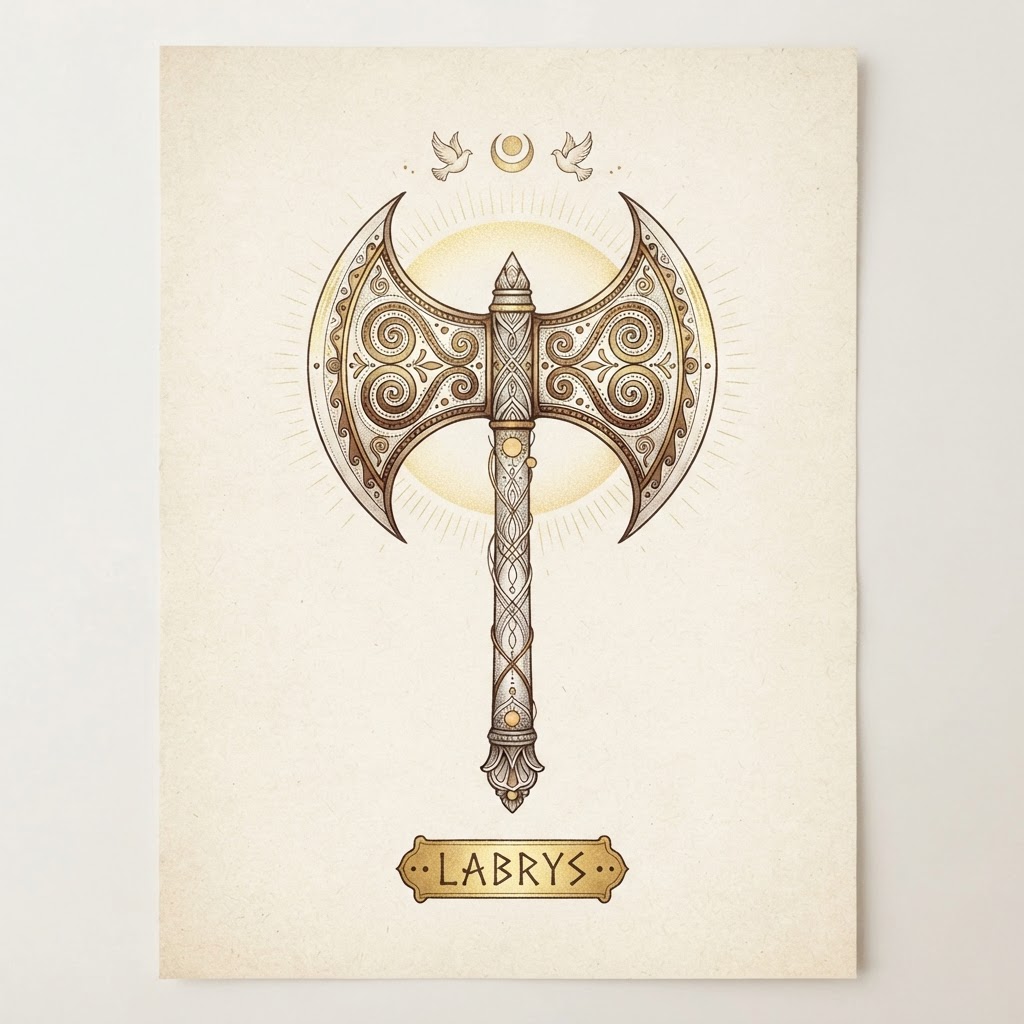
Labrys: Meaning, Origin & Symbolism
Also known as: Double-Headed Axe, Pelekys
Greek & Roman
Minoan, Greek, and Roman
Sacral Chakra
Crown Chakra
Ether/Spirit
Empowerment
Transformation
Balance
Protection
A double-bladed axe associated with Minoan matriarchal religion and later Greek deities, symbolizing sovereignty and dual transformation.
Quick Facts
- Category
- Greek & Roman
- Culture / Origin
- Minoan, Greek, and Roman
- Geographic Origin
- Crete and the Aegean Basin
- Historical Period
- Bronze Age through Classical Antiquity
- Estimated Age
- circa 2000 BCE
- Element
- Ether/Spirit
- Planet
- Moon
- Chakra
- Sacral, Crown
- Zodiac
- Cancer, Libra
- Deities
- Potnia Theron, Artemis, Zeus Labraundos, Demeter
- Verification
- unverified
What is Labrys?
The Labrys is a symmetrical, double-headed ritual axe of ancient Mediterranean origin, most prominently unearthed within the Bronze Age Minoan palace civilization of Crete. Although its functional roots lie in stone and bronze forestry tools, the Minoan Labrys was overwhelmingly a sacred, ceremonial instrument rather than a practical weapon.
Found in frescoes, gold jewelry, and sanctuary altars across Knossos, the Labrys was exclusively wielded by Minoan priestesses and goddesses. The word 'labyrinth' itself is linguistically linked to the Labrys, meaning 'the palace of the double axe'. It presided over sacrificial consecrations, harvest dedications, and threshold ceremonies.
In classical Greek religion, the symbol was adopted into the mythos of Zeus Labraundos, Dionysus, and the fierce matriarchal warrior society of the Amazons, retaining its primordial associations with sovereignty, transformation, and cosmic balance.
Meaning of Labrys
The Labrys represents sacred authority, goddess sovereignty, transformative sacrifice, and the union of lunar dualities.
Origin & History
Archaeological excavations by Sir Arthur Evans at Knossos yielded massive bronze and gilded double axes standing on stepped pedestals, far too heavy and delicate for combat. They stood as monumental fixtures within sacred halls.
As Minoan culture blended into Mycenaean and Archaic Greek culture, the labrys was integrated into Hellenic religion. In Caria (southwestern Anatolia), Zeus Labraundos was depicted holding the axe as a thunderbolt emblem, showing how the symbol transitioned from a Cretan goddess emblem into a symbol of divine storm-power.
Spiritual Meaning
Esoterically, the crescent-shaped dual blades of the Labrys correspond to the waxing and waning phases of the moon, embodying the eternal cycle of birth, death, and renewal. It balances the outward expression of power with inward spiritual contemplation.
Because of its balance and dual edges, it serves as a spiritual compass for walking the inner labyrinth—clearing spiritual obstacles and unifying the subconscious with the waking mind.
Symbolism
The dual crescent blades represent the waxing and waning moon, balance of opposites, and divine feminine authority; the central haft represents the axis mundi and decisive focus.
Traditional Uses
A sacred Minoan altar instrument wielded by priestesses for rituals of consecration and communion with the Great Mother.
Modern Spiritual Uses
Adopted in modern matriarchal spirituality, feminist theology, and LGBTQ+ culture as an emblem of female empowerment, autonomy, and balance.
Healing Associations
Cutting away toxic attachments, balancing shadow and light aspects of the psyche.
Protection Associations
Used historically to ward thresholds and protect sacred ceremonial precincts from profane intrusion.
How the Symbol Is Used
- •Goddess rituals
- •Labyrinth meditation
- •Boundary consecration
- •Shadow release
Cultural Context
Minoan, Greek, and Roman — Crete and the Aegean Basin (Bronze Age through Classical Antiquity)
Sources & References
- 1.Evans, Arthur. 'The Palace of Minos at Knossos'. Macmillan.
- 2.Castleden, Rodney. 'Minoans: Life in Bronze Age Crete'. Routledge.
This content is for educational and informational purposes only. Where modern spiritual interpretations are described, they are not presented as ancient historical facts. It is not a substitute for professional medical or spiritual advice.