Kokopelli: Meaning, Origin & Symbolism
Also known as: Kokopele, Humpbacked Flute Player
Indigenous
Ancestral Puebloan / Hopi / Zuni
Sacral Chakra
Throat Chakra
Air
Abundance
Transformation
Joy
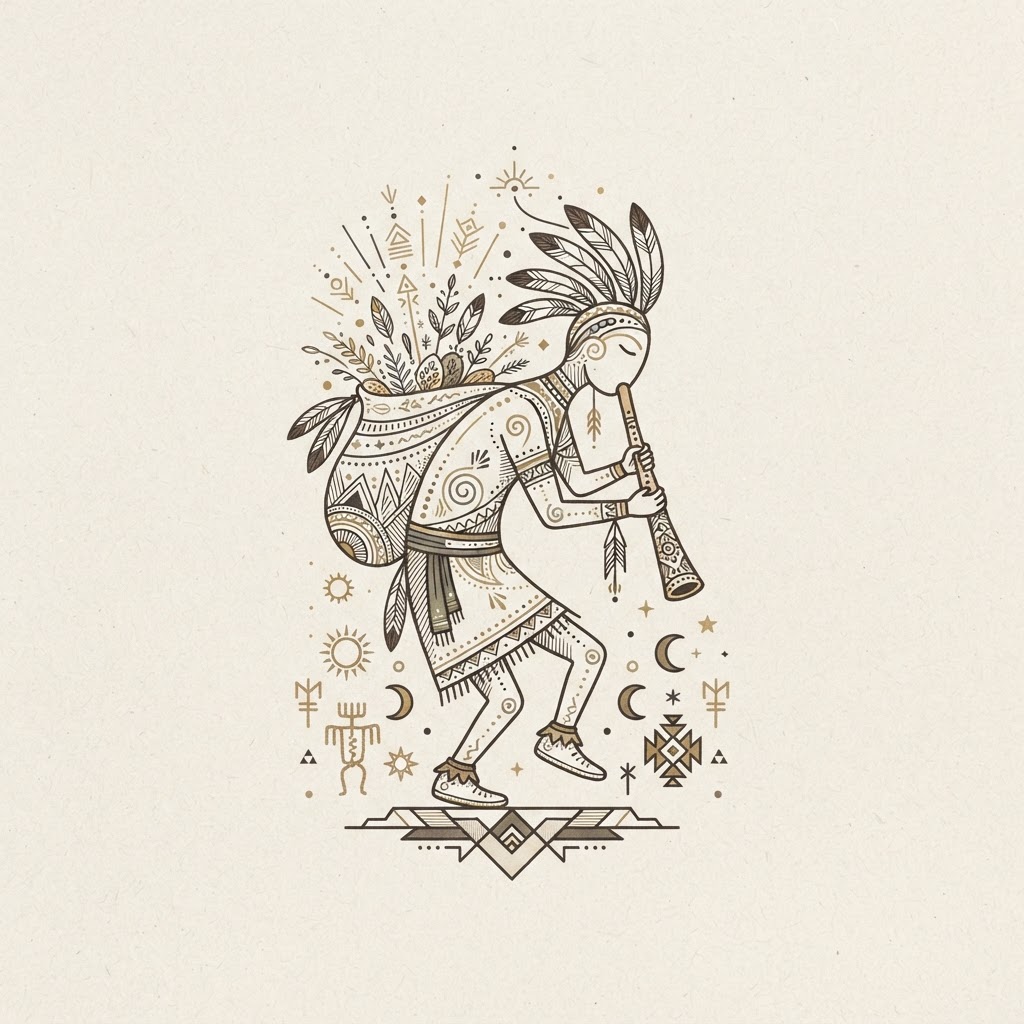
An ancient Southwestern Indigenous fertility deity and trickster, depicted playing a flute while carrying songs and seeds.
Quick Facts
- Category
- Indigenous
- Culture / Origin
- Ancestral Puebloan / Hopi / Zuni
- Geographic Origin
- Southwestern United States
- Historical Period
- Basketmaker III to Historic Pueblo
- Estimated Age
- 1500+ years
- Element
- Air
- Planet
- Mercury
- Chakra
- Sacral, Throat
- Zodiac
- Gemini, Sagittarius
- Deities
- Koko (Kachinas), Kokopölö
- Verification
- unverified
What is Kokopelli?
Kokopelli is an iconic petroglyphic figure found across the canyons, mesas, and river basins of the American Southwest. Traditionally rendered as a hunched or humpbacked figure playing a transverse flute, he is revered among Ancestral Puebloan, Hopi, and Zuni traditions.
His hump is understood traditionally not as a physical deformity, but as a woven pack loaded with sacred seeds, songs, babies, blankets, and blessings for agricultural communities. By playing his flute, he coaxes warmth from the earth, causes the snow to melt, brings down rain, and stirs the germinating seeds.
While popularized as an artistic motif, Kokopelli embodies sacred fertility, jovial mischief, musical invocation, and the deep connection between communal joy and agricultural survival in an arid landscape.
Meaning of Kokopelli
Agricultural abundance, human fertility, seasonal warmth, musical power, and jovial transformation.
Origin & History
Kokopelli appears on rock walls, ceramics, and kiva murals dating back to at least 700 to 1000 CE. He was frequently depicted alongside animal spirits, spiral rain motifs, and celestial events.
Some anthropologists hypothesize Kokopelli originated from traveling Pochteca traders from Mesoamerica who carried trade goods in large packs and played flutes to announce friendly, non-threatening entry into desert settlements.
Spiritual Meaning
Kokopelli personifies the ecstatic and fertile life force that animates nature. His flute music acts as an acoustic bridge between human supplication and celestial rainfall.
As a trickster figure, he teaches the spiritual virtue of lightheartedness, demonstrating that rigid dogma can be broken through humor, creative song, and spontaneous celebration.
Symbolism
The flute signifies the voice of the wind, song, and prayer for rain; the hump represents a pack brimming with seeds, plants, and prosperity; the curved body posture denotes vitality and rhythmic dance.
Traditional Uses
A respected Kachina spirit and agricultural deity whose arrival heralds springtime fertility, seasonal rains, and communal copiousness.
Modern Spiritual Uses
A ubiquitous emblem of southwestern art, music, creative inspiration, playful freedom, and non-conformist spirit.
Healing Associations
Assists with reproductive health, lifts depressive mood, and inspires creative awakening.
Protection Associations
Invoked traditionally to protect crops from drought, frost, and barrenness.
How the Symbol Is Used
- •Planting ceremonies
- •Flute rituals
- •Fertility dances
Cultural Context
Ancestral Puebloan / Hopi / Zuni — Southwestern United States (Basketmaker III to Historic Pueblo)
Sources & References
- 1.Malotki, Ekkehart. The Many Faces of Kokopelli (1993).
- 2.Fewkes, J. Walter. Hopi Katcinas Drawn by Native Artists (1903).
This content is for educational and informational purposes only. Where modern spiritual interpretations are described, they are not presented as ancient historical facts. It is not a substitute for professional medical or spiritual advice.