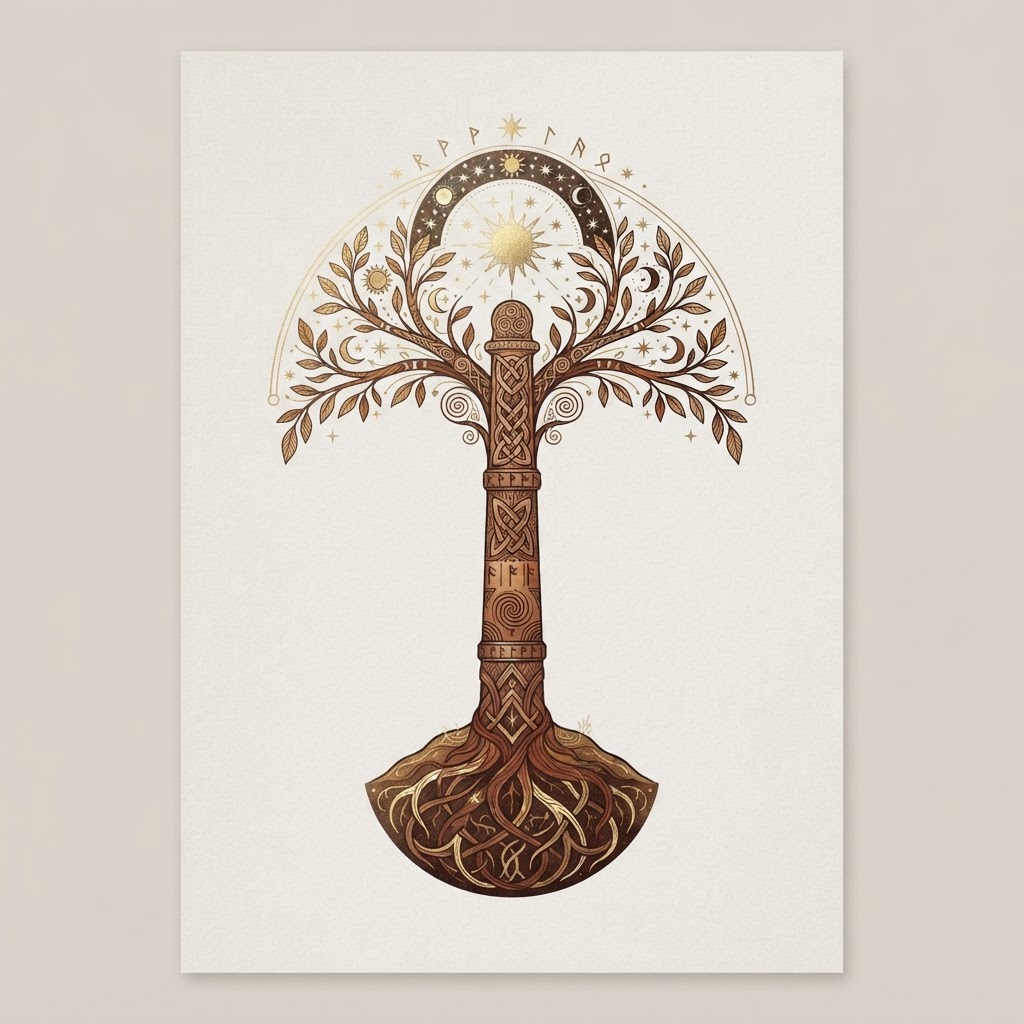
Irminsul: Meaning, Origin & Symbolism
Also known as: Great Pillar, Ermensul, Saxon World Column
Norse/Germanic
Germanic (Saxon)
Root Chakra
Crown Chakra
Earth
Grounding
Strength
Harmony
Consecration
The sacred pillar of the Continental Saxons that served as the axis supporting the firmament.
Quick Facts
- Category
- Norse/Germanic
- Culture / Origin
- Germanic (Saxon)
- Geographic Origin
- Central Europe, modern Germany (Westphalia)
- Historical Period
- Early Medieval
- Estimated Age
- circa 8th century CE and older
- Element
- Earth
- Planet
- Jupiter
- Chakra
- Root, Crown
- Zodiac
- Taurus, Capricorn
- Deities
- Tyr, Irmin, Odin
- Verification
- unverified
What is Irminsul?
The Irminsul was a colossal, sacred wooden pillar or tree trunk venerated by the Old Saxons of ancient Germany. Described by medieval chronicler Rudolf of Fulda in the 9th century as 'universalis columna quasi sustinens omnia' (a universal column, as it were, sustaining all things), it formed the spiritual and religious epicenter of Saxon resistance against forced Christianization. In 772 CE, Charlemagne launched his Saxon campaigns by capturing the stronghold of Eresburg and systematically destroying the chief Irminsul to break the spiritual morale of the Germanic tribes. Iconographically, it is traditionally depicted with two curved branches curling outward from a central trunk, resembling both an unbent arch and the horns of celestial equilibrium.
Meaning of Irminsul
The sacred cosmic axis supporting the celestial vault and unifying tribal community around natural law.
Origin & History
The Irminsul was dedicated either to Irmin, an ancient Germanic celestial or war deity closely cognate with Tiwaz (Tyr) or Odin/Wodan, or stood simply as a personification of cosmic order. Its destruction by Frankish forces marked a pivotal turning point in the Christianization of Northern Europe.
Spiritual Meaning
The Irminsul represents unwavering divine alignment and the bridge connecting humanity to the stars. It embodies cosmic stability, truth, and community endurance. Standing tall against external corruption, it reminds the soul of its unbreakable divine lineage and the necessity of establishing firm spiritual roots to uphold heavenly ideals.
Symbolism
The central shaft denotes the upward ascent of consciousness, while the outward-curling crest represents the heavens cradling the cosmos, embodying balance and universal harmony.
Traditional Uses
The tribal sanctum of the Saxons where high councils were convened, religious rites enacted, and oaths sworn to the gods.
Modern Spiritual Uses
Revered in Continental Germanic heathenry as a symbol of cultural restoration, honoring natural sanctuaries, and maintaining unyielding spiritual integrity.
Healing Associations
Aligns the spinal column energetically and promotes structural posture and grounding.
Protection Associations
Defends community cohesion and shields sacred spaces against external desecration.
How the Symbol Is Used
- •Sacred grove rites
- •Altar pillar consecration
- •Community gatherings
- •Seasonal blóts
Cultural Context
Germanic (Saxon) — Central Europe, modern Germany (Westphalia) (Early Medieval)
Sources & References
- 1.Rudolf of Fulda, Translatio Sancti Alexandri
- 2.Jacob Grimm, Teutonic Mythology
- 3.Bernard Mees, The Science of the Swastika and Other Symbols
This content is for educational and informational purposes only. Where modern spiritual interpretations are described, they are not presented as ancient historical facts. It is not a substitute for professional medical or spiritual advice.