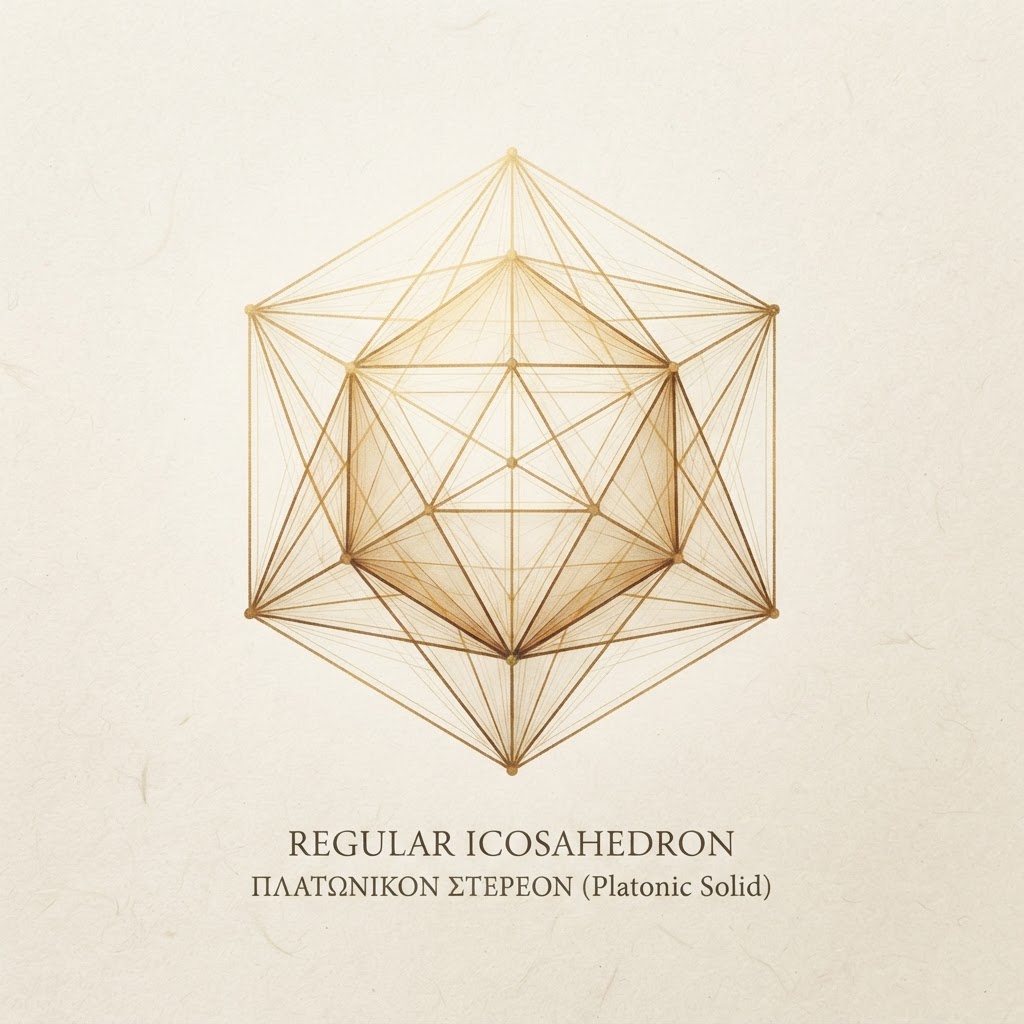
Regular Icosahedron: Meaning, Origin & Symbolism
Also known as: Water Polyhedron, Twenty-Faced Solid
Sacred Geometry
Classical Greek and Hellenistic
Sacral Chakra
Water
Healing
Harmony
Transformation
A Platonic solid composed of twenty identical equilateral triangular faces, thirty edges, and twelve vertices.
Quick Facts
- Category
- Sacred Geometry
- Culture / Origin
- Classical Greek and Hellenistic
- Geographic Origin
- Greece and the Mediterranean
- Historical Period
- Classical Antiquity
- Estimated Age
- circa 5th century BCE
- Element
- Water
- Planet
- Moon
- Chakra
- Sacral
- Zodiac
- Cancer, Scorpio, Pisces
- Deities
- Poseidon, Varuna
- Verification
- unverified
What is Regular Icosahedron?
The regular icosahedron is one of the five Platonic solids, distinguished by possessing the highest number of faces of the regular convex polyhedra. It is constructed from twenty identical equilateral triangular faces that intersect along thirty equal edges, converging at twelve distinct vertices. In three-dimensional space, the icosahedron exhibits a high degree of spherical symmetry and is the geometric dual of the dodecahedron. Its vertices naturally trace three orthogonal golden rectangles, embedding the divine proportion (Phi) directly into its fundamental structure.
Meaning of Regular Icosahedron
The geometric archetype of the element Water, representing fluidity, emotional depth, adaptation, and harmonious flow.
Origin & History
The mathematical characterization of the icosahedron emerged within the Pythagorean circle and was mathematically codified by Theaetetus of Athens. In Plato's cosmological dialogue Timaeus, the icosahedron was assigned to the element Water because of its smooth, rounded mobility, which Plato reasoned allowed it to flow and roll easily compared to the more rigid polyhedra. In modern virology, structural biology has verified that many viral capsids (such as Adenovirus and Herpesvirus) naturally form icosahedral shells to maximize enclosed internal space using minimal genetic coding.
Spiritual Meaning
The icosahedron embodies dynamic surrender, emotional release, and organic adaptability. Because its twenty faces allow it to roll almost as smoothly as a sphere, it teaches the conscious release of rigid attachments and encourages harmonious movement with the currents of life. In spiritual disciplines, meditating upon its complex geometric balance helps one navigate profound life transitions, fostering emotional maturity and opening creative avenues.
Symbolism
The twenty equilateral faces signify the fluidity of experience and emotional multiplicity. The three intersecting golden rectangles at its center symbolize the harmonious presence of divine proportion within organic flow.
Traditional Uses
Identified by classical Greek philosophy as the elemental component of water, reflecting fluidity, coolness, and responsiveness to change.
Modern Spiritual Uses
Used within contemporary sound healing and bioenergetics to dissolve rigid psychological habits and encourage creative and emotional flow.
Healing Associations
Used to balance fluid retention, support lymphatic harmony, and resolve repressed emotional trauma.
Protection Associations
Contemplated to soften aggressive confrontational environments through the fluid adaptation of defensive energy.
How the Symbol Is Used
- •Elemental attunement
- •Sacral chakra healing
- •Meditation on sacred form
- •Bioenergetic alignment
Cultural Context
Classical Greek and Hellenistic — Greece and the Mediterranean (Classical Antiquity)
Sources & References
- 1.Plato. Timaeus. translated by Benjamin Jowett, circa 360 BCE.
- 2.March, Lionel. Architectonics of Humanism: Essays on Number in Architecture. Academy Editions, 1998.
This content is for educational and informational purposes only. Where modern spiritual interpretations are described, they are not presented as ancient historical facts. It is not a substitute for professional medical or spiritual advice.