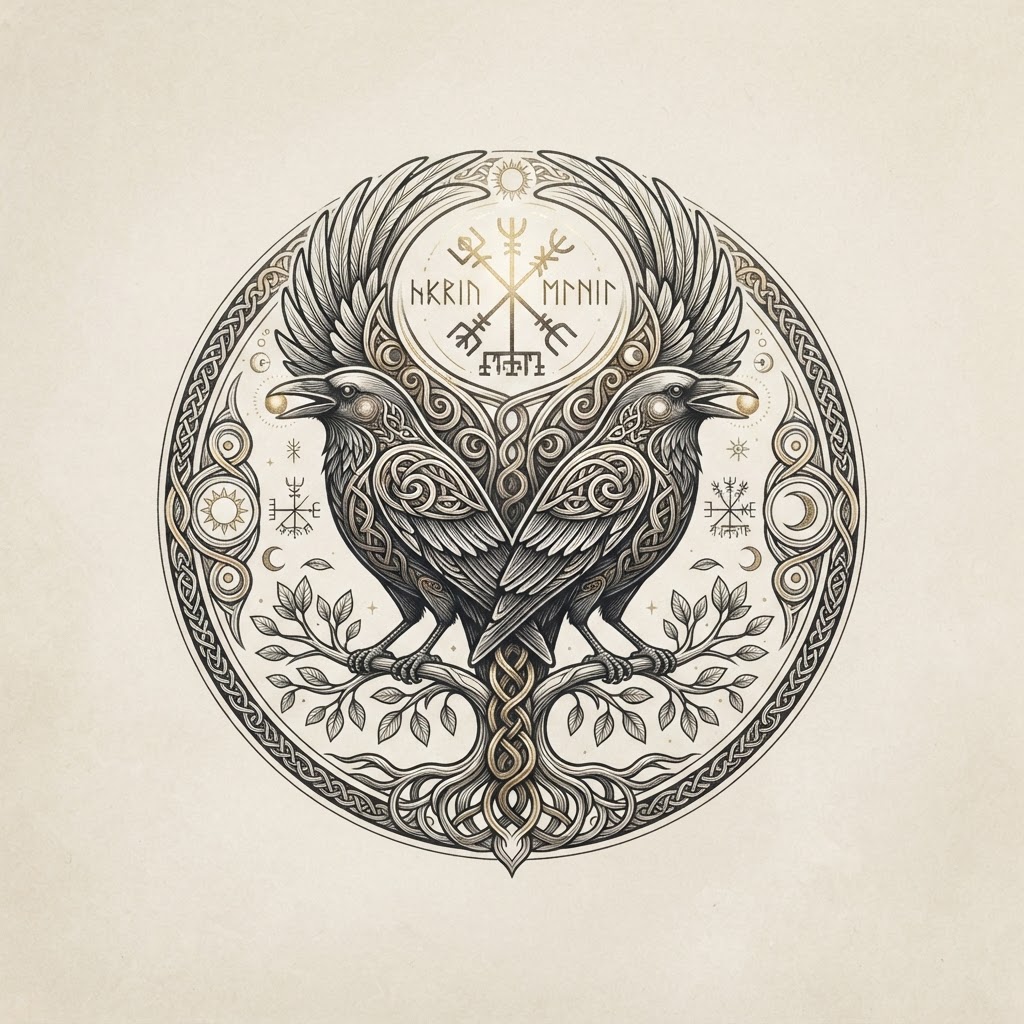
Huginn and Muninn: Meaning, Origin & Symbolism
Also known as: Odin's Ravens, Thought and Memory
Norse/Germanic
Norse/Germanic
Throat Chakra
Third Eye Chakra
Air
Wisdom
Clarity
Transformation
The twin ravens of Odin that fly across the entire world each day to bring back wisdom and knowledge.
Quick Facts
- Category
- Norse/Germanic
- Culture / Origin
- Norse/Germanic
- Geographic Origin
- Northern Europe
- Historical Period
- Migration Period to Viking Age
- Estimated Age
- circa 6th–11th century CE
- Element
- Air
- Planet
- Mercury
- Chakra
- Throat, Third Eye
- Zodiac
- Gemini, Virgo, Scorpio
- Deities
- Odin
- Verification
- unverified
What is Huginn and Muninn?
Huginn ('Thought') and Muninn ('Memory' or 'Mind') are the twin ravens that perch upon the shoulders of Odin the Allfather. According to the Grímnismál in the Poetic Edda, Odin sends them forth each morning at dawn to fly over the expanse of Midgard; they return at dusk to whisper into his ears all the tidings, secrets, and events they have witnessed. Odin famously expresses his deep anxiety that Huginn might not return, but fears even more for the loss of Muninn. Archeologically, ravens associated with warrior-deities appear on Vendel-era helmet plates, Migration Period bracteates, and Viking Age jewelry, reflecting the profound symbiosis between the god of war, battle carrion, and supreme mental perception.
Meaning of Huginn and Muninn
The projection of intellectual consciousness and deep intuitive memory across all dimensions of reality.
Origin & History
Ravens were deeply revered across Germanic culture as sacred birds of omen, battle, and wisdom. The famous Raven Banner was carried by Viking fleets to invoke Odin's tactical guidance and guarantee victory.
Spiritual Meaning
Huginn and Muninn represent the outward projection of the human psyche (Hugr) during meditative contemplation or shamanic trance. Huginn embodies active analytical thought, future vision, and intellectual exploration, while Muninn represents deep ancestral memory, introspection, and soul wisdom. Together, they demonstrate that complete consciousness requires a balanced harmony between forward-looking thought and respectful remembrance of roots.
Symbolism
The raven signifies keen perception, transformation through darkness, adaptability, and the bridge between physical reality and spiritual insight.
Traditional Uses
The eyes and ears of Odin, providing the sovereign god with omniscient intelligence over mundane affairs and the movements of fate.
Modern Spiritual Uses
An inspiring motif for writers, researchers, and spiritual seekers pursuing mental acuity, shadow work, mindfulness, and ancestral recall.
Healing Associations
Restores cognitive focus, enhances memory recall, and clears brain fog.
Protection Associations
Acts as an alert spiritual scout, warning of unseen deception and hidden danger.
How the Symbol Is Used
- •Vision questing
- •Memory retrieval exercises
- •Runic contemplation
- •Mindfulness meditation
Cultural Context
Norse/Germanic — Northern Europe (Migration Period to Viking Age)
Sources & References
- 1.Poetic Edda (Grímnismál)
- 2.Snorri Sturluson, Prose Edda
- 3.Claude Lecouteux, The Return of the Mhorg: Spirits, Familiars, and Animal Guides
This content is for educational and informational purposes only. Where modern spiritual interpretations are described, they are not presented as ancient historical facts. It is not a substitute for professional medical or spiritual advice.