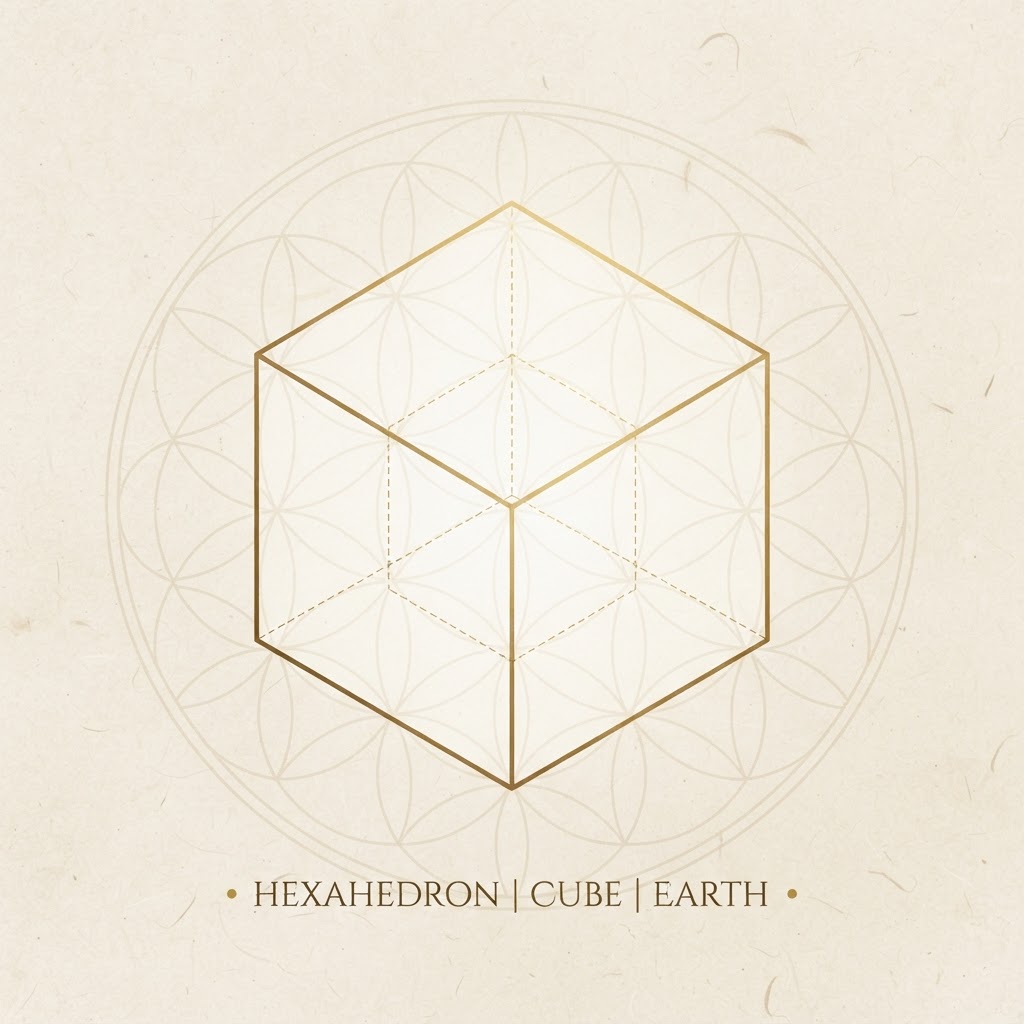
Hexahedron (Cube): Meaning, Origin & Symbolism
Also known as: Cube, Platonic Earth Solid
Sacred Geometry
Classical Greek and Semitic Traditions
Root Chakra
Earth
Protection
Harmony
A regular Platonic solid composed of six identical square faces meeting at right angles.
Quick Facts
- Category
- Sacred Geometry
- Culture / Origin
- Classical Greek and Semitic Traditions
- Geographic Origin
- Ancient Mediterranean and Near East
- Historical Period
- Classical Antiquity
- Estimated Age
- circa 5th century BCE
- Element
- Earth
- Planet
- Saturn
- Chakra
- Root
- Zodiac
- Taurus, Virgo, Capricorn
- Deities
- Gaia, Saturn
- Verification
- unverified
What is Hexahedron (Cube)?
The regular hexahedron, commonly designated as the cube, consists of six square faces, twelve equal edges, and eight vertices with right-angle corners. It is the only regular polyhedron whose faces tile three-dimensional Euclidean space continuously without leaving gaps.
Its structural symmetry represents the ultimate physical equilibrium in geometry. Every face, axis, and coordinate corresponds directly to the three dimensions of space, making it the universal geometric standard for spatial measurement and structural stability.
Meaning of Hexahedron (Cube)
The primordial element of Earth; stability, foundation, and terrestrial manifestation.
Origin & History
In Plato's 'Timaeus', the cube was linked directly to the element of Earth due to its heavy, stable, and immovable base, which provides the most solid structural foundation among the Platonic solids.
Beyond Greek philosophy, cubic architecture was central to sacred spaces across ancient traditions, from the Holy of Holies (Kodesh Hakodashim) in the Temple of Jerusalem to the Kaaba in Mecca, symbolizing sacred boundaries containing the unconditioned presence of the Divine within physical reality.
Spiritual Meaning
The cube represents grounded presence, material manifestation, and divine truth rooted in moral integrity and stability. It conveys that true spiritual elevation requires an unshakable, balanced physical and psychological vessel.
Contemplating the cube assists seekers who feel ungrounded, disoriented, or overwhelmed by abstract thoughts to reconnect with reality, routine, and practical manifestation.
Symbolism
Six faces signify stability across all directional axes; right angles denote righteousness, measure, and balanced boundaries.
Traditional Uses
Identified in Pythagorean and Hermetic philosophy as the primordial matrix of physical matter, stability, and enduring structure.
Modern Spiritual Uses
Used as a grounding archetype to balance bioenergies, establish firm personal boundaries, and root high-frequency mental insights into daily life.
Healing Associations
Assists with skeletal alignment, chronic exhaustion, and calming manic emotional volatility.
Protection Associations
Acts as an impenetrable geometric fortress in psychic visualization to repel chaotic energies.
How the Symbol Is Used
- •Grounding Visualizations
- •Sacred Altar Construction
- •Crystal Layouts
Cultural Context
Classical Greek and Semitic Traditions — Ancient Mediterranean and Near East (Classical Antiquity)
Sources & References
- 1.Euclid. The Thirteen Books of the Elements. Translated by Thomas L. Heath. Dover Publications, 1956.
- 2.March, Lionel. Architectonics of Humanism. Academy Editions, 1998.
This content is for educational and informational purposes only. Where modern spiritual interpretations are described, they are not presented as ancient historical facts. It is not a substitute for professional medical or spiritual advice.