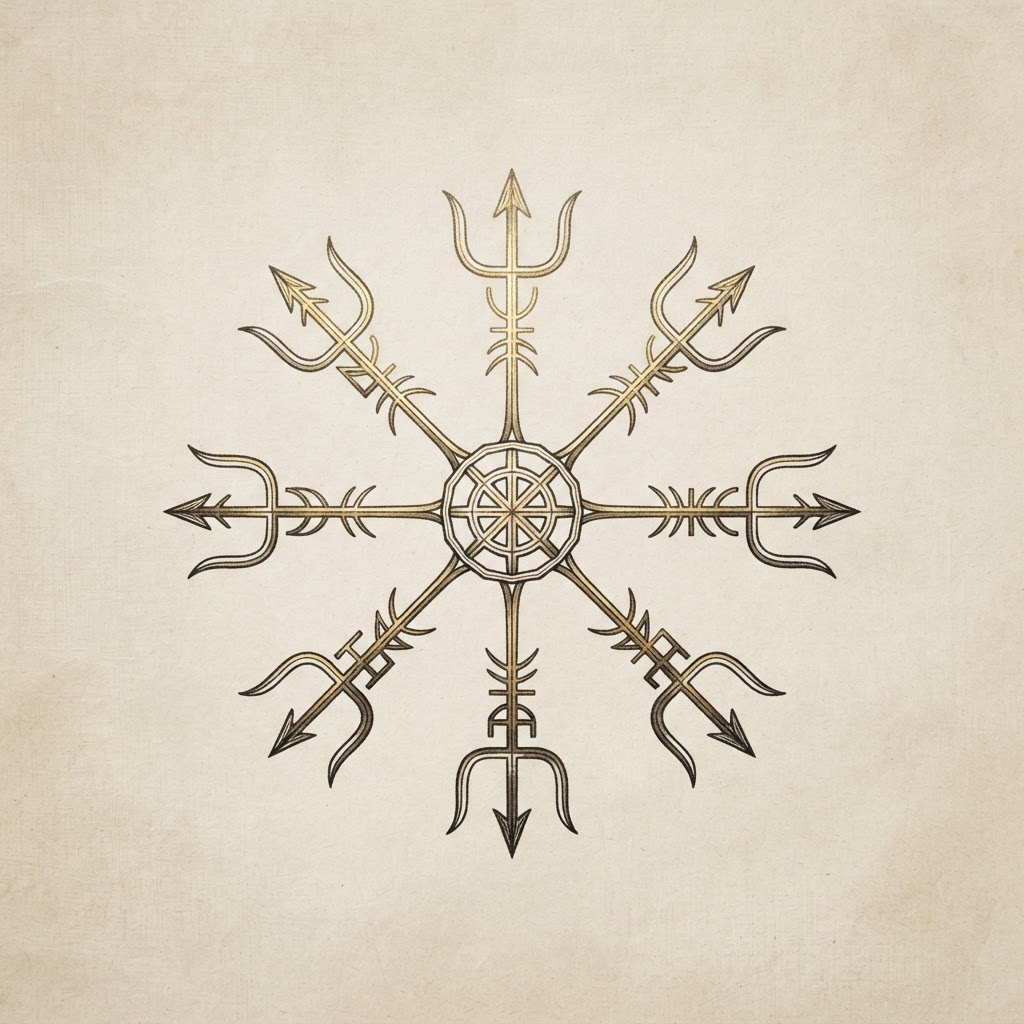
Helm of Awe: Meaning, Origin & Symbolism
Also known as: Ægishjálmr, Aegishjalmur
Norse/Germanic
Norse/Icelandic
Third Eye Chakra
Solar Plexus Chakra
Fire
Protection
Courage
Confidence
An eight-spoked magical stave designed to instill fear in adversaries and confer absolute spiritual invulnerability.
Quick Facts
- Category
- Norse/Germanic
- Culture / Origin
- Norse/Icelandic
- Geographic Origin
- Iceland
- Historical Period
- Late Medieval to Early Modern
- Estimated Age
- circa 16th–17th century CE (manuscript form)
- Element
- Fire
- Planet
- Mars
- Chakra
- Third Eye, Solar Plexus
- Zodiac
- Aries, Scorpio
- Deities
- Odin, Tyr
- Verification
- unverified
What is Helm of Awe?
The Helm of Awe, known in Icelandic as Ægishjálmr, is an eightfold symmetrical stave terminating in trident-like or crossbar points radiating from a central core. While early heroic literature such as the Völsunga Saga and Fáfnismál mentions the 'helm of terror' worn by the dragon Fáfnir as a physical helmet or mantle that made him invincible, the graphic stave itself is documented in early modern Icelandic grimoires, most prominently the Galdrabók (circa 1600 CE). The magical texts instruct the user to press the stave in lead or paint it between the eyes to strike terror into enemies, overcome opposition, and maintain invulnerability against sorcery and mundane malice.
Meaning of Helm of Awe
A protective talisman designed to induce terror in enemies and shield the bearer from external hostility.
Origin & History
Although originating conceptually in Viking heroic saga traditions regarding dragon-hoards and terror-helmets, the specific geometric sigil developed within the Icelandic galdrastafir tradition, combining indigenous runic motifs with European Renaissance esoteric geometry.
Spiritual Meaning
On an esoteric level, the Helm of Awe represents an impenetrable energetic fortress. Radiating outwards from the center (the self), its eight arms create a psychic perimeter that neutralizes incoming negative intentions, psychic attacks, and oppressive social energies while reinforcing the bearer's unshakeable sovereignty and core truth.
Symbolism
The radiating arms resemble Algiz (Elhaz) protection runes multiplied eightfold, projecting divine defense in all directions around the central seat of consciousness.
Traditional Uses
Applied between the brows or upon armor to conquer rivals, assert authority in legal conflicts, and prevail in combat.
Modern Spiritual Uses
Extensively worn in modern spirituality as an amulet of supreme psychic defense, inner confidence, and emotional fortitude against toxic environments.
Protection Associations
Provides psychic defense, repels hostile entities, wards against ill intent, and paralyzes opposition.
How the Symbol Is Used
- •Amulet crafting
- •Sigil meditation
- •Psychic shielding
- •Modern Galdr practice
Cultural Context
Norse/Icelandic — Iceland (Late Medieval to Early Modern)
Sources & References
- 1.Stephen Flowers, The Galdrabók: An Icelandic Grimoire
- 2.Völsunga Saga
- 3.Jón Árnason, Icelandic Legends
This content is for educational and informational purposes only. Where modern spiritual interpretations are described, they are not presented as ancient historical facts. It is not a substitute for professional medical or spiritual advice.