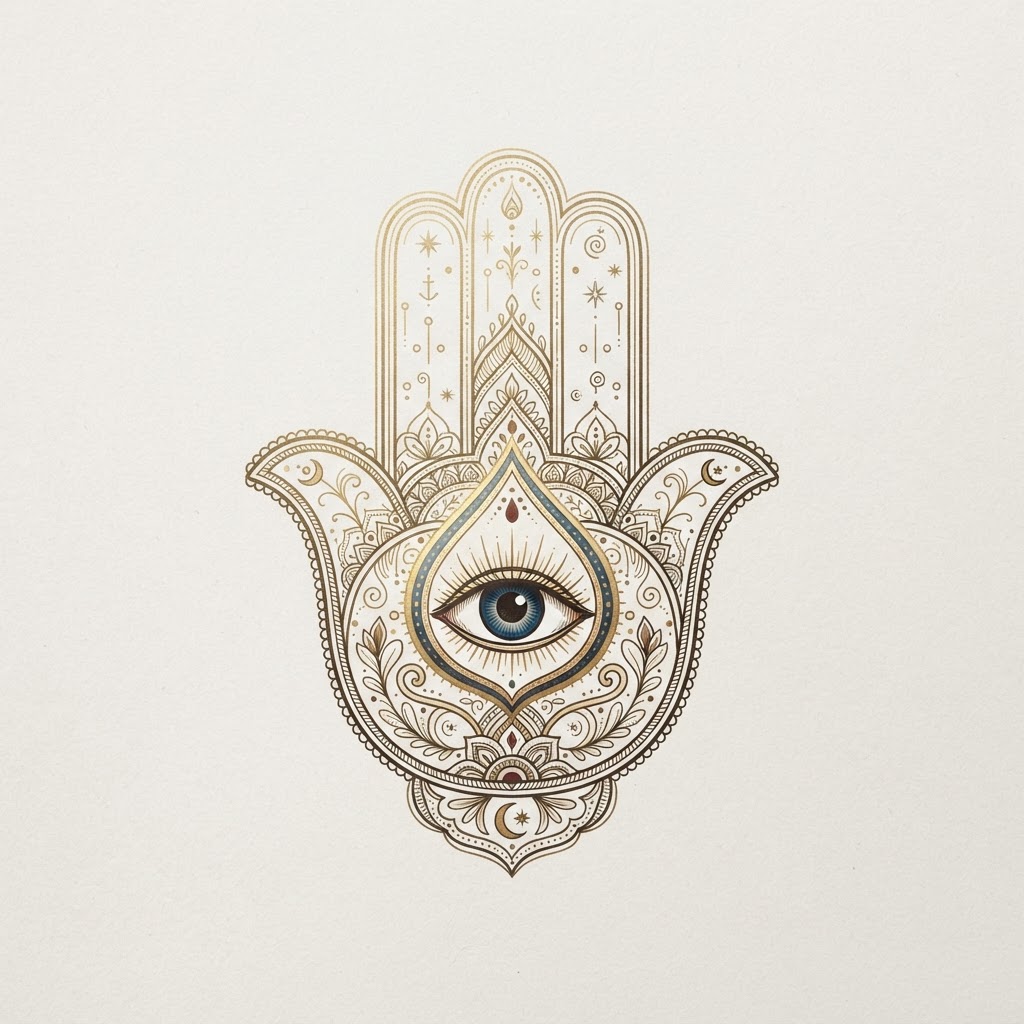
Hamsa: Meaning, Origin & Symbolism
Also known as: Hand of Fatima, Hand of Miriam, Khamsah, Hamesh
Protective Symbols
Middle Eastern
Heart Chakra
Throat Chakra
Water
Protection
Peace
Abundance
Love
An ancient Middle Eastern palm-shaped amulet recognized across cultures as a powerful defense against the evil eye and bearer of good fortune.
Quick Facts
- Category
- Protective Symbols
- Culture / Origin
- Middle Eastern
- Geographic Origin
- Levant, Mesopotamia, and North Africa
- Historical Period
- Bronze Age through Classical Antiquity to Modern Era
- Estimated Age
- circa 1800 BCE
- Element
- Water
- Planet
- Moon
- Chakra
- Heart, Throat
- Zodiac
- Cancer, Taurus
- Deities
- Tanit, Ishtar, Inanna
- Verification
- unverified
What is Hamsa?
The Hamsa is a palm-shaped open hand, frequently depicted symmetrically with two thumbs facing outward, although asymmetrical variations resembling an anatomically realistic hand also exist. Rooted in ancient Semitic and Mediterranean cultures, the Hamsa is universally deployed as an apotropaic charm, held up as an energetic barrier to repel envious glares, curses, and misfortune.
Over millennia, the Hamsa has woven itself through multiple theological frameworks. In Islamic culture, it is commonly revered as the Hand of Fatima, honoring the devotion and purity of the Prophet Muhammad's daughter. In Jewish traditions, it is celebrated as the Hand of Miriam, sister to Moses and Aaron, frequently inscribed with sacred prayers such as the Birkat HaBayit (Blessing for the Home) or the Shema.
Often adorned with an open eye motif in the center of the palm, floral arabesques, fish, or geometric motifs, the Hamsa functions as a two-way conduit: reflecting malicious spiritual energies back to their source while channeling divine blessings, vitality, fertility, and peace toward the possessor.
Meaning of Hamsa
The Hamsa represents defense against envy, spiritual defilement, and malicious intentions, while ushering in divine benevolence and prosperity.
Origin & History
Archaeological evidence indicates that the open right hand was utilized as a protective motif in ancient Mesopotamia and Phoenicia, notably associated with the goddess Tanit in Carthage. Punic stelae from North Africa bear clear renderings of the raised hand meant to ward off harm.
Following antiquity, the symbol was integrated into Jewish, Christian, and Islamic practices across North Africa and the Mediterranean basin. Despite periodic skepticism from orthodox theologians regarding magical amulets, the Hamsa remained deeply cherished as folk protection against the evil eye.
Spiritual Meaning
Spiritually, the Hamsa functions as an energetic shield that stops lower vibrational frequencies before they can breach the auric field. By presenting an open, raised palm, it commands negative forces to halt, asserting personal sovereignty and spiritual inviolability.
It additionally embodies the five fingers as avenues of sensory experience, urging the individual to purify thought, deed, and speech, thus transforming the physical body into an instrument of sacred service and receptive grace.
Symbolism
The open palm signals non-aggression combined with protective boundary-setting; the five fingers represent the five pillars of Islam, five books of the Torah, or five senses; the central eye reflects psychic envy back to its origin.
Traditional Uses
Traditionally, hanging a Hamsa near the threshold of a residence or wearing it close to the chest deflects ayin hara (the evil eye) and protects mothers, children, and resources from jealous entities.
Modern Spiritual Uses
In contemporary holistic and wellness circles, the Hamsa is appreciated as an emblem of universal safety, mindfulness, emotional centering, and respectful interconnection across diverse spiritual heritages.
Healing Associations
Relief from chronic anxiety born of energetic sensitivity, emotional grounding, and stress reduction.
Protection Associations
Deflection of the evil eye (ayin hara / al-ayn), neutralization of negative energies, warding off jealous intent, and spiritual protection for homes.
How the Symbol Is Used
- •Kabbalah
- •Sufism
- •Folk Magic
- •Home Cleansing
- •Jewelry Amulets
Cultural Context
Middle Eastern — Levant, Mesopotamia, and North Africa (Bronze Age through Classical Antiquity to Modern Era)
Sources & References
- 1.Budge, E. A. Wallis. Amulets and Talismans. University Books, 1961.
- 2.Frankel, Ellen, and Betsy Platkin Teutsch. The Encyclopedia of Jewish Symbols. Jason Aronson, 1992.
This content is for educational and informational purposes only. Where modern spiritual interpretations are described, they are not presented as ancient historical facts. It is not a substitute for professional medical or spiritual advice.