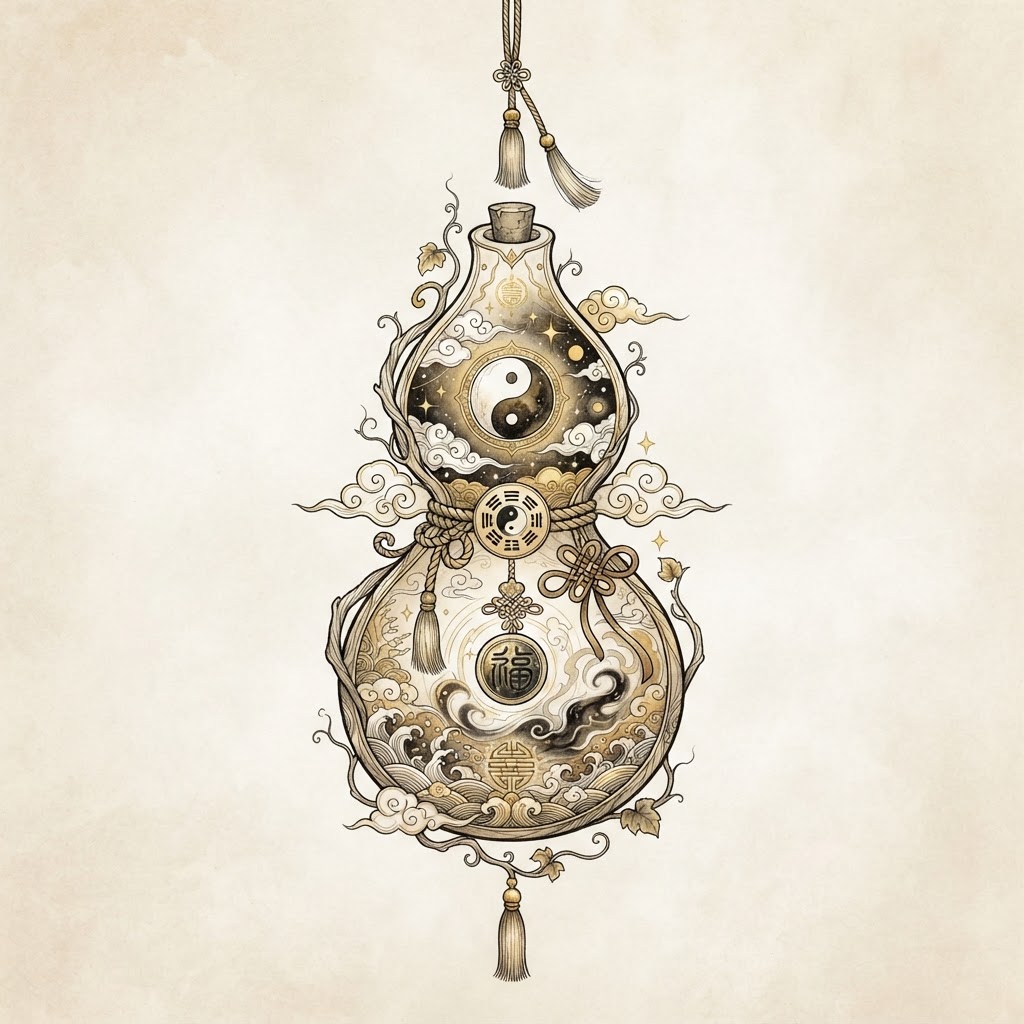
Hulu (Calabash Gourd): Meaning, Origin & Symbolism
Also known as: Calabash, Bottle Gourd, Gourd of Immortality, Hu Lu
Taoist/Chinese
Taoist/Chinese
Root Chakra
Sacral Chakra
Earth
Healing
Protection
Purification
Longevity
A distinctive hourglass-shaped gourd symbolizing the universe, healing remedies, internal alchemy, and the containment of negative energy.
Quick Facts
- Category
- Taoist/Chinese
- Culture / Origin
- Taoist/Chinese
- Geographic Origin
- China
- Historical Period
- Neolithic to present
- Estimated Age
- 7000+ years
- Element
- Earth
- Chakra
- Root, Sacral
- Deities
- Tieguai Li (Iron Crutch Li), Shouxing, Shennong
- Verification
- unverified
What is Hulu (Calabash Gourd)?
The Hulu, or bottle gourd (Lagenaria siceraria), is an ancient and multi-layered emblem in Taoist cosmology, folk religion, and traditional medicine. Characterized by its hourglass shape—featuring a smaller upper bulb and a broader lower bulb joined by a narrow neck—the dried Hulu has historically been used to store fresh water, wine, precious seeds, and medicinal concoctions.
In Taoist iconography, the Hulu is the quintessential attribute of healers and immortals, notably Iron Crutch Li (Tieguai Li) of the Eight Immortals and the celestial God of Longevity. Immortals were said to carry the Elixir of Immortality inside their gourds, or even keep miniature universes and secret heavens (Dongtian) enclosed within their hollow interiors.
Because its hollow interior and narrow opening naturally trap contents, the Hulu gained a reputation in esoteric practice as an energetic vessel capable of absorbing, neutralizing, and storing malignant spirits, disease pathogens, and negative environmental Qi (Sha Qi).
Meaning of Hulu (Calabash Gourd)
The Hulu represents the containment of life-giving medicines, protection against illness and negative energies, and the microcosm of the universe.
Origin & History
Archaeological remains of cultivated bottle gourds in the lower Yangtze River basin date back more than seven millennia. In the early texts of Zhuangzi (4th century BCE), the gourd is famously discussed in a dialogue between Zhuangzi and Huizi regarding the nature of utility and spiritual freedom.
As Traditional Chinese Medicine emerged, traveling physicians identified themselves by hanging a brass or dried gourd outside their stalls—originating the classical Chinese idiom 'hanging a gourd to practice medicine' (Xuanhu Jishi). In Taoist ritual traditions, consecrated metal or natural gourds were actively utilized by priests during exorcistic ceremonies to capture malevolent entities.
Spiritual Meaning
Spiritually, the Hulu represents the profound mystery of the Taoist microcosm. The lower bulb represents the Earth, the upper bulb represents Heaven, and the narrow waist between them symbolizes the transitional gateway between material and spiritual realms. To enter the gourd is a Taoist metaphor for entering deep meditation, retreating from worldly chaos into the primordial womb of pure potentiality.
Within internal alchemy (Neidan), the shape of the gourd corresponds to the human body and its three Dantians (energy centers). Cultivating the inner elixir involves circulating breath and refining consciousness inside this secure energetic vessel, keeping vital life force from leaking into external distractions.
Symbolism
The shape mirrors the union of Heaven (upper bulb) and Earth (lower bulb). The narrow neck symbolizes discernment, containment, and keeping treasures safe from corruption. Its numerous seeds symbolize abundant descendants, prosperity, and the endless generation of life.
Traditional Uses
Traditionally placed near beds, entryways, or in sickrooms to absorb disease-causing energies, ward off wandering spirits, and bless the household with abundant health and protection.
Modern Spiritual Uses
In modern Feng Shui and holistic wellness, the Hulu is employed as an energetic purifier, placed in homes to clear stress, neutralize electromagnetic and spatial clutter, and foster recovery.
Healing Associations
Hung by the bedside of those recovering from chronic illness to gather and absorb pathopathic energetic frequencies, supporting physical recovery.
Protection Associations
Renowned for capturing, absorbing, and trapping negative Sha Qi, ill-intentioned spirits, and the adverse influences of the annual Illness Star (Flying Star #2).
How the Symbol Is Used
- •Feng Shui
- •Traditional Chinese Medicine
- •Taoist Exorcism
- •Neidan Meditation
Cultural Context
Taoist/Chinese — China (Neolithic to present)
Sources & References
- 1.Zhuangzi. 'The Complete Works of Zhuangzi' (Trans. Burton Watson, 1968)
- 2.Welch, Patricia Bjaaland. 'Chinese Art: A Guide to Motifs and Images' (2008)
- 3.Eberhard, Wolfram. 'A Dictionary of Chinese Symbols' (1986)
This content is for educational and informational purposes only. Where modern spiritual interpretations are described, they are not presented as ancient historical facts. It is not a substitute for professional medical or spiritual advice.