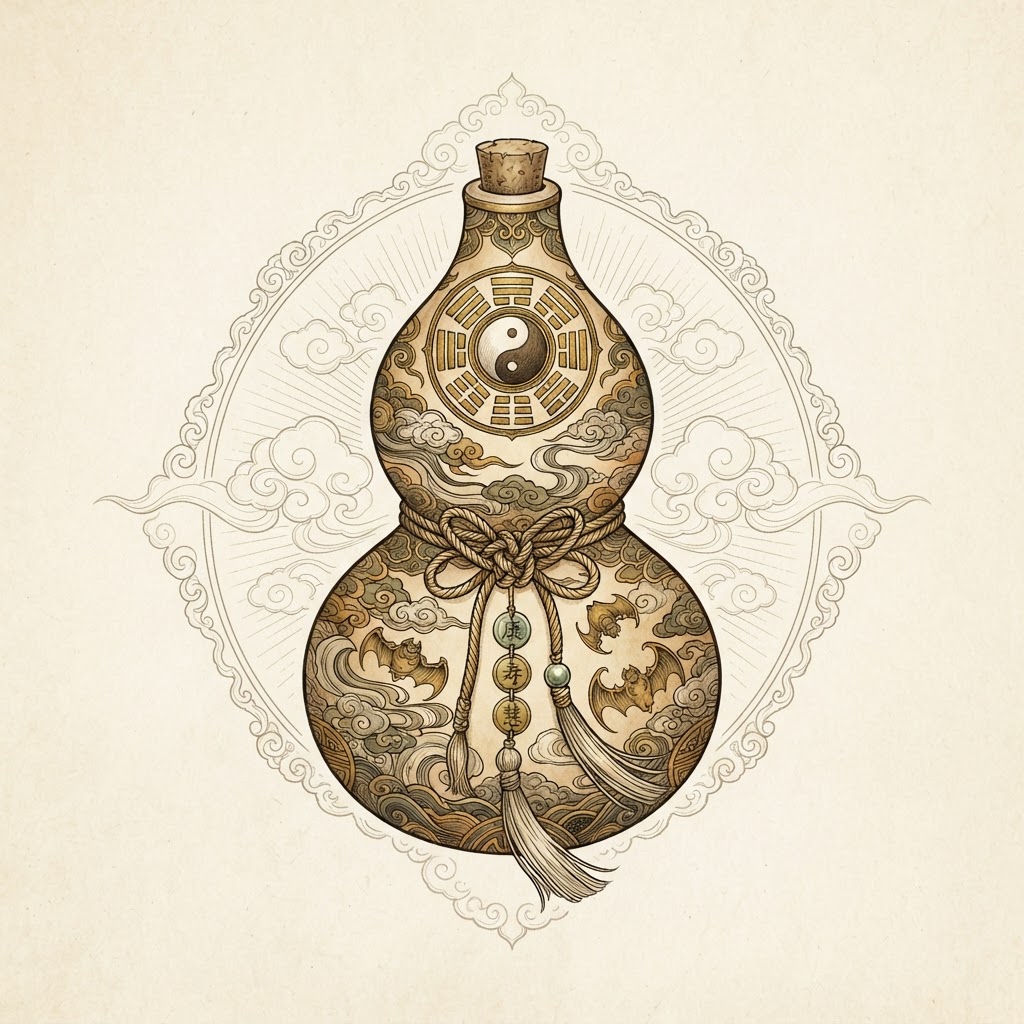
Hulu (Calabash Gourd): Meaning, Origin & Symbolism
Also known as: Calabash, Wu Lou, Doctor's Gourd
Taoist/Chinese
Taoist/Chinese
Root Chakra
Sacral Chakra
Wood
Healing
Protection
Wisdom
Harmony
A bottle gourd symbolizing health, longevity, esoteric Daoist wisdom, and the containment of healing elixirs.
Quick Facts
- Category
- Taoist/Chinese
- Culture / Origin
- Taoist/Chinese
- Geographic Origin
- China
- Historical Period
- Neolithic to Han Dynasty
- Estimated Age
- circa 5000 BCE
- Element
- Wood
- Planet
- Moon
- Chakra
- Root, Sacral
- Deities
- Tieguai Li, Shouxing, Baosheng Dadi
- Verification
- unverified
What is Hulu (Calabash Gourd)?
The Hulu, or bottle gourd (Lagenaria siceraria), is a classical Taoist emblem known for its unique figure-eight silhouette. Traditionally hollowed out and dried to store life-saving medicines, wine, and water, the gourd became indelibly associated with healing, alchemy, and wandering holy immortals. It is famously carried by Tieguai Li (Iron Crutch Li), one of the Eight Immortals, who used it to store celestial elixirs and release trapped spirits. In Taoist philosophy, the Hulu is viewed as an entire miniature cosmos in itself—the narrow neck and expansive lower chamber represent the gateway through which one passes from mundane reality into mystical dimensions. Taoist masters frequently referred to mystical journeys as entering 'the heaven within the gourd.'
Meaning of Hulu (Calabash Gourd)
Abundant good health, miraculous healing, protection from illnesses, and the safe storage of vital essence.
Origin & History
Bottles fashioned from gourds have been discovered at ancient Hemudu culture sites dating back thousands of years. As medicine advanced in China, traveling physicians hung gourds outside their dispensaries to signal the presence of healing remedies, giving rise to the Chinese idiom 'what medicine is sold in the gourd?' meaning to uncover a mystery. In Daoist ritual traditions, gourds were widely utilized as both spiritual storage vessels and instruments for trapping errant spirits.
Spiritual Meaning
The gourd represents the inward containment of one's own spiritual light (qi) rather than dissipating it outward through worldly cravings. It exemplifies the Taoist ideal of humble, practical simplicity masking profound internal depth and spiritual power.
Symbolism
Its narrow upper bulb represents heaven, its broad lower bulb represents earth, and the narrow connecting waist represents humanity acting as the conduit between both realms.
Traditional Uses
Hung by the bedside of sick individuals to absorb toxic or afflicted qi and promote rapid physical recovery.
Modern Spiritual Uses
Popular in contemporary Feng Shui as a protective talisman to neutralize environmental stress lines and promote holistic health within the home.
Healing Associations
Strongly associated with physical recovery, medical practitioners, herbal medicine, and clearing energetic blockages around the body.
Protection Associations
Used in traditional rituals and homes to entrap malevolent wandering spirits and absorb negative disease-bearing energetic stars.
How the Symbol Is Used
- •Traditional Chinese Medicine
- •Feng Shui
- •Daoist Internal Alchemy
Cultural Context
Taoist/Chinese — China (Neolithic to Han Dynasty)
Sources & References
- 1.Eberhard, Wolfram. A Dictionary of Chinese Symbols. Routledge, 1986.
- 2.Schipper, Kristofer. The Taoist Body. University of California Press, 1993.
This content is for educational and informational purposes only. Where modern spiritual interpretations are described, they are not presented as ancient historical facts. It is not a substitute for professional medical or spiritual advice.