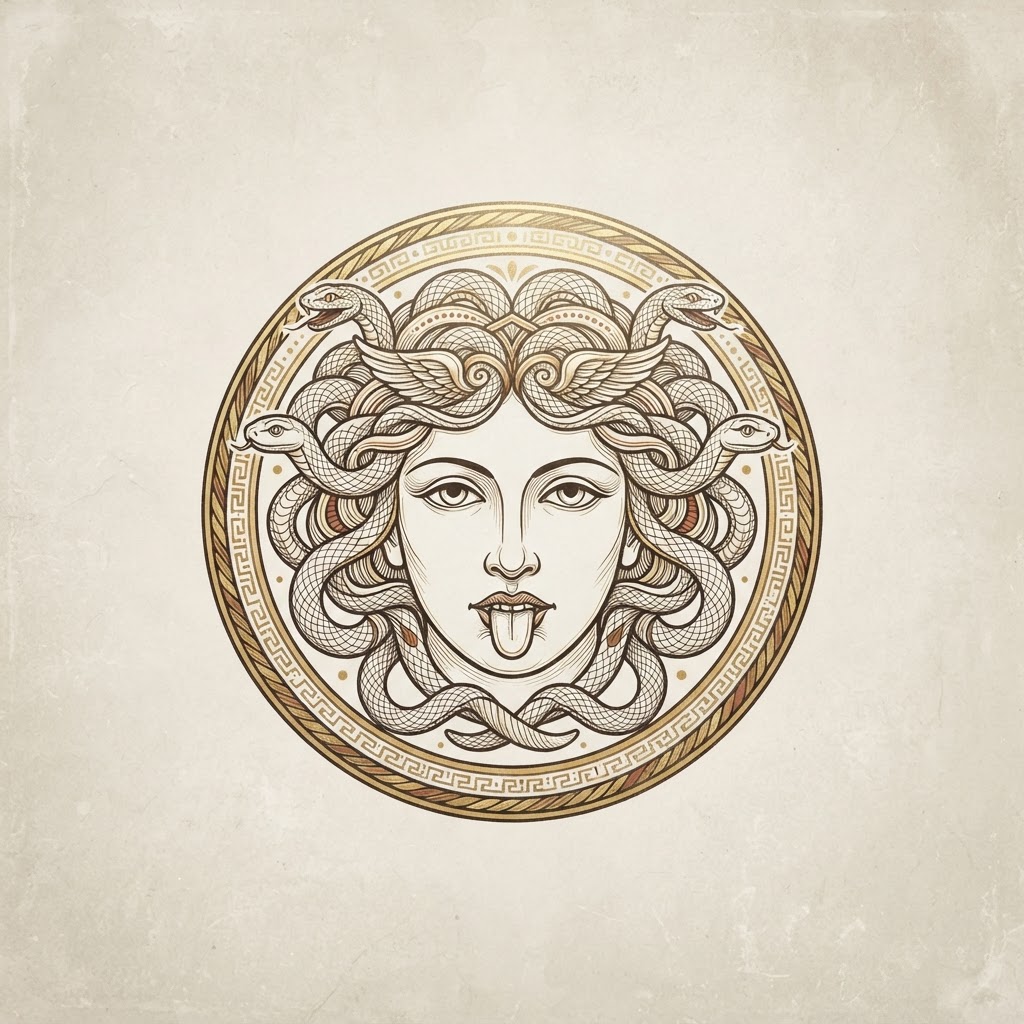
Gorgoneion: Meaning, Origin & Symbolism
Also known as: Medusa's Head, Aegis Medusa
Greek & Roman
Ancient Greek, Etruscan, & Roman
Solar Plexus Chakra
Root Chakra
Fire
Protection
Strength
Courage
Boundaries
The stylized face of the Gorgon Medusa, utilized across the classical world as a potent apotropaic ward against evil and harm.
Quick Facts
- Category
- Greek & Roman
- Culture / Origin
- Ancient Greek, Etruscan, & Roman
- Geographic Origin
- Ancient Greece, Magna Graecia, and Rome
- Historical Period
- Archaic to Imperial Antiquity
- Estimated Age
- circa 700 BCE
- Element
- Fire
- Planet
- Pluto
- Chakra
- Solar Plexus, Root
- Zodiac
- Scorpio, Aries
- Deities
- Athena, Minerva, Perseus, Medusa
- Verification
- unverified
What is Gorgoneion?
The Gorgoneion is a special apotropaic amulet and decorative motif depicting the severed or stylized head of the Gorgon, particularly Medusa. Characterized by wide, staring eyes, protruding fangs, an outstretched tongue, and writhing serpents for hair, it was one of the most widespread protective devices in Greek, Etruscan, and Roman architecture.
In classical myth, the hero Perseus decapitated Medusa and presented her head to the goddess Athena, who affixed it to her shield (the Aegis) or breastplate. Her lethal gaze, which previously turned beholders to stone, was thus redirected to paralyze and ward off evil, injustice, and enemy forces.
From temple pediments and warrior shields to household door knockers, pottery, and mosaics, the Gorgoneion served as an impenetrable barrier. It exemplified the apotropaic principle of turning a monstrous, terrifying visage outwards to terrify and repel negative energies.
Meaning of Gorgoneion
The Gorgoneion is an apotropaic talisman designed to ward off malevolent forces, freeze enemies, and protect sacred spaces.
Origin & History
Archaic Gorgoneia from the 7th and 6th centuries BCE were intentionally grotesque and monstrous, featuring boar tusks and gaping mouths, mounted on temple roof tiles (antefixes) in places like Corfu and Thermon to safeguard sacred buildings from lightning and malevolence.
By the 5th century BCE and into the Roman Hellenistic era, the Gorgon's visage softened into the 'Medusa Rondanini' type—depicting a tragic, beautiful woman with serpentine locks. Roman soldiers continued to wear Gorgoneion medallions on their cuirasses for protection on the battlefield.
Spiritual Meaning
Spiritually, the Gorgoneion represents the fierce guardian of the subconscious threshold. It embodies the necessity of confronting internal terrors, base instincts, and rage to transmute them into formidable spiritual protection.
It teaches that what society often demonizes—raw feminine boundary-setting, deep emotional instinct, and primal power—can serve as the ultimate shield against spiritual violation and exploitation.
Symbolism
The staring eyes symbolize vigilance and truth that paralyzes deception; the serpent hair represents wisdom, regeneration, and primal earth power; the open mouth wards off dark forces.
Traditional Uses
A divine defensive emblem gifted by Athena, turning the destructive power of chaos against anyone who threatens cosmic order.
Modern Spiritual Uses
Embraced by modern spiritualists and artists as a symbol of unapologetic personal boundaries, female fury reclaimed as protection, and psychic defense.
Healing Associations
Integration of trauma, boundary restoration, and overcoming feelings of victimization.
Protection Associations
Exceptional protection against the evil eye, psychic assault, curses, physical violence, and hostile spirits.
How the Symbol Is Used
- •Apotropaic shielding
- •Threshold warding
- •Amulet carving
- •Warrior consecration
Cultural Context
Ancient Greek, Etruscan, & Roman — Ancient Greece, Magna Graecia, and Rome (Archaic to Imperial Antiquity)
Sources & References
- 1.Vernant, Jean-Pierre. 'Mortals and Immortals: Collected Essays'. Princeton University Press.
- 2.Harrison, Jane Ellen. 'Prolegomena to the Study of Greek Religion'. Cambridge University Press.
This content is for educational and informational purposes only. Where modern spiritual interpretations are described, they are not presented as ancient historical facts. It is not a substitute for professional medical or spiritual advice.