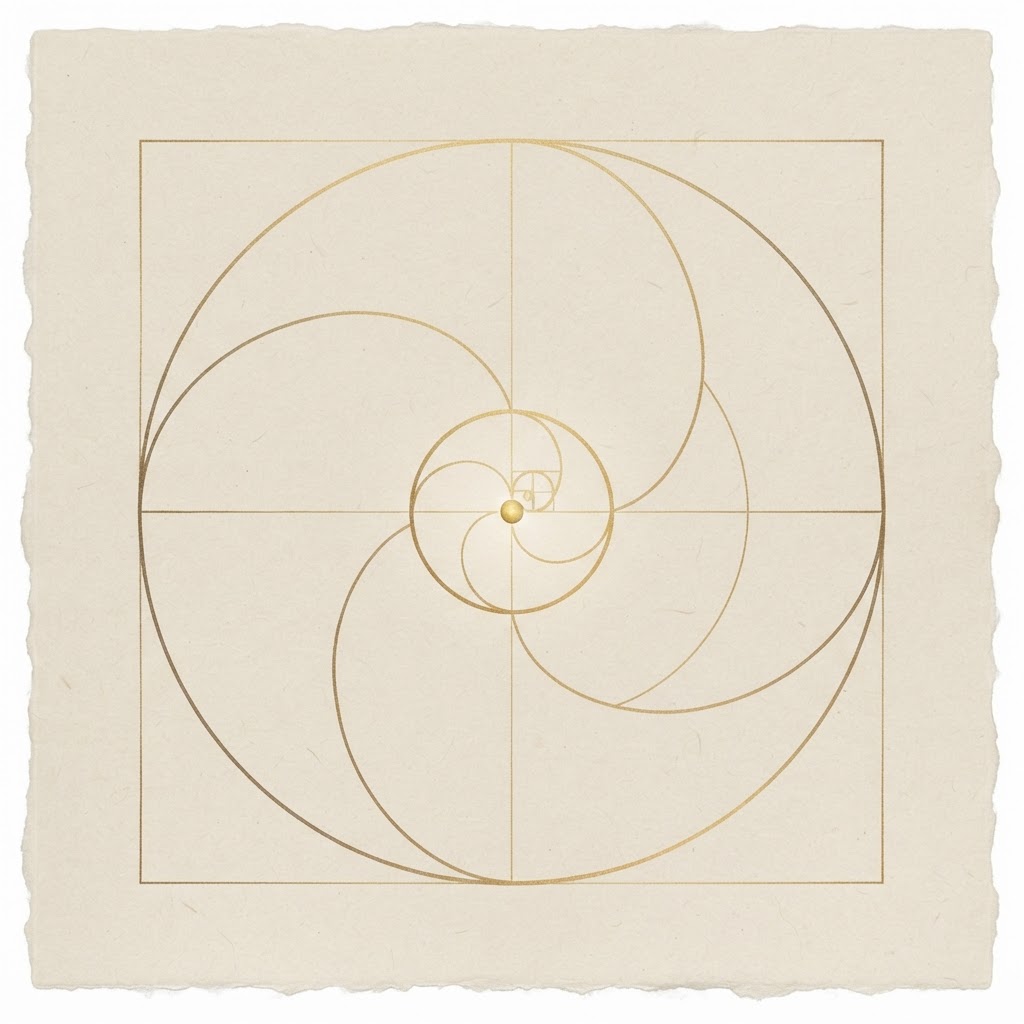
Golden Spiral: Meaning, Origin & Symbolism
Also known as: Fibonacci Spiral, Logarithmic Spiral, Spira Mirabilis
Sacred Geometry
Universal / Hellenistic and Renaissance Europe
Crown Chakra
Third Eye Chakra
Ether/Spirit
Wisdom
Transformation
Harmony
Creativity
A logarithmic spiral whose growth factor is mathematically derived from the golden ratio (Phi).
Quick Facts
- Category
- Sacred Geometry
- Culture / Origin
- Universal / Hellenistic and Renaissance Europe
- Geographic Origin
- Italy and Mediterranean Europe
- Historical Period
- Medieval to Renaissance
- Estimated Age
- circa 1202 CE (Fibonacci's Liber Abaci)
- Element
- Ether/Spirit
- Planet
- Sun
- Chakra
- Crown, Third Eye
- Deities
- Athena, Thoth
- Verification
- unverified
What is Golden Spiral?
The Golden Spiral is a logarithmic spiral that widens outward by a factor of the golden ratio (Phi, approximately 1.6180339887) for every quarter-turn it makes. It is geometrically approximated by drawing circular arcs connecting the opposite corners of squares nestled within successive golden rectangles generated by the Fibonacci sequence (0, 1, 1, 2, 3, 5, 8, 13, 21, etc.). Because it maintains the exact same proportion and shape regardless of how large it expands, seventeenth-century mathematician Jacob Bernoulli christened it 'Spira Mirabilis' (the Marvelous Spiral). This self-similar curve appears extensively throughout nature, from the unfurling of fern fronds and nautilus shells to atmospheric hurricanes and galactic arms.
Meaning of Golden Spiral
The mathematical law of balanced organic expansion, dynamic self-similarity, and harmonious growth.
Origin & History
Although the golden ratio was analyzed in antiquity by Euclid, the mathematical sequence closely approximating the golden spiral was introduced to Western Europe by Leonardo of Pisa (Fibonacci) in his 1202 work Liber Abaci in the context of calculating rabbit population growth. The logarithmic spiral was later rigorously analyzed by René Descartes in 1638 and celebrated by Jacob Bernoulli, who requested it be engraved on his tombstone with the phrase 'Eadem mutata resurgo' ('Though transformed, I arise the same'). Renaissance artists including Leonardo da Vinci integrated these spiral proportions into their artistic compositions.
Spiritual Meaning
The Golden Spiral embodies the cosmic principle of perpetual unfolding: living systems expanding into the unknown while remaining anchored in their divine origin. Because the spiral grows without changing its fundamental shape, it represents the journey of the evolving soul—deepening its wisdom, learning, and consciousness across cyclical lifetimes without losing its essential identity. It assures the seeker that personal evolution is not a repetitive circle, but an ascending spiral toward higher integration.
Symbolism
The infinitesimal central vortex symbolizes the unmanifest divine source from which all form expands. The outward curving arc represents the natural, effortless flow of life expanding harmoniously into manifestation.
Traditional Uses
Historically revered by classical mathematicians and artists as the visible signature of divine geometry and dynamic aesthetic symmetry in creation.
Modern Spiritual Uses
Used in modern holistic wellness as an archetype of natural life transitions, personal evolution, and alignment with the effortless rhythm of nature.
Healing Associations
Employed in visualization practices to break rigid, cyclical mental patterns and gently widen personal perspective.
Protection Associations
Utilized in sacred space organization to diffuse stagnant, chaotic energy by encouraging natural outward kinetic circulation.
How the Symbol Is Used
- •Meditation on organic growth
- •Sacred architectural planning
- •Art and composition design
- •Contemplative breathwork
Cultural Context
Universal / Hellenistic and Renaissance Europe — Italy and Mediterranean Europe (Medieval to Renaissance)
Sources & References
- 1.Livio, Mario. The Golden Ratio: The Story of Phi. Broadway Books, 2002.
- 2.Doczi, György. The Power of Limits: Proportional Harmonies in Nature, Art, and Architecture. Shambhala, 1981.
This content is for educational and informational purposes only. Where modern spiritual interpretations are described, they are not presented as ancient historical facts. It is not a substitute for professional medical or spiritual advice.